

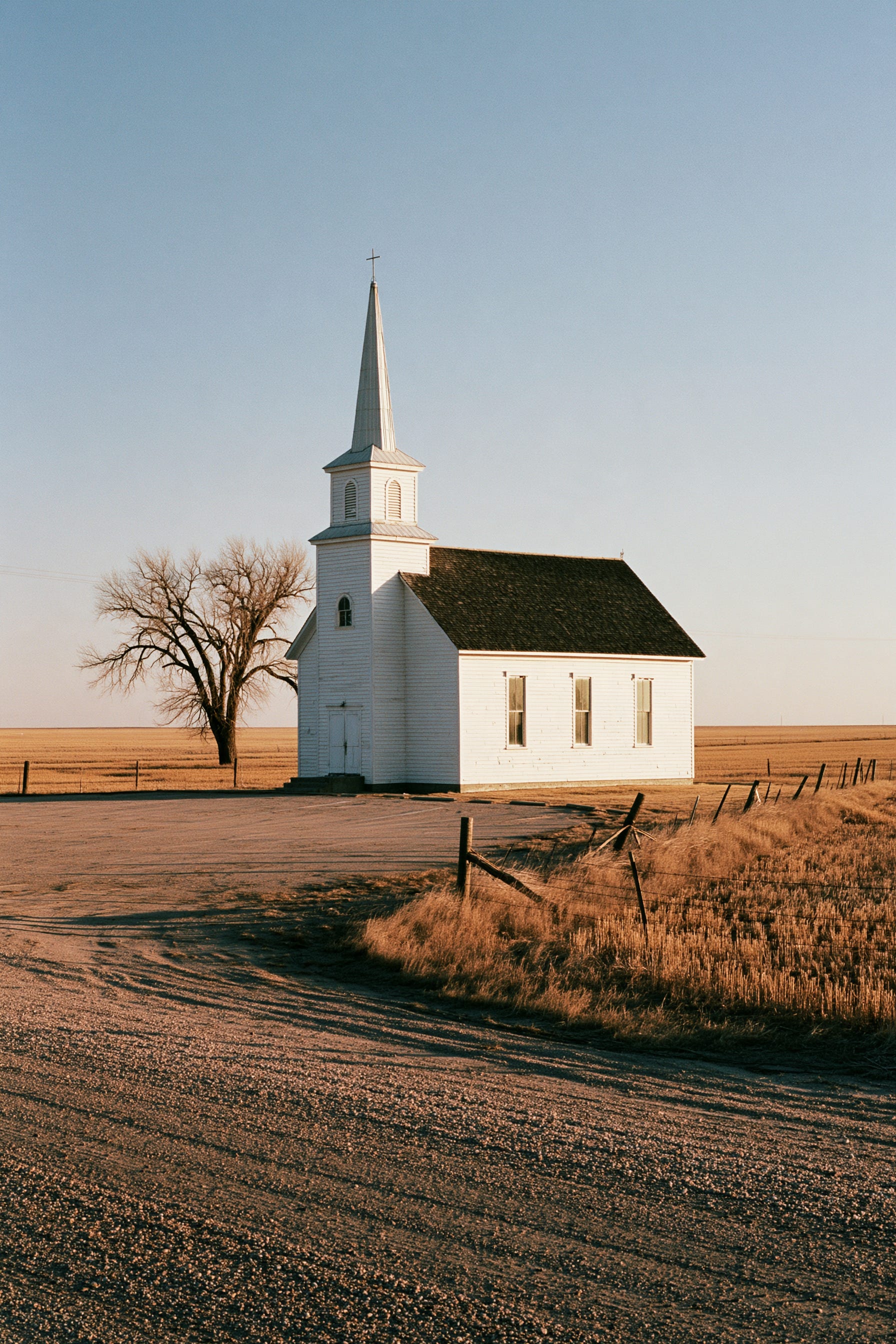
The tornadoes did not close the church in Pilger. St. Peter’s Lutheran stood through the twin tornadoes that tore across the Nebraska village in June 2014, and the building outlasted the storm by nine years. Falling attendance and a shortage of volunteers finished what the twisters could not, and the congregation closed its doors in January 2023. The members gave the building to the Stanton County Historical Society, which runs a museum there now. One Lutheran church remains in Pilger, and most of the town’s worshipers drive to Norfolk or Wisner, a half hour either way. Gene Willers, a former member, summed it up for the Flatwater Free Press: “It’s just a hard adjustment.”
The old church in Benedict is a house. Zion Evangelical Lutheran closed in January 2020 after more than a century of worship, and seven months later Kathy and Tim Johnson bought it. The kitchen table sits near where the altar stood. A recliner and a couch share the living room with a wooden pew, and stained glass throws colored light across the bedroom in the morning. The Johnsons say visitors walk in and stop and stare, and that the family sometimes forgets the place was a church. The building is warm and lived in. The closest open churches are in other towns now.
The closures add up to a ledger. Hartford Institute for Religion Research data puts median weekly attendance at an American congregation at 137 people in 2000 and 65 in 2020. Public Religion Research Institute polling found that 56 percent of Americans seldom or never attended services in 2022, up from 43 percent in 2013. The Center for Applied Research in the Apostolate at Georgetown keeps the Catholic count: 17,763 parishes in 1965, a peak of 19,620 in 1990, and 16,125 by 2025. The sharper number is the priest count. In 1965, some 530 American parishes had no resident priest pastor. In 2025, 3,674 did, and active diocesan priests per parish averaged 0.9, less than half the 1965 figure of two. The Catholic population grew by half across those same decades.
Empty churches have their own economics. Rick Reinhard, an urban planner, spent four years assessing United Methodist properties across the country, and he calls the problem a mismatch: aging congregations holding large buildings they can no longer fill or heat. Membership falls and maintenance rises, and the pandemic taught the remnant to worship from home. Lincoln shows how the mismatch resolves. Three Methodist congregations there consolidated into a single body called New Visions and sold two of their three buildings. One building went to a Baptist congregation. The other, Southminster Methodist at 16th and Otoe, awaited a religious buyer and drew only secular offers, a gym and an art gallery among the proposals. It went under contract for $350,000 to an architecture firm that will convert the building to offices and apartments. The sale proceeds went into the surviving congregation’s renovation and reserves.
The Diocese of Salina is the frontier made administrative. It covers 31 counties and about 26,700 square miles of northwest Kansas, a jurisdiction larger than West Virginia. In 1966 it held 57,496 Catholics, 147 priests, and 101 parishes. In 2023 it held 38,916 Catholics, 74 priests, and 85 parishes. The parishes thinned more slowly than the clergy. The see itself has moved once already: Leo XIII erected the Diocese of Concordia in 1887, and Pius XII renamed it the Diocese of Salina two days before Christmas in 1944, following the population. Nebraska’s version went further. Rome erected the Diocese of Kearney in 1912 and suppressed it five years later, folding the territory into Grand Island, and there has been no cathedral in Kearney since.
Catholic retrenchment runs the length of the prairie. The Diocese of Sioux City, which covers northwest Iowa, adopted a plan called Ministry 2025 that projected cutting its 74 parishes to 34, and local reporting in 2024 described further adjustments still coming. The Diocese of Sioux Falls reorganized its eastern South Dakota parishes into multi-church pastorates under a plan called Set Ablaze, effective July 5, 2023, with teams of pastors rotating through regionally grouped churches. About 86,000 Catholics live east of the Missouri River in South Dakota, served by a little more than 70 priests. Father Scott Traynor, the diocese’s vicar for clergy formation, told Dakota News Now the plan’s purpose was to avoid a future of only “managing decline.” A decade earlier the same diocese merged a string of northeastern parishes at once after Blue Cloud Abbey closed and the Missionary Oblates of Mary Immaculate withdrew from the region they had served since 1923. Holy Trinity in Hosmer joined St. Augustine in Bowdle. St. Anthony in Hecla joined St. John de Britto in Britton. The letterheads changed, and the towns kept shrinking anyway.
Omaha’s archdiocese gave its numbers to the Flatwater Free Press. Fifteen of its churches have closed since 2000. Sunday Mass attendance among Catholics in northeast Nebraska has fallen 42 percent since 2003, and only about one Catholic in four attends. In 2022 the archbishop grouped the archdiocese’s 134 churches into 33 parish families to share priests and resources. The Missouri Synod Lutheran district covering most of Nebraska reports 35 congregations closed or disbanded since 2000. Bishop Scott Alan Johnson of the ELCA’s Nebraska Synod keeps his own tally. One congregation was already closing when he took office in 2022, he told the paper, another ran the full course under him, and a third had begun the process. There has been no organized pushback, he said, and there is grief.
The Methodist split came by paragraph and deadline. United Methodist property is held in trust for the whole denomination, so a congregation that votes to leave cannot walk away with its building on a handshake. A special General Conference in 2019 cut a temporary exit door into the Book of Discipline and called it Paragraph 2553. A congregation could disaffiliate over the denomination’s disputes about sexuality if two thirds of its voting members approved and it met certain financial terms. The door closed on December 31, 2023. By then more than 7,600 congregations had used it, about 26 percent of the denomination’s American churches and about 24 percent of its members. The 2024 General Conference deleted the paragraph outright, and the trust clause still binds everyone who stayed.
Iowa kept the cleanest ledger of the exit. The Iowa Annual Conference approved 83 disaffiliations at a special session on May 23, 2023, and 59 more on November 18, a total of 142 congregations out of roughly 750, nearly one church in five. The conference’s November list reads like a road atlas of the state’s western half. Blanchard, Braddyville, Carbon, Clearfield, Macedonia, Napier, and Stratton left from along the Missouri line. Anthon, Kingsley, Ocheyedan, Rock Rapids, Swea City, and Le Mars left from up toward the Dakotas. Twelve more Iowa churches closed the same year for the plain reason that they were no longer sustainable, places like Fontanelle, Fostoria, Henderson, Marathon, Silver Creek, and Unionville. Most of the departing congregations joined the Global Methodist Church, which launched on May 1, 2022, counted 3,000 churches by July 2023, and reported 6,000 congregations by October 2025. Others went independent, with no denomination above them and no appointed pastor to call.
What remained is its own story. The Iowa Conference reported 132,750 members in 2022 and an average worship attendance of 29,476, about one baptized Methodist in five in a pew on Sunday. One congregation, Everly United Methodist, was closed by the conference itself in 2023 for what the conference called the unauthorized intent to transfer church property to another entity. The congregations that stayed now share pastors across wider circuits; at the 2023 session the conference retired 34 clergy and ordained three. The furnace bills did not change for anyone. Towns that voted to leave kept their buildings and changed the sign out front. Towns that stayed kept the sign and split their pastor with the next town over.
Lutheran numbers move slower and land harder. The Evangelical Lutheran Church in America formed in a 1988 merger with about 5.25 million baptized members; by 2023 it counted about 2.8 million. The denomination’s Research and Evaluation team reported the proportions in 2025. Congregations averaging fewer than 50 worshipers grew from three in ten in 2015 to nearly six in ten in 2022. Only 167 congregations nationwide averaged more than 250 in the pews. About 60 percent of ELCA congregations sit in rural communities and small towns under 50,000 people, which makes the shrinkage a prairie story before it is anything else. The church’s structural answer is the synod-authorized minister, a lay person licensed by the bishop to preach and preside where no pastor can be afforded or found. At least 756 congregations, about 9 percent of the denomination, were served by these lay ministers in 2024, and a majority of synods said their use was rising.
The Dakotas show what the end of the curve looks like. Eastern North Dakota’s synod went from 183 congregations in 2023 to 178 in 2024, baptized membership there fell 13 percent between 2017 and 2024, and in-person attendance fell 39 percent, from 20,063 on an average Sunday to 12,238. The South Dakota Synod lists 189 congregations with an average of 101 people in worship, a fifth of baptized membership, and 57 of its congregations did not file reports at all. Western North Dakota’s synod lists 153 congregations and 51,543 baptized members, served by 67 pastors under call and 44 lay ministers filling the gap. The clergy run out before the buildings do. In the last annual reports on file from eastern North Dakota, the churches in Tolna and Walcott reported an average weekly attendance of one.
A country church works six days a week at jobs nobody counts in the annual report. The fellowship hall seats the funeral lunch and the election-day polling line. The basement holds the AA meeting, the food pantry shelf, the 4-H club, and the quilt raffle that pays the furnace bill. The building is the storm shelter in some towns and the only room big enough for a wedding in others. I learned the county grid on gravel roads northeast of North Loup, and a church stood at what felt like every third crossroads; the ones still open mostly hold services twice a month on a shared pastor’s circuit. When the building sells, the town loses its largest indoor room, its biggest kitchen, and its Sunday floor, and nothing zoned or budgeted replaces them.
What fills the void, when anything does, arrives in three shapes. Sometimes nothing comes at all: the building goes to a homeowner, a developer, or the weather, and the steeple becomes a landmark people use for giving directions. Sometimes a civic heir steps in, the way the Stanton County Historical Society took the Pilger church and made it a museum, preserving the shell while the function dissolves. The third shape is another congregation under a different name: the Baptist church that took the New Visions building in Lincoln, the Global Methodist and independent congregations now occupying former United Methodist sanctuaries across western Iowa. The pews stay and the hymnals change. A town’s calendar of suppers and meetings either migrates with the new sign or stops appearing at all.
Lexington shows the void forming in real time. Tyson Foods announced on November 21, 2025, that it would permanently close the beef plant IBP built there in 1990, a plant with 3,200 workers in a city of about 10,500. The closure took effect January 20, 2026, and University of Nebraska economists estimate the loss to the state’s economy at $3.3 billion a year. First United Methodist Church, built in 1901, held services in English and Spanish. In the months after the announcement, about 30 people left the Spanish-speaking service, and attendance fell from 65 in November toward a dozen, as families followed the work to other states. Genesis Brito, leaving for a Cargill plant in Fort Morgan, Colorado, gave the Flatwater Free Press the summary line: “Tyson was what was holding Lexington together.” When Tyson closed its Norfolk, Nebraska, plant in 2006, the company stripped the interior so it could never process beef again, and that building still sits empty. Back in Lexington, the church holds its two Sunday services and waits to see who is left.
The frontier diocese is an old form returning. In 1851, Pius IX erected the Vicariate Apostolic of Indian Territory East of the Rocky Mountains. He handed Bishop John Miège a million square miles holding 700 Catholics, six finished churches, three under construction, 11 mission stations, and eight priests. The vicariate took in the whole of the future prairie: Kansas, Nebraska, the Dakotas, Colorado, Wyoming, Montana. Episcopal authority was measured then in miles per priest, and it is again now, with the movement running the other way. Salina fields 74 priests across its 31 counties, and the Western North Dakota Synod fields 67 called pastors across half a state. Miège’s frontier was filling up behind him. This one is emptying out ahead of its clergy, and the buildings get left behind like section-line schools, one more piece of prairie infrastructure for the people who remain to adopt, convert, or watch go to grass.
Pilger’s answer is a museum, Benedict’s is a living room with a pew in it, and Lincoln’s is an office suite waiting on a permit. None of these are failures of faith, and none are victories for anyone else; they are property transfers following population, the slowest census a county keeps. On the prairie, the church building was the last public room left after the depot, the school, and the elevator office closed. Now it is closing too, and no county keeps a record of what held a town’s Tuesdays together. The stained glass still works in Benedict. It lands on a bed.