

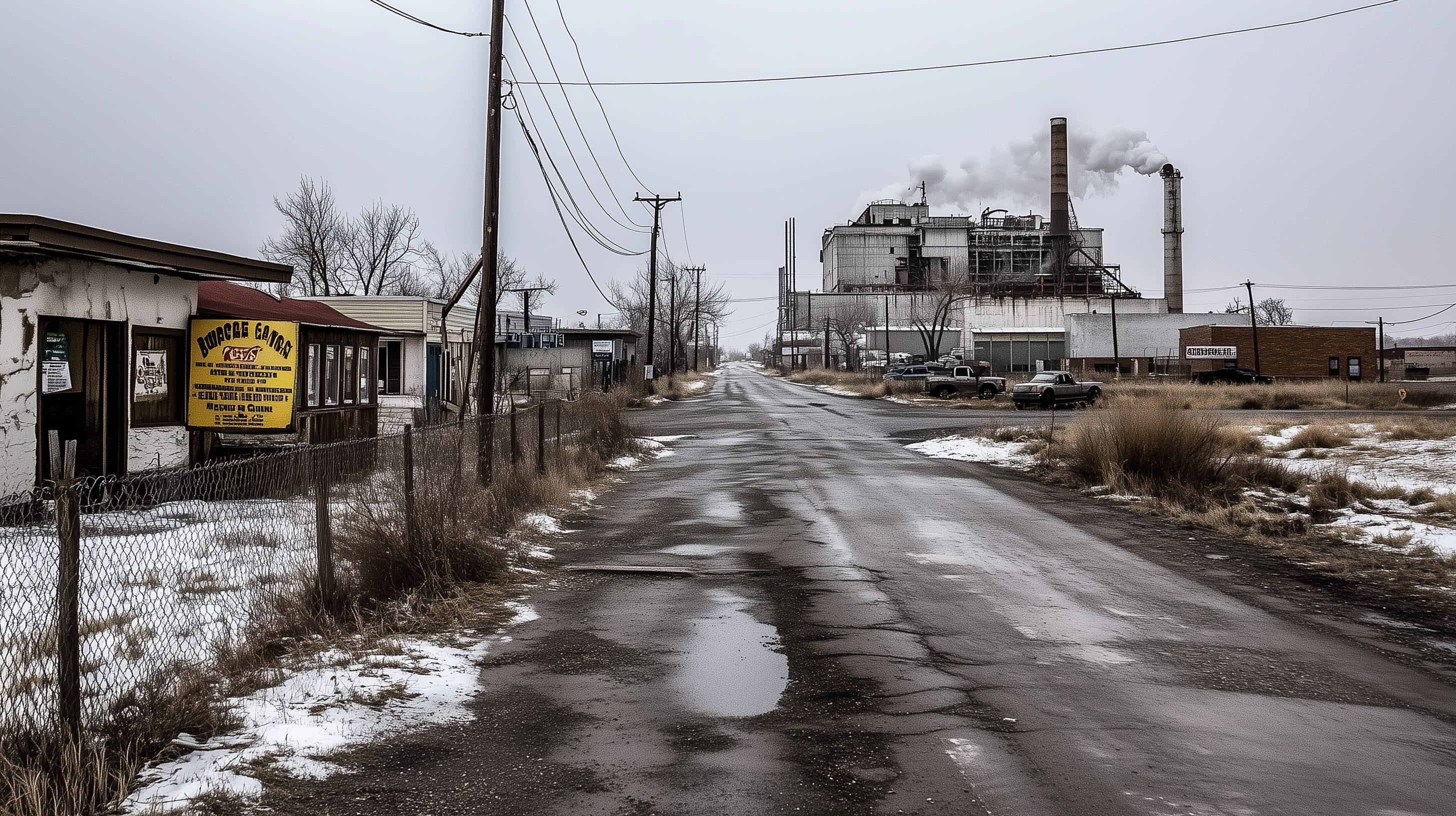
The building on U.S. Highway 283 in Lexington, Nebraska, has died three times. It was born in 1975 as a Sperry-New Holland combine factory, a temple to the mechanical harvest, where men and women from the surrounding counties assembled the machines that cut the grain that fed the nation. By the early 1980s, nearly 900 people walked through its doors each morning. Then the Farm Crisis came, and in 1985 Sperry-New Holland shuttered the plant, eliminating 940 jobs and ripping $16 million in annual payroll from a town that could not afford to lose a dime. That was the first death.
The building sat quiet while Lexington bled. In a three-year span, the town also lost a cultivation equipment manufacturer and its biggest downtown retailer. Twenty-six buildings stood vacant in the commercial district. The population dropped 6.2 percent through the decade. Dawson County recorded record farm bankruptcies. City Manager Bill Podraza watched the storefronts go dark, and anybody who could read a census table could see the trajectory: Lexington was becoming a ghost, another Great Plains town folding into the soil that once sustained it.
Then came Iowa Beef Packers.
In 1988, IBP, the world’s largest meat processing firm, announced it would buy the old Sperry plant and retrofit it for beef slaughter. Governor Kay Orr stood beneath a “Celebrate Nebraska” banner at the ceremony and called it resurrection. The plant opened on November 8, 1990, and almost immediately, everything changed. IBP needed bodies. The kill floor does not run itself. The company recruited from South Texas and California, from Mexico and Guatemala and El Salvador, from communities where a dollar an hour was a good wage and nine or ten dollars an hour in Nebraska sounded like a different life on a different planet. Within three years, the population swelled by nearly 2,000. Within five, the school enrollment had almost doubled. By the end of the 1990s, Lexington had grown 52 percent from its 1990 baseline, exceeding 10,000 residents for the first time in its history.
The cost of this resurrection was real and should not be softened. The mostly young, mostly Latino workforce that filled the plant accepted conditions that would have emptied a union hall in Chicago or Omaha. Repetitive motion injuries were constant. A local physician described seeing “an endless stream of hand and arm injuries caused by overwork.” Turnover was brutal, sometimes exceeding 100 percent annually, because the work breaks people down. Housing was scarce. Medicaid cases spiked 30 percent in a single year. Crime rose, then fell, then rose again in patterns that had more to do with the churn of a transient labor force than with any ethnic character. Some long-term white residents packed up and left. At a 1999 town hall meeting, they still spoke of their Latino neighbors as “them” and “they,” even as those neighbors were opening restaurants, starting businesses, buying homes, and sending their children to college.
Tyson Foods acquired IBP in 2001 and expanded the Lexington plant into one of the largest beef processing operations in the country, capable of killing nearly 5,000 cattle per day, roughly 4.8 percent of total daily U.S. beef slaughter. The workforce grew to 3,200. The town’s demographic composition settled into something approaching permanence: about 60 percent Hispanic, with significant populations from Somalia, Sudan, and Vietnam. Thirty-two languages were spoken in the local schools. A Guatemalan market sat on Washington Street next to a Somali restaurant next to a laundromat that would eventually become a mosque. Lexington was, by any honest measure, one of the most successfully integrated immigrant communities in rural America. It was messy and complicated and occasionally contentious, and it worked.
That was the second life. It lasted thirty-five years.
On Friday, November 21, 2025, two days before Thanksgiving, Tyson Foods announced the permanent closure of the Lexington plant, effective January 20, 2026. The Vice President of Operations, Jason Poole, sent letters in English and Spanish informing workers that their positions “will be eliminated as part of a mass layoff resulting from this decision.” The company simultaneously announced it would cut one of two shifts at its Amarillo, Texas facility, eliminating another 1,700 jobs there. Together, the two moves would reduce national beef processing capacity by seven to nine percent.
The timing was not accidental. Drop catastrophic news on the Friday before a holiday weekend and you buy yourself three days of silence. By Monday, the shock has softened enough that the television cameras treat it as a business story rather than a human one. Tyson’s corporate communications team understood this calculus with precision.
The town understood different mathematics. One-third of Lexington’s residents worked at that plant. The Lexington Area Chamber of Commerce vice president, Clay Patton, called it a “gut punch” and immediately began listing what would cascade: car dealerships, body shops, restaurants, food trucks, motels, grocery stores, the school district’s 3,000 students, half of whom had at least one parent on the Tyson payroll. A community health worker named Maria Barocio said it plainly: “It’s going to affect the business, the schools, all the systems.”
Tyson’s stated rationale was corporate efficiency. The company’s beef division had hemorrhaged money for three consecutive years: $720 million in combined losses over fiscal years 2023 and 2024, followed by an adjusted loss of $426 million in fiscal 2025 and a projected $400 to $600 million more in fiscal 2026. Cattle costs rose nearly $2 billion in a single year. The U.S. cattle herd had shrunk to its smallest size in over 70 years, a consequence of sustained drought, herd liquidation, and record feed costs that forced ranchers to sell breeding stock rather than maintain it. With fewer cattle to process, the nation’s slaughterhouses were running well below capacity, and Tyson needed to “right-size” its beef business. The Lexington plant, built decades ago to manufacture combines and never purpose-built for beef, was running at roughly 3,600 to 3,700 head per day against a 5,000-head capacity. Governor Jim Pillen, whose family operates a massive hog operation, said as much: “If that plant would have been built brand new from scratch, this is a conversation that wouldn’t be taking place.”
None of this reasoning is incorrect. All of it is incomplete.
To understand what Tyson did to Lexington, you have to understand what the Big Four did to beef.
Tyson, JBS, Cargill, and National Beef control approximately 83 to 85 percent of U.S. beef processing capacity. This concentration did not happen by accident. It was built through decades of acquisition, consolidation, plant closures, and the deliberate relocation of slaughter operations from unionized urban centers to non-union rural communities where labor was cheap, regulation was light, and entire towns could be made dependent on a single employer. IBP pioneered this strategy in the 1960s and 1970s, moving out of Omaha’s stockyards and into places like Lexington and Garden City and Emporia, where a company that provided 900 or 3,000 jobs was not merely an employer but the economic foundation of the community itself.
The result is a system in which the packers have extraordinary leverage in both directions. They control the price they pay ranchers for cattle, and they control the price retailers pay for boxed beef. When cattle are plentiful, packers profit while ranchers suffer. When cattle are scarce, as they are now, packers lose money because they cannot fill their plants, but they can choose which plants to close, and the communities that depend on those plants have no recourse whatsoever. The cattle cycle is approximately ten years long. Packers are positioned to survive the trough. Towns are not.
Senate Minority Leader Chuck Schumer, in a letter to USDA Secretary Brooke Rollins, argued that the closure violated the Packers and Stockyards Act, which prohibits manipulation or control of pricing in the industry. Nebraska Senate candidate Dan Osborn, who led the 77-day Kellogg’s strike in Omaha in 2021, called the closure illegal and pushed for federal intervention. A labor attorney at a press conference in Lexington echoed concerns about antitrust violations. None of these interventions stopped anything. The plant closed on schedule.
What makes this closure structurally different from past disruptions is its permanence. When a fire destroyed Tyson’s Holcomb, Kansas plant in 2019, the company rebuilt it. When Cargill idled its Plainview, Texas facility in 2013, the company initially preserved the infrastructure for potential reopening. In Lexington, the precedent that matters is Norfolk, Nebraska. When Tyson closed its Norfolk plant in 2006, the company stripped every piece of usable infrastructure from the building so it could never be used for meatpacking again. Twenty years later, the building remains empty. U.S. Representative Mike Flood, who represents the Norfolk area, shared a video of that abandoned plant and pleaded with Tyson not to repeat the pattern.
Tyson’s public statement says it is “assessing how we can repurpose the facility within our own production network.” Governor Pillen has spoken optimistically about conversion to a value-added operation. Tyson has said nothing specific. The company that in 2015 invested $47 million to expand cold storage in Lexington, releasing a marketing video in which a Tyson executive called the investment “an assurance” to the community, has offered no assurance at all.
The University of Nebraska-Lincoln’s economic impact analysis, released in late December, put the numbers in clinical terms. The permanent closure generates an estimated $3.283 billion in annual statewide economic losses, including both direct and multiplier effects. Total labor income losses are projected at $530 million per year across 7,003 jobs, of which the 3,212 plant positions are only the core. The rest are the teachers and bus drivers and restaurant workers and mechanics and nurses and librarians whose livelihoods depended on those 3,200 paychecks cycling through the local economy every two weeks. The average annual compensation for a plant worker was $94,169 including benefits, roughly half of which came from the benefits themselves.
For cattle producers, the closure removed 15 percent of Nebraska’s steer and heifer slaughter capacity overnight. Feedlot operators near Lexington now face $10 to $25 per head in additional hauling costs to reach more distant plants. The Monday after the announcement, live cattle futures hit their daily limit down, falling $7.25. Feeder cattle futures dropped the $9.25 limit across the board. Nebraska feeder cattle prices fell $10 to $40 per hundredweight depending on weight class. These are not abstract numbers. They are the margins that determine whether a ranch survives the year.
Meanwhile, Tyson posted what it called “stellar revenue improvements” for the quarter, driven almost entirely by its chicken operations. The company that was losing hundreds of millions on beef was making it back on poultry. The decision to close Lexington was not the act of a company in existential crisis. It was the act of a company optimizing a portfolio.
On January 20, 2026, the plant went dark. Operations ceased. About 300 workers were retained to perform closure duties, fewer than half of whom would remain past the end of the month. By early February, only 142 were still on site, with final layoffs expected by late July.
What followed was the kind of organized desperation that small towns practice better than anyone. At 2 a.m. on a 16-degree January Monday, a woman named Magdalena Barrios got in line outside the Dawson County Opportunity Center, a former Walmart directly across the street from the shuttered Tyson plant. Only ten people stood in front of her. By 5:30 a.m., the line wrapped around the side of the building. The doors did not open until 9 a.m. Seven hours after she arrived, Barrios reached the front, received a ticket, filled out paperwork, and was promised a phone call from a nonprofit that could help with her utility bills.
The Lexington Community Foundation mobilized a coalition of organizations: the local hospital for medical expenses, Micah’s House for housing costs, Community Action Partnership for utilities, and $20 grocery vouchers to the locally-owned Plum Creek Market Place. By January 23, they had raised $259,000 and dispersed $105,000. By February 6, the fund had reached $457,535, with $299,835 distributed to cover 4,878 people and households. On January 27, the Foundation paused intake services because the volunteer organizations could not process referrals fast enough to keep up with the lines.
At the Lexington Public Library, fifty former workers filled a meeting room to learn about saving money on utility bills. A member of the crowd volunteered to translate for Arabic-speaking attendees. A library staff member translated for Spanish speakers. This is what thirty-two languages in a school district sounds like when the school district is trying to survive.
The state reported that unemployment claims filed the week of the closure were 178 percent higher than the same week the previous year, with nearly half of all claims statewide originating from Dawson County alone.
Two hundred students left the school system.
More than fifty homes went up for sale in a town with a tight housing market that suddenly had no market at all.
A community health worker named Handy Marin Diaz said: “We’re already talking about possibly relocating or even losing our house. When you walk outside, almost every person you see is affected by Tyson in one way or another.”
A 52-year-old father of four named Francisco Antonio, who had worked at the plant for decades, tried to explain what losing the job meant and could not finish the sentence. He took off his glasses, paused, apologized, and tried again. “It’s home mostly,” he said, “not the job.”
A man named Fernando Sanchez, who had worked at Tyson for 35 years, sat with his wife and spoke carefully: “We started here from scratch and it’s time to start from scratch again.” Tears rolled down his wife’s cheeks. He held her hand.
The owner of Los Jalapenos, a Mexican restaurant down the street from the plant whose customers were mostly Tyson workers, said he would close if they did not come back. His name was Armando Martinez. He had diabetes and underwent regular dialysis. He was missing a foot. He greeted every customer with “Hola, amigo!” and a grin, and now most of the booths were empty.
A woman named Fernanda Rodriguez, whose father worked at the plant for 35 years, first for IBP and then for Tyson, whose aunts, uncles, and brothers-in-law all worked there too, looked down at the small daughter holding her hand and said: “They started these jobs at that plant with the intent of making a life.”
There is a phrase that corporate America uses when it destroys a town. The phrase is “right-sizing.” It means making the operation the correct size for current conditions, as though the 3,200 people and their families and their mortgages and their children’s schools and their churches and their quinceañeras and their Eid celebrations and the small businesses they opened on Washington Street were merely excess capacity, an inefficiency to be trimmed.
Tyson did not build Lexington. IBP did, with Tyson’s later expansion, and the people who came to work did the rest. They came from places where a dollar an hour was a wage, and they took jobs that American-born workers would not take at any price, and they built the most improbable community on the Great Plains: a town of 10,000 in the middle of the Nebraska sand and corn where thirty-two languages were spoken, where a Guatemalan market sat next to a Somali restaurant, where a mosque operated in a converted laundromat, where sixty percent of the population was Hispanic and seventeen percent was African-born and somehow, imperfectly, stubbornly, it worked. It worked because the people made it work. Not Tyson. Not IBP. Not the State of Nebraska. The people.
And then, on the Friday before Thanksgiving, a Vice President of Operations in Springdale, Arkansas, signed a letter.
The building on Highway 283 has died three times now. It died when Sperry-New Holland left in 1985, and the town nearly died with it. It died again when Tyson closed it on January 20, 2026, and the town is dying with it again, slowly, one family at a time, one moving truck at a time, one empty booth at Los Jalapenos at a time.
The question that Lexington asks, the question that Norfolk asked twenty years ago and never received an answer, the question that every meatpacking town in the rural Midwest will eventually have to ask, is simple: What does a corporation owe to the community it created and then abandoned?
Tyson’s answer, if you read the press releases carefully, is nothing. The company offered workers the chance to relocate to other Tyson plants, hundreds of miles away, if they were willing to uproot their families. The company said it was “assessing” options for the building. The company released a statement recognizing “the impact these decisions have on team members and the communities where we operate.”
Recognition is not responsibility. Assessment is not commitment. Right-sizing is not a moral category.
The building sits on Highway 283, and the trucks no longer speed past carrying cattle, and the workers no longer cross the road carrying plastic backpacks to start their shifts. The old combine factory turned slaughterhouse turned empty shell waits for its fourth incarnation, or for the stripping crews, whichever Tyson sends first.
Lexington waits, too. It has done this before. It is very good at waiting. It is less clear, this time, what there is to wait for.
David Boles is a writer and publisher. Prairie Voice covers the culture, community, and contested morality of the American Great Plains. PrairieVoice.com