

The hospital in the town I have been thinking about all summer closed in 2019. Its maternity ward had closed eleven years earlier. Pregnant women in that county now drive sixty miles for a delivery. The high school football team merged with another town’s team in 2022 because neither could field eleven boys alone. A grocery store became a Dollar General in 2014. After that, the bank branch closed in 2018. The Methodist church, which had two services on Sunday in 1985, now has one service every other week and a visiting minister who drives in from elsewhere.
This is a real county in the state where I grew up. I am not going to name it because the same description applies to several hundred American counties across the prairie states and across the rural South. Each closing happens in its own way, on its own schedule, for its own immediate reasons. The pattern is national.
That county votes Republican. It has voted Republican for as long as anyone alive can remember. Eighty percent in 2020 for Donald Trump. Eighty-three in 2024. Republican candidates in that county usually run unopposed in local races. When Democratic candidates appear, they lose by margins that would be national news in a competitive district.
I wrote a book about this. The book is Tomorrow as Tribute: The Politics of the Burnt Future. It is out now from David Boles Books in paperback, in Kindle, and as a free web edition for anyone who would rather read on a screen. The book argues that voter populations across more than a dozen contemporary countries have agreed to trade the material future of their political communities for the maintenance of a fantasy past. I call this trade the politics of tribute.
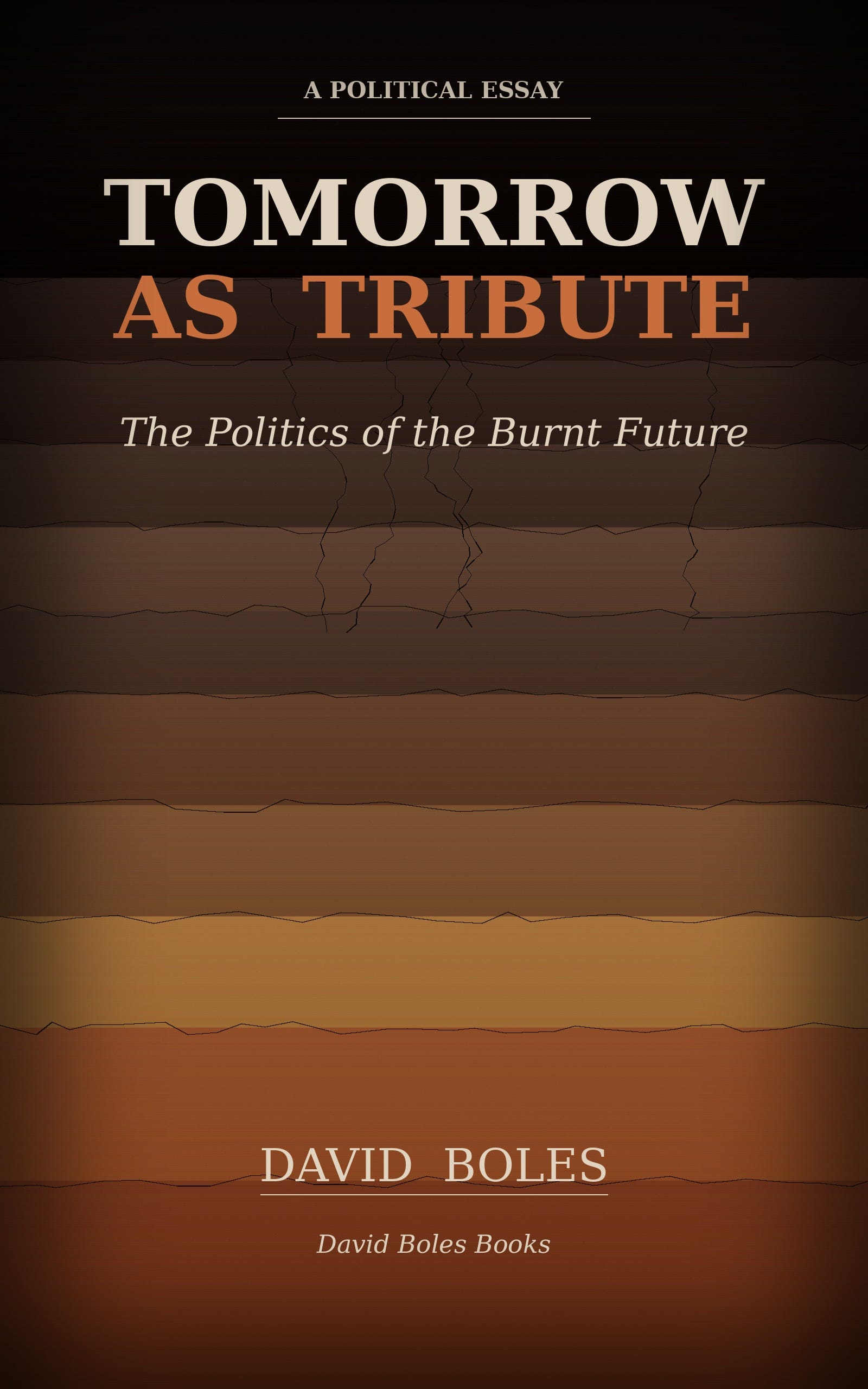
Russia under Putin and the United States across the second Trump administration are the two anchor cases. Hungary under Orbán, India under Modi, and Turkey under the long Erdoğan get extensive chapters. Israel, Brazil, Argentina, Italy, France, Germany, and Poland appear as the harder comparative cases. Each is examined for what is being traded, what past is being maintained, what future is being foreclosed in order to maintain it, and who pays the costs.
In the prairie county I have been thinking about, the costs are visible from the road. Closed hospitals. Boarded storefronts. Funeral notices in the weekly paper for men in their forties who died of overdose or suicide. Obituaries that read: he leaves behind a wife and three young children. He worked at the elevator for fifteen years before the elevator closed. He was preceded in death by his father, who farmed the same ground for forty-two years.
Closings of this kind have causes that are economic and geographic: consolidation in agriculture across decades, hollowing in American manufacturing, centralization of medicine into regional systems, demographic drift toward metropolitan areas, the rise and fall of meatpacking and ethanol. These forces are older than any current administration. They precede the second Trump presidency by half a century.
The Republican Party has, however, been the consistent vehicle for the response. Its response, across that half century, has been to promise the restoration of a past in which the closings did not happen. That promise has taken many forms. Reagan promised it. The Tea Party promised it. Trump’s first campaign promised it. Trump’s second administration promised it. Each version is the same. Someone or something is to blame for the lost world, the someone or something can be defeated, and the lost world will return when the enemy is defeated.
Enemies vary across the cycles. Immigrants. The federal government. The coastal elite. China. Welfare recipients. The press. Universities. Trans people. Drag queens. Critical race theory. The administrative state. Joe Biden. Anthony Fauci. The deep state. The list is long and changing because the actual losses are real and continuous and structural and have no easy enemy.
What the prairie county has been buying, through forty years of Republican voting at every level, is the maintenance of the fantasy that an enemy can be defeated and the lost world restored. The county has paid for this fantasy with its own hospitals, its own schools, its own grocery stores, its own funeral homes, its own families. That fantasy was always undeliverable. Losses have continued. Voting has continued. The losses are the tribute the county has paid for the maintenance of the fantasy.
This is what I mean by the politics of tribute. The trade is voluntary. Voters in the county know what the closings look like. They drove past the hospital before it closed and they drive past the empty building now. The elevator man was someone they knew, and they know the wife and three young children who survived him. They are buying something they have decided is worth what it costs.
The book argues that organizing against the politics of tribute requires beginning from accurate description of what the voters are buying and what they are paying. Standard liberal accounts of misinformation and propaganda miss the level at which the transaction operates. People are voting for an emotional product, and the product is being delivered exactly as promised. The lost world’s possibility, restored each cycle, is what they are buying. They are getting it.
I do not pretend that this is a comfortable account. Several friends who read the manuscript objected to the word voluntary. They argued that the voters are trapped, that they have been propagandized for forty years, that the alternatives have been systematically denied to them by gerrymandering and voter suppression and the collapse of local journalism. All of that is true. None of it changes the basic point. Voters know what the closings look like. They know what the obituaries read. They have decided, year after year, that the fantasy is worth the closings. That decision is the transaction. The transaction is the trade.
The harder part of the book is the affirmative argument. What replaces the trade in the historical record is patient institution-building. Schools that work. Hospitals that stay open. Wages that rise. Public health systems that function. Climate policy that protects the actual places where actual people live. A political class that accepts the loss of short-term advantage that the long view requires. The book examines four historical cases of democratic restoration in detail: postwar West Germany, postwar Italy, post-Franco Spain, and post-junta Greece. Each of those restorations took decades. None was complete. All were preferable to the alternative.
Restoration of this kind is unglamorous and slow. It is the only work that has ever defeated the politics of tribute in the historical record. Faster answers on offer are all versions of the trade in different packaging. There is no faster answer. Prairie time runs long. The land remembers everything that has been done to it across decades. The land also remembers what work succeeds across decades. Patient institution-building is the kind of work the prairie understands.
I wrote the book in part because I needed an honest account of what is being lost across the counties where I grew up. The losses are the cost of a transaction the voters have entered into knowingly, election after election, across two generations now. Voters know what they are buying. They participate. That transaction will end when the trade is replaced by an offer of actual material delivery that the voters can recognize and verify. The offer has not yet been made at scale. Constructing it is the actual substance of restoration politics.
The book is Tomorrow as Tribute: The Politics of the Burnt Future. You can find it at BolesBooks.com, on Amazon in paperback and Kindle, and as a free web edition for anyone who wants to read it without paying. The audiobook is in production. Its web edition is free because I want the argument to circulate as widely as possible.
The county I have been thinking about will not read this book. Its hospital will not reopen. The football team will not get back the boys it has lost. None of this is reversible on the time scale of a single election or a single administration. The work that could repair it is generational. The prairie has the patience for generational work. Whether the political class does is the open question.