

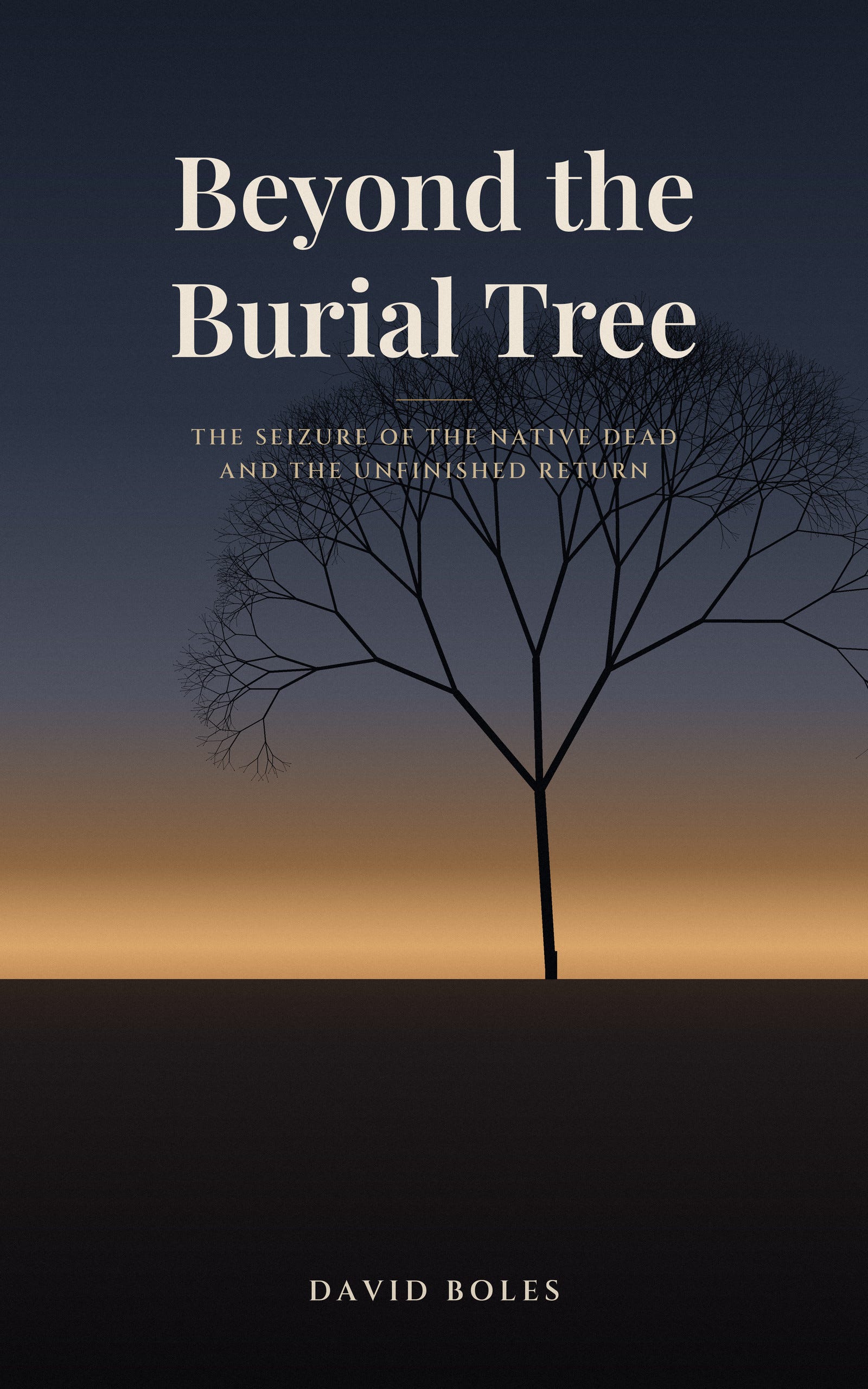
Stand anywhere along the Loup in central Nebraska and the country will try to tell you it is empty. Grass to the edge of seeing, a brown river working its sandbars, a few cottonwoods bent the way the wind has taught them, a meadowlark riding the fence wire. That emptiness is a trick of the surface. Beneath the section lines and the center pivots lies one of the most thoroughly inhabited places on the continent, because the prairie keeps its dead, and the people who held this valley longest laid a great many of them in this ground. My new book, Beyond the Burial Tree, is about what was done to those dead, and about the long work of bringing them home.
The title comes from an older way of keeping the dead. A Plains family would build a scaffold, or choose the high fork of a tree, and set the body up in the open air, close to the sky. The dead stayed visible and named, tended by the living, until the bones came down to the earth in their own season. Those who held this valley were a sky people in the most literal sense. The Skidi band, the Wolf people, built their earth lodges as small models of the heavens and read the calendar of their planting in the stars that crossed the smoke hole. A nation that watched the sky that closely carried a deep and exact teaching about where the dead go, and it kept its own dead in the open, lifted toward the light.
For a long time this was their country, lived in and worked daily. The Pawnee ran villages of earth lodges along the Loup and the Platte, many thousands of people at their height, farming the river bottoms in corn and beans and squash and riding out twice a year after the buffalo. They buried their dead in the rises above the rivers, where the high ground drains and the view runs long, and the people who made those graves knew them and visited them and kept them, for as long as they were allowed to stay. Removal in the 1870s ended that and sent the living south to Indian Territory, while the dead stayed behind in ground that was about to change hands.
Then the dead were carried off. Through the nineteenth century and far into the twentieth, the bones of Native people were gathered for science, dug from graves and battlefields, lifted from the freshly buried, then measured and numbered and shelved in universities, in historical societies, and in the medical collections of the Army. In 1868 the Surgeon General’s office circulated a request for Native skulls, so that Army surgeons might measure them. The measuring served a racial science that has since been thrown out as worthless, and yet the dead it produced stayed on the shelves long after the theory died. The grief of a family arrived, at the far end of that traffic, as a specimen with a tag, and a bone that had belonged to somebody’s grandmother came to rest in a drawer a thousand miles from the river she was buried beside.
How far this ran is hard to hold in the mind. For decades a roadside attraction in Kansas, the Salina burial pit, kept open Pawnee graves on display for paying tourists, the dead left in the dirt for anyone with a dollar and an idle afternoon. That pit did not close until 1989. The same machinery that filled the museum drawers also filled the government boarding schools, where Native children were sent to be remade and where a great many never came home. This past summer the Interior Department closed its own count and documented at least nine hundred and seventy-three children who died in those schools, while stating in plain language that the real number runs far higher. A child shipped away who never returned and an ancestor lifted from a grave who never came back are one wound worn in two places. The ground lost them both.
The return began with the people whose dead had been taken, and it began here. In the 1980s a Pawnee attorney named Walter Echo-Hawk, working through the Native American Rights Fund, pressed the state of Nebraska to give the Pawnee dead back, and the historical society fought him the whole way. In 1989 the Nebraska legislature passed a bill by Senator Ernie Chambers requiring the return of Native remains and funerary objects, the first state law of its kind. A year later Congress built the national statute, the Native American Graves Protection and Repatriation Act, on that Nebraska footing. The law gave the dead a road home, and the dead traveled it. In one of the truest acts I know of, the Nebraska writer Roger Welsch deeded sixty acres of his own land back to the Pawnee Nation, ground that had been theirs before the removal, so that ancestors carried out of glass cases and storage rooms could be buried once more in the country they came from. The people held services over that ground and put their relatives back into the prairie that had been waiting for them.
That is the turn the book honors, and I will not dress it up as a finish. The work is undone. Nebraska’s own museums were still holding more than a hundred sets of Native remains as recently as two years ago, and across the country the number of ancestors still waiting in boxes climbs into the many thousands. Each set of remains in a storeroom is a person whose burial was interrupted and never allowed to finish. A law opens a door. Walking an ancestor back through it is separate labor, and decades on, much of that labor remains undone.
Prairie Voice exists to listen to this kind of ground, the country the rest of the map drives past at seventy miles an hour and calls flyover. The plains have always held more history than the postcard admits, and a great deal of that history is buried in the literal soil. To write honestly about this region is to account for who lies in that soil and how they came to be there, the tended and the stolen together. A place is its dead as surely as it is its living. The Loup valley is the people in it, the ones whose names were kept and the ones whose names were filed into an accession ledger, and a country that digs up its buried has injured the ground itself, not only the descendants who carry the loss.
Writing this book was the only return open to me. I set the history down where it cannot be filed away and forgotten a second time, and I say the plain thing out loud, that these were people, and they are owed. Beyond the Burial Tree is out now, in print and as an ebook, with the audiobook on the way, at BolesBooks.com. If you read it, read it the way you would walk an old cemetery, slowly, with your hat in your hand. The valley is still keeping its dead, the ones who came home and the ones still boxed on a shelf far from the river. Knowing whose they are is the least we owe the ground that keeps them.