

I. The Seed Beneath the Snow
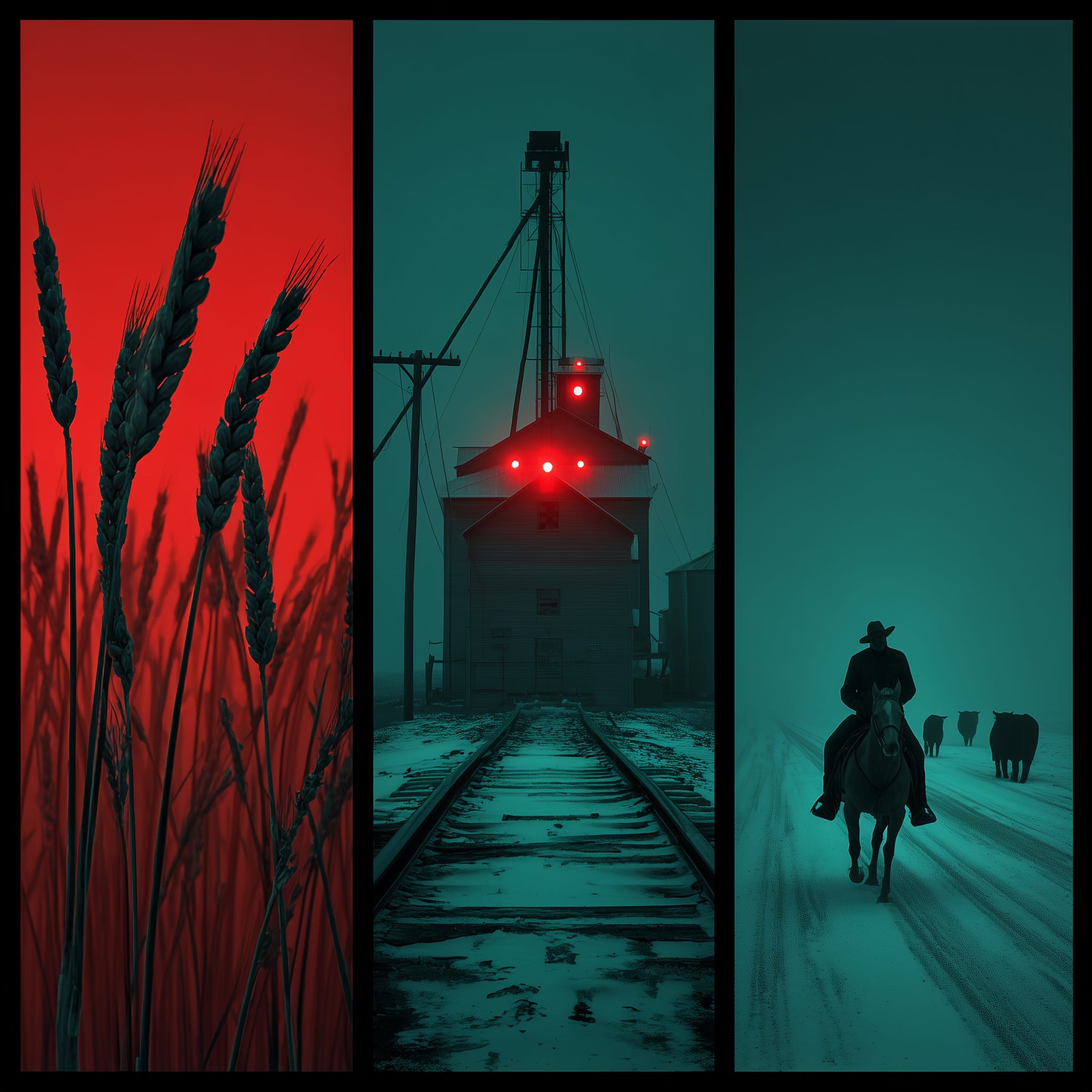
In late September, across Kansas and Nebraska and into the Oklahoma Panhandle, farmers climb into tractors as the first cool nights settle over the prairie. They are planting a crop they will not harvest until next June. The seed drills cut furrows into soil still warm from summer, depositing kernels of hard red winter wheat at precise depths, one inch down, where moisture waits. Within days the seeds swell with water, crack their hulls, and send pale roots downward and green shoots upward through the dirt. By the time the first hard freeze arrives, the wheat stands two inches tall across fields that stretch to the horizon, a faint green wash over brown stubble.
And then it stops.
This is the central mystery of winter wheat, the fact that confounds intuition and yet anchors the agricultural economy of the Great Plains. The plant must experience cold to complete its life cycle. Without weeks of temperatures below 48 degrees Fahrenheit, winter wheat will remain forever vegetative, producing leaves but never seed. The process is called vernalization, from the Latin vernus, meaning spring. The plant requires winter to achieve spring.
The physiology involves complex hormonal cascades triggered by prolonged cold exposure, changes occurring at the cellular level in the crown of the plant where it meets the soil. Researchers at Ohio State University have found that vernalization requires forty to seventy days of temperatures between 34 and 52 degrees, though the precise requirements vary by variety. What matters practically is this: the wheat knows something is happening even when we cannot see it. Beneath the snow, in soil that may be frozen solid at the surface, biological work continues. The plant is not dead. It is not dormant. It is transforming.
This particular wheat came to Kansas in 1874, carried in crocks and chests and canvas sacks by twelve thousand German Mennonites fleeing Russian persecution. They had developed it on the steppes of Ukraine, where winters were as brutal as those on the American plains and summers equally hot and dry. The variety was called Turkey Red, a hard winter wheat that thrived where the soft spring wheats of Western Europe failed. Bernhard Warkentin, a miller’s son from Crimea who had scouted the Kansas prairies in 1872, settled near Halstead and planted the first commercial crop. The variety dominated Kansas agriculture for seventy years.
By 1900, Kansas was harvesting eighty million bushels annually. By 1914, that number had more than doubled to 172 million bushels. The state that had been dismissed as the Great American Desert became the breadbasket of the world. Railroad lines proliferated. Grain elevators rose from the prairie like cathedrals. Flour mills opened in nearly every county. An entire civilization organized itself around a seed that required patience, that demanded faith in processes invisible to the eye.
The Mennonites knew something that the American farmers they joined had not yet learned. They understood that planting in fall and harvesting in summer allowed the crop to capture autumn rains and spring moisture while maturing before the scorching heat of July. They understood that dormancy was not absence but preparation. They had spent a century on the Ukrainian steppes learning to read what could not be seen.
On Christmas morning, when snow covers the fields of western Kansas, there is nothing to indicate that anything alive lies beneath. The farmhouses are warm with families gathered around tables. The combines sit idle in machine sheds. No one is working the land. But every hour, every day, through December and January and into February, the wheat is undergoing changes that will determine the size of next year’s harvest. Cold is doing its work. The vernalization process is accumulating degree days like a savings account, moving the crop incrementally toward the reproductive stage it cannot reach without this investment of winter.
Kansas State University researchers conducted a seven-year study at Garden City, seeding winter wheat monthly from October through April. Wheat planted through January 1 still produced fifty to one hundred percent of optimal yields. Wheat planted March 1 headed and produced grain. But wheat planted April 1 never headed at all. It had missed its winter. Without the cold, it could not remember how to become what it was meant to be.
There is a certain comfort in this during the Christmas season, in knowing that the work of the year is not finished but merely invisible. The bills are paid, the equipment maintained, the seed in the ground. Now comes the season of waiting, of trusting that the biological machinery set in motion months ago continues to operate according to principles older than any individual farmer’s experience. The wheat beneath the snow is not sleeping. It is becoming.
II. The Lights Across the Prairie
In Minden, Nebraska, population 2,700, the Kearney County Courthouse has been wrapped in Christmas lights every December since 1915. The tradition began when City Light Commissioner J.C. Haws strung lights from the railroad depot to the town square to impress a convention of Civil War veterans. Weather delayed the display until Christmas, and what was meant as a one-time gesture became permanent. More than ten thousand bulbs now outline the courthouse dome in red and green, visible for miles across the flat Nebraska plain.
Jack Hultquist, Minden’s unofficial historian, remembers being able to see the courthouse as a child from a hill on the north side of Kearney, nearly twenty miles away. In the 1940s, passenger trains running east to west would slow down as they approached, conductors and travelers straining for a glimpse of the lights. In 1946, a sound system was installed in the courthouse tower, enabling the Light of the World pageant that has been performed annually ever since. Santa declared the town should henceforth be known as Minden, the Christmas City, back in 1923. Governor Ben Nelson made it official in 1996.
Three hundred miles southwest, in WaKeeney, Kansas, population 1,800, a different tradition has endured for seventy-five years. Art Keraus and J.H. “Jake” Heckman, local businessmen, organized the first display in 1950, erecting a thirty-five-foot Christmas tree of fresh pine greenery at the intersection of Main and Russell Avenue. The tree stands beneath a canopy of heavenly blue lights. Four ivory stars, each five feet in diameter, crown the top. A four-block square is draped with greenery, handcrafted wreaths, bells, and bows. More than 6,800 lights illuminate what was claimed to be the largest Christmas display between Denver and Kansas City.
The decorations are stored year-round in what locals call the Christmas Room in the city building. The twenty-four original handmade bells and fourteen wreaths, some now approaching their eighth decade, are cleaned and repainted each November by volunteers. In 2018, the town installed LED perimeter lights on every downtown building, lights that remain on year-round so that WaKeeney is never not the Christmas City of the High Plains.
These are not wealthy communities. Minden’s economy depends on the ethanol plant, the machine shops, the surrounding farmland. WaKeeney sits on Interstate 70, halfway between Kansas City and Denver, three hundred miles in either direction, a town that exists in part because travelers need gas and food and a place to sleep. The Christmas displays are not commercial ventures. They do not generate revenue beyond what visitors spend at the pharmacy soda fountain or the hometown bakery. They exist because someone, generations ago, decided that darkness needed answering.
In Superior, Wisconsin, the CHS grain elevator has hosted a Christmas tree of lights since 1961, strung from a flagpole in a tree-like shape. Terminal manager Dan Vandenhouten says the display requires constant maintenance. Being that high off the ground, replacing burned-out bulbs is not for the faint of heart. Last year, when the flagpole broke and had to be replaced, people called the elevator asking when the lights would go up. They noticed.
In Creighton, Nebraska, population 1,100, Santaland fills Bruce Park with more than 100,000 lights, sixteen elves, and a Santa who receives every visiting child. Two thousand volunteer hours go into the setup each year, beginning the first weekend of November. In WaKeeney and Minden and Creighton and dozens of other prairie towns, the pattern repeats: community members giving time they could spend elsewhere to create something that serves no practical purpose except to push back against the longest nights of the year.
Driving the back roads of western Kansas or central Nebraska at Christmas, you can see which farmhouses are occupied by the lights in the windows, the strands along the gutters, the illuminated wreaths on doors visible from half a mile away. Families driving these roads know the tradition. They check the displays the way neighbors once checked on each other’s cattle, noting who is still here, who has kept the faith, who has decided that the darkness is not the final word.
The historian in Minden describes the lights as a ray of light amidst whatever troubles the world brings. The lights came on in 1915, at the height of the Great War in Europe. They came on through the Depression, through the Dust Bowl years when the sky itself seemed to have turned against the prairie. They came on through every subsequent crisis that has tested the faith of small communities. The bulbs are unscrewed individually each January, placed in separate boxes to prevent breakage, rolled into heavy copper strands that are more than fifty years old. Then they are stored, waiting for next November, when it will be time again to climb the courthouse and begin.
III. The Feedlot at Dawn
At 4:30 on Christmas morning, while most of America sleeps, a pickup truck pulls into the parking area of a feedlot somewhere in the Texas Panhandle. The temperature is seventeen degrees. The driver, a man in his thirties wearing insulated coveralls and a cap pulled low, pours coffee from a thermos and waits for the heater to take the edge off the cold. In the darkness beyond the windshield, eleven thousand cattle stand in pens arranged across several hundred acres, their breath rising in clouds, their eyes catching the reflected glow of the yard lights.
Cattle do not observe holidays. They require feed twice daily, water continuously, monitoring constantly. The biological processes that convert grain into weight gain operate at the same rate on December 25 as on any other day. A steer on finishing ration will gain between two and a half and four pounds today, Christmas or not. The bunk caller has calculated the feed requirements. The mill has ground and mixed the ration. Someone must distribute it.
The man finishes his coffee and walks to the barn where the horses are kept. In large feedlots, pen riders still work on horseback, a practice that seems anachronistic until you understand the logic. A horse provides elevation, allowing the rider to see across a pen of cattle without disturbing them. A horse moves slowly enough that cattle remain calm. A horse can isolate a single animal from a group and move it to a hospital pen without stressing the rest. This is not tradition for tradition’s sake. It is the most efficient technology available for the task.
The pen rider’s primary job is to maintain the health and welfare of the cattle. He rides through assigned pens daily, identifying sick animals by observing outward signs of distress, segregating them for treatment, calling in deads for removal. A typical day starts at dawn, regardless of weather, and continues for six or seven hours through a section that may contain six thousand head. At larger operations like Simplot Livestock in Idaho, twelve riders go out each morning at seven, responsible for checking six hundred pens before lunch.
Steven Seymour, who spent eight years as a pen rider for Swisher County Cattle Company in Tulia, Texas, maintaining sixteen thousand head, describes what the work requires. You have to have a good eye for the subtle signs of distress, he says. The most obvious sign is an animal laying down or standing with its head in the dirt, but by then it is usually too late. Before it gets to that point, you want to be aware of how the animals move, if their flanks look normal, if their eyes are saying anything. Over time, pen riders come to know each group of livestock, what normal is for that particular pen. They are the first line of defense against disease.
The work is not for beginners. It can be a fast-paced, high-stress environment. Between the tight space and inherent dangers, if you are green, it is easy to get hurt. The days are long, sometimes up to fifteen hours. The weather is whatever the weather is. Seymour notes that the pay and conditions are not great, but pen riders are out there because that is exactly what they want to do and where they want to be.
On Christmas morning, the water tanks need checking. In seventeen-degree weather, ice forms overnight, and cattle cannot break through to drink. A dairy cow in milk can require thirty to fifty gallons of water daily. Beef cattle on high-grain finishing rations need less but still cannot go without. Someone must walk the alleys between pens, checking each tank, breaking ice with an axe or sledge hammer or simply running warm water until the hole opens. The tanks hold heat better than buckets, but bitter cold defeats everything eventually.
The feed truck rolls at first light. The driver follows a route that has been optimized for efficiency, delivering precisely calculated amounts to each bunk according to the call sheet prepared the day before. The cattle know the sound of the truck. They move toward the bunks, waiting. The driver dumps the ration, moves to the next pen, repeats. This continues until every animal has been fed, a process that may take several hours across a large operation.
There are groups that portray feedlots and the beef industry as something horrible, Seymour says. And that could not be further from the truth. The cowboy’s job is to take care of cattle, and he would not be doing that if he did not actually care for them. It is certainly not for the money. The distinction matters. The people working on Christmas morning are not there because they have no choice. They are there because the animals cannot wait.
By mid-morning, when families across the country are opening presents and preparing holiday meals, the first shift of feedlot work is complete. The cattle have been fed and watered. The sick have been identified and treated. The dead have been removed. The infrastructure that delivers beef to American tables continues to operate, staffed by people whose names will never appear in any account of the holiday season but without whom the system would stop.
The pen rider unsaddles his horse, rubs it down, returns it to the barn. He drives home to whatever celebration awaits, knowing that tomorrow morning at 4:30 he will be back, and the morning after that, and every morning until the cattle ship or until he finds another line of work. The rhythm is not sentimental. It is simply what the work requires.
What Endures
Christmas on the prairie asks nothing and offers no guarantees. The wheat beneath the snow may winter-kill if temperatures drop too fast or rise too soon. The lights on the courthouse will eventually need replacing, the volunteers growing older, the young people moving to cities where such traditions seem quaint. The feedlots will consolidate further, the pen riders replaced by drones and sensors and algorithms that can detect illness before any human eye.
But for now, in this particular December, the old systems hold. The Turkey Red wheat that Bernhard Warkentin carried from Crimea in 1874 has been bred into every modern variety grown on the plains, its genetics woven into the foundation of American agriculture. The lights that J.C. Haws first hung in Minden in 1915 still draw visitors from across the state, still slow the trains. The horseback skills developed over centuries still represent the best technology for monitoring cattle health in confinement operations.
What endures on the prairie is what has always endured: the willingness to do necessary work in difficult conditions, the faith that processes invisible to the eye are nevertheless operating according to reliable principles, the stubborn insistence on marking the darkest season with light. These are not romantic notions. They are the hard-won conclusions of people who have learned what it costs to live in a place that offers no easy rewards.
The wheat will emerge in March, greening the fields with the first warm days, growing rapidly through April and May toward the harvest that comes when the rest of the country is celebrating summer. The Christmas lights will be carefully packed away in January, stored until next November when the cycle begins again. The pen rider will continue his rounds, seven days a week, fifty-two weeks a year, because cattle cannot read calendars and do not understand that some days are supposed to be different from others.
This is what the prairie teaches, if you stay long enough to learn it. That dormancy is not death. That darkness asks for light. That the work is never finished, only paused. That what matters most is often what cannot be seen: the root system spreading beneath frozen ground, the volunteer climbing a courthouse dome, the cowboy riding out at dawn on a day the rest of the world takes off.
Merry Christmas from the prairie. The wheat is growing beneath your feet.