

Nebraska posts its towns at the shoulder of the highway. A green sign, white letters, a name, and a number. The number comes from the decennial census, and it hangs there until the next count changes it. Along the roads I know best, the numbers read like a countdown. Ord, two thousand. North Loup, three hundred. Monowi, one. Two years ago I drove the length of that ladder to bury one of our own, and I have been trying since to say what the rungs mean.
When a prairie town shrinks, its institutions leave in an order. The school goes, then the church, the grocery, the post office, and the last two standing are the bar and the books. That is my claim, from a lifetime of watching, and I have checked it against the tables. None of it is random. The order tells you what a town is for.
Ord is the county seat of Valley County, and it looks the part. The census counted 2,113 people there in 2020, against 2,112 a decade earlier, down from a peak of 2,658 in 1980. A town that gave back a fifth of itself across forty years and then held. The three-story brick courthouse on the square went up in 1921. The Ord Quiz has come out every week since 1882, though as I write this, in September of 2026, the paper is listed for sale, price reduced, waiting on a buyer. KNLV has been on the air since 1965, founded by a group of valley businessmen, and John Sullivan of North Loup signed on as treasurer. The call letters are the valley’s own initials. K, North Loup, Vally. The station still reads the farm reports and the obituaries, and it still carries the high school game on Friday night.
The town itself is named for a man who was only passing through. General E.O.C. Ord came up the North Loup Valley in the 1870s to pick a site for Fort Hartsuff, and the founders put his name on the plat while he was elsewhere being a general. That is an honest origin for a county seat. A town begins the moment somebody marks a place for other people to stop.
Two thousand people is enough to staff a government with a conscience. I have sat in an Ord city council meeting and watched the council tell a man no. The vote cost the councilors something, and they took it anyway. A council that can afford to say no believes the town will outlast the dispute. That is what two thousand buys. A bench deep enough to lose people and keep playing. A newspaper worth inheriting, if somebody steps up to inherit it. A radio station worth the electricity.
Eleven miles south on Highway 11, the number loses a digit. North Loup stood at 254 in the 2020 census, down from 657 in 1930. The town and my title both round up to three hundred, and I will not argue with either of them.
North Loup began as a church. Seventh Day Baptists out of Wisconsin scouted the valley in 1871, and in May of 1872 they held their first service at the river’s edge. The Reverend Oscar Babcock preached from a borrowed rocking chair, because that is what was available for a pulpit. The Union Pacific reached town in 1882, after North Loup and Ord voted nine thousand dollars in bonds to bring the rails up the valley, and the village doubled in a single year. Four years later the line was finished through to Ord, and the boom moved north with the terminus. A town learns early whether it is a destination or a pass-through, and a railroad usually delivers the lesson.
What three hundred keeps is a schedule. Popcorn Days began in 1901, when the merchants gave away popcorn to thank the farmers for a year of trade, and this August the town held the 125th running, the longest continuous festival in Nebraska. The carnival takes over Highway 11 for the weekend. In a good year the giveaway runs to three thousand pounds of corn, free, handed out on the street the way it was handed out when my grandfather was young.
His house is in North Loup, and my summers there ran on one television channel. Whatever the antenna pulled out of the sky was what you watched, and you watched it. If the picture rolled, you waited it out. There was no other channel to leave for. Two years ago we buried one of our own in the ground north of town, on a day when the grass had gone dry and the chairs came over from the church. I had not been back for Popcorn Days in longer than I want to admit, and I came back for that. We stood in the wind until the chairs went home. The stones around us carried names I knew from the parade route. A town of three hundred can promise only a few things. One of them is this: when you come back to be buried, the crowd at the graveside will know exactly who you were. That is what the middle rung is for. Gathering on schedule. The festival in August, the funeral when it comes.
The elegy is earned, and I want to grant it before I argue with it. Ninety years of tables run one way. The young leave, and the sociologists have mapped the leaving. In 2001, on MacArthur Foundation money, Patrick J. Carr and Maria J. Kefalas moved to Iowa and stayed long enough to write Hollowing Out the Middle, published by Beacon Press in 2009. Their finding still stings: a small town exports its young people the way it exports corn, and the adults help with the shipping, steering the best students out and away because staying looks like failure. Robert Wuthnow, a Princeton sociologist raised in a small Kansas town, drew on more than a thousand interviews for The Left Behind, published by Princeton University Press in 2018. What rural people are defending, he writes, is a moral community, a web of obligations among people who know one another’s names, and the rage arrives when the web frays.
Neither of them, so far as I can find, sets down the order in which the institutions leave. That order is my own observation, from this valley and from towns like it across the Plains. The school goes, then the church, the grocery, the post office, and the last two standing are the bar and the books. The sequence has a logic. A school needs children, and a church needs a quorum of the faithful. A grocery runs on a margin the county seat will always undercut, and the post office answers to Washington and takes no orders from anyone local. The bar needs a thirst and the books need a reader, and one determined person can supply both.
A hundred miles northeast, the ladder bottoms out. Highway 12 runs along the top of the state there as the Outlaw Trail Scenic Byway, between the Niobrara and the Missouri. A townsite company platted Monowi in 1902, as the Fremont, Elkhorn and Missouri Valley pushed west from Niobrara. People called the railroad the Elkhorn. They say the name comes from a Native word for the wildflowers that grew at the site, the snow-on-the-mountain. In 1930 the census counted 123. The reporters who came later, when almost nobody was left to correct them, wrote 150. Then the long arithmetic ran: 99 in 1940, 67 in 1950, 40 in 1960, 16 in 1970, 18 in 1980, 6 in 1990, 2 in 2000, 1 in 2010.
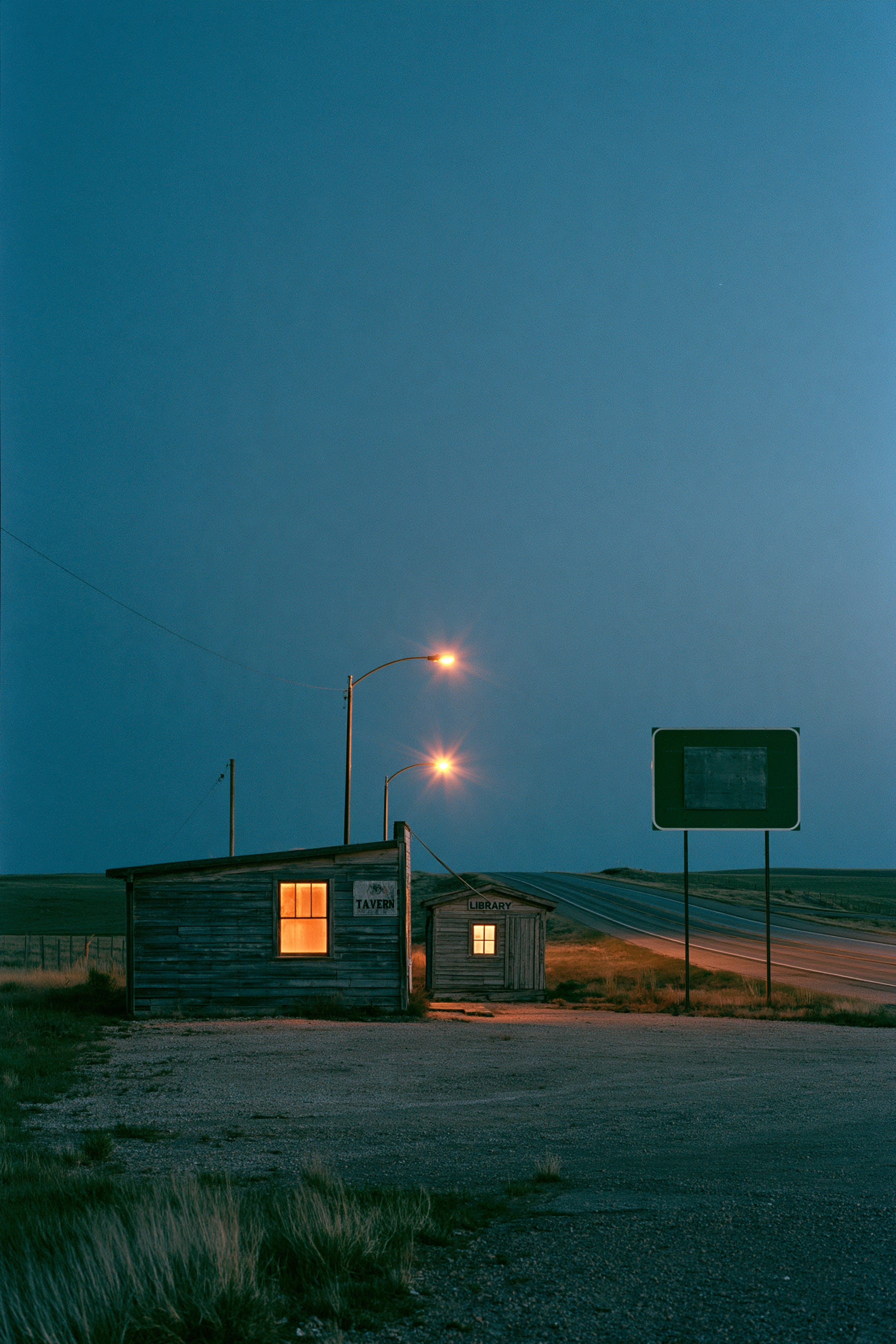
Monowi scrambled my order, and I want the record to show it. The church went first: the last funeral in the wooden church was held in 1960, for the father of a woman named Elsie Eiler. Between 1967 and 1970 the post office and the last of the three grocery stores closed. The federal record says the post office ended in 1967; local memory holds it to 1971, the year the tavern opened, and I understand why memory prefers the symmetry. The school followed in 1974, and the Chicago and North Western, heir to the Elkhorn, quit the line in 1978. When the leaving was done, what was left standing was a bar and a library. The Monowi Tavern, which Elsie and her husband Rudy bought in June of 1971, in a building put up in 1903, is still open. Rudy’s Library, five thousand books in a shed Rudy ordered before the cancer took him in January of 2004, stands a few steps away. Ask for the key. There are no library cards and no overdue charges.
Rudy’s death halved the town. What remains is Elsie, ninety-two years old, mayor, clerk, treasurer, librarian, cook, and bartender. She signs her own liquor license. She files an annual municipal road plan so the state will keep paying for the streetlights, three of them, lit. In 2020 the Census Bureau counted two people in Monowi. The bureau fudges the small numbers on purpose, a spokeswoman explained, to keep anyone’s data from being read too closely. Monowi’s second resident was a rounding error, a phantom with a name like Noise. “Well, then someone’s been hiding from me, and there’s nowhere to live but my house,” Elsie told the Lincoln Journal Star. “But if you find out who he is, let me know?” It is funny. It is also the loneliest joke ever told in Nebraska.
The bottom rung is busy. Fifty people a day stop at the tavern. The guest books, six of them filled, carry names from all fifty states and sixty foreign countries. The sheriffs of Boyd and Knox counties hold their monthly meeting at her bar, and in the summer of 2021, for the tavern’s fiftieth year, the neighbors fed Elsie for a change. A town of one is for whoever stops. People stop from everywhere on earth.
So the ladder holds, all the way down. At two thousand, a town is for governing itself. Three hundred is for gathering on schedule. And a town of one is for whoever stops, and for the one who stayed to keep the lights. The bar is where the town still meets. The books are what it meant. Institutions leave in an order, and the order tells on the town. A town can lose its future, its faith, its food, and its mail, and still be a town as long as somebody pours and somebody reads.
Drive out in the evening and the last thing Monowi gives you is the number. The green sign at the edge of town reads MONOWI 1, the letters reflectorized white, sized to be legible at the speed of a passing car. That is the speed at which most of us pass our towns now, if we pass them at all. The sign makes one demand: read me before I’m gone. Two thousand. Three hundred. One. The bar is open. The library key hangs where it hangs. And the streetlights, all three of them, are on.