

In the Lincoln, Nebraska, of my childhood, you waved at cars because the cars waved first. Two fingers off the wheel on a county road, a palm from a porch, a nod across the counter from the man who fixed shoes. Nobody legislated any of it. A town that size runs on the knowing the way it runs on water pressure, and a child raised inside that system absorbs its first premise before he can spell it.
I absorbed mine around the time a Lincoln newspaper first paid me for words, which happened when I was ten. The premise ran eight words and wore no punctuation worth mentioning: if I know you, you are my friend. My new book calls that sentence the blanket, because a blanket is what it was, warm, wide, and thin, thrown over the shoe man and the counter woman and the dogs three streets over and, decades later, over an actor in a rehearsal room a time zone east of that counter who crossed the floor one afternoon and asked me, sincerely, for the thing I had been handing out free to everyone else. What I did with his request took me thirty years to say honestly, and the saying became a book.
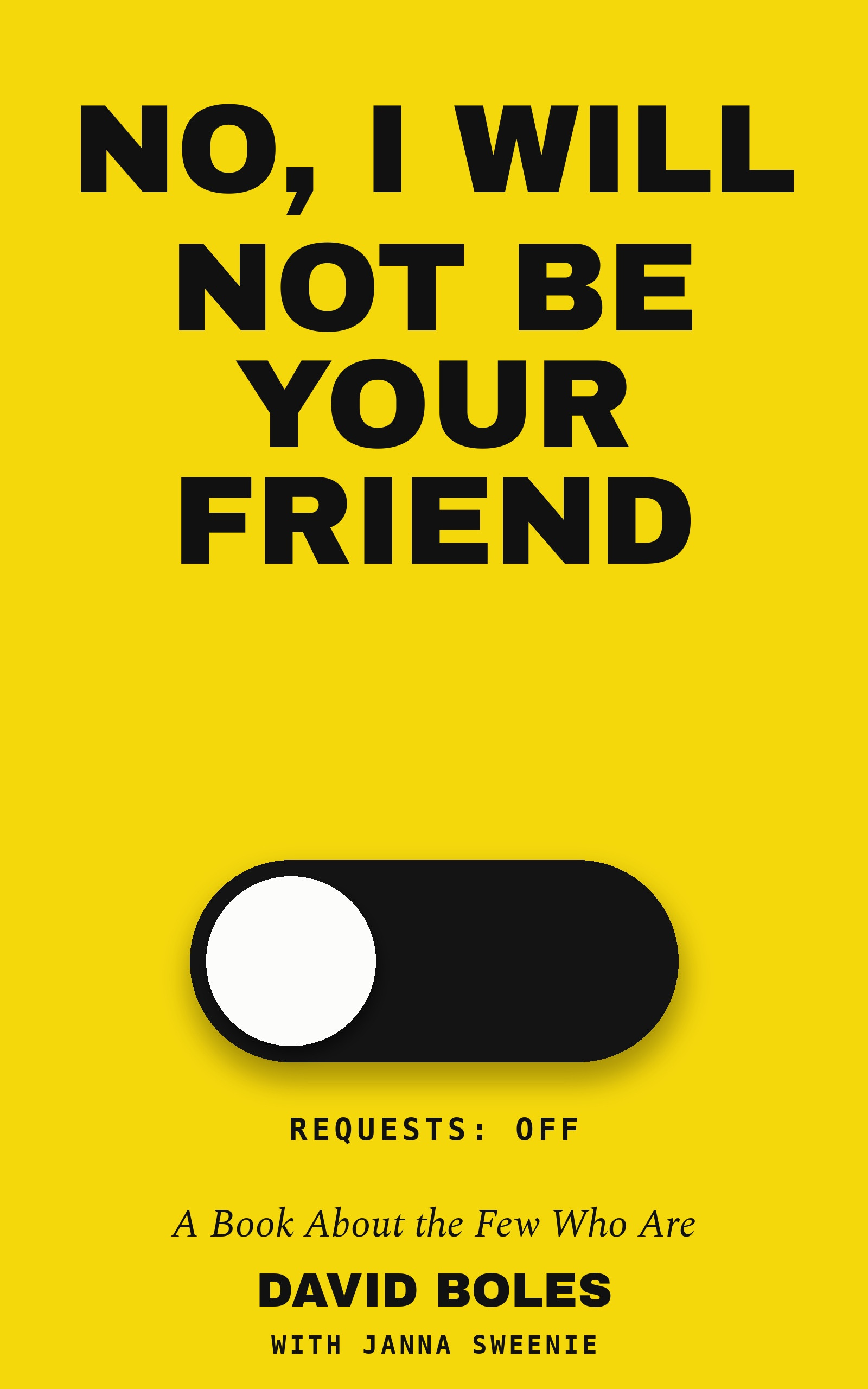
The book is No, I Will NOT Be Your Friend: A Book About the Few Who Are, written with Janna Sweenie, and it is out now. This article is a celebration of it, which on this page means an accounting of it, because Prairie Voice does its celebrating with the ledger open.
◊
Start with a unit of measure this readership already owns: the bushel.
The ancients had a proverb that you could call nobody a friend until the two of you had eaten a bushel of salt together, and they meant the bushel. The book runs the arithmetic in plain prairie style. Call it fifty pounds of salt. Divide the pounds by the pinches, a pinch or two per shared meal, and the proverb resolves into a number of dinners that runs to the thousands, which resolves into years. The bushel was a clock. Friendship, for most of the human record, was measured the way this region still measures wheat, by volume and by season, and it was made the way a barn was made: sworn before witnesses, and priced in salt and gold. Two English knights who swore that kind of bond in the fourteenth century share one carved stone in Constantinople to this day, their helmets leaning toward each other across six centuries.
Then the bond was privatized, and then it was platformed. The word that once required a ceremony now requires a thumb. And here is the detail from the book that should stop a practical people cold: the engineers kept the old law. Inside every friend request sits a three-part clause the culture threw away long ago, offer, acceptance, mutual confirmation. The machine remembers the ceremony. It just performs it a billion times a day, for strangers, for free, until the word inside it weighs nothing at all.
◊
Prairie Voice does its subjects the honor of naming their failures, and this one is ours to name. The blanket is a prairie manufacture. The friendliness that raised me, the wave, the casserole that arrives before the ambulance has cleared the driveway, is a genuine glory of this region, and it is also the raw material the platforms industrialized. They took the manner of a county seat, where knowing everyone is a utility, and scaled it to the planet, where knowing everyone is a lie. When the coasts sold the world a button that calls every stranger a friend, they were bottling something they first tasted out here.
And the manner trained me in something darker, which the book confesses at length. When that actor asked me his six-word question, I answered him with a warm little question of my own, and it was Lincoln politeness doing exactly what Lincoln politeness is built to do: it ended the conversation without ever appearing to refuse anything. The prairie teaches a courtesy so smooth it can decline a man to his face and leave him thanking you. That skill kept the peace at ten thousand church suppers. It also let me dodge a brave question for thirty years and call the dodge good manners.
◊
Here is what the ledger shows on the other side, and why this book belongs on this page. The prairie kept the old instruments longer than almost anyone. When a farmer goes into the hospital in harvest season, his neighbors still bring their combines to his field, unasked, unpaid, and unphotographed, which is a threshing ring by its older name, which is friendship as a made thing, performed in public, exactly as the ancients would recognize it. The church basement after a funeral, the coffee in steel urns, the casserole brigade in aprons: that is the bushel of salt being eaten on schedule. One of the book’s later chapters reports that at funerals across the country the casket is now carried by employees of the funeral home, hired men in gray gloves who never met the deceased. Where I come from, we still mostly carry our own. The book argues that the difference between those two funerals is the whole subject.
Janna’s chapter belongs in this accounting too. She writes about the Deaf world’s name signs, marks a community confers and will never sell, and her pages stand in the book as one more culture that kept its ceremonies while the hearing world put its names on sale. She and I disagree in print about the actor in the rehearsal room, and we left the disagreement standing, because an argument held openly between two people who chose each other is the book’s thesis wearing work clothes.
◊
No, I Will NOT Be Your Friend is available now in paperback and Kindle editions, and as a free web edition at bolesbooks.com. It is a memoir braided into a social history, and it ends where this region begins: with the understanding that a word is worth what it costs.
The wave costs nothing. The bushel costs years. This book is about learning, late, which one I had been offering, and about the few people in any life who quietly paid the full freight anyway. The prairie has always known the difference. I wrote three hundred and fifty pages to catch up.