

Prairie Voice has spent years documenting the hidden economies that sustain rural communities after the visible ones collapse. Data centers humming in converted grain elevators. Rendering plants processing what feedlots produce and grocery stores refuse to acknowledge. Missile silos maintained by skeleton crews in counties where the population has halved since 1960. And prisons. Prisons above all, the industry that moved into the emptied heartland with a simple proposition: we need your isolation, and you need our payroll.
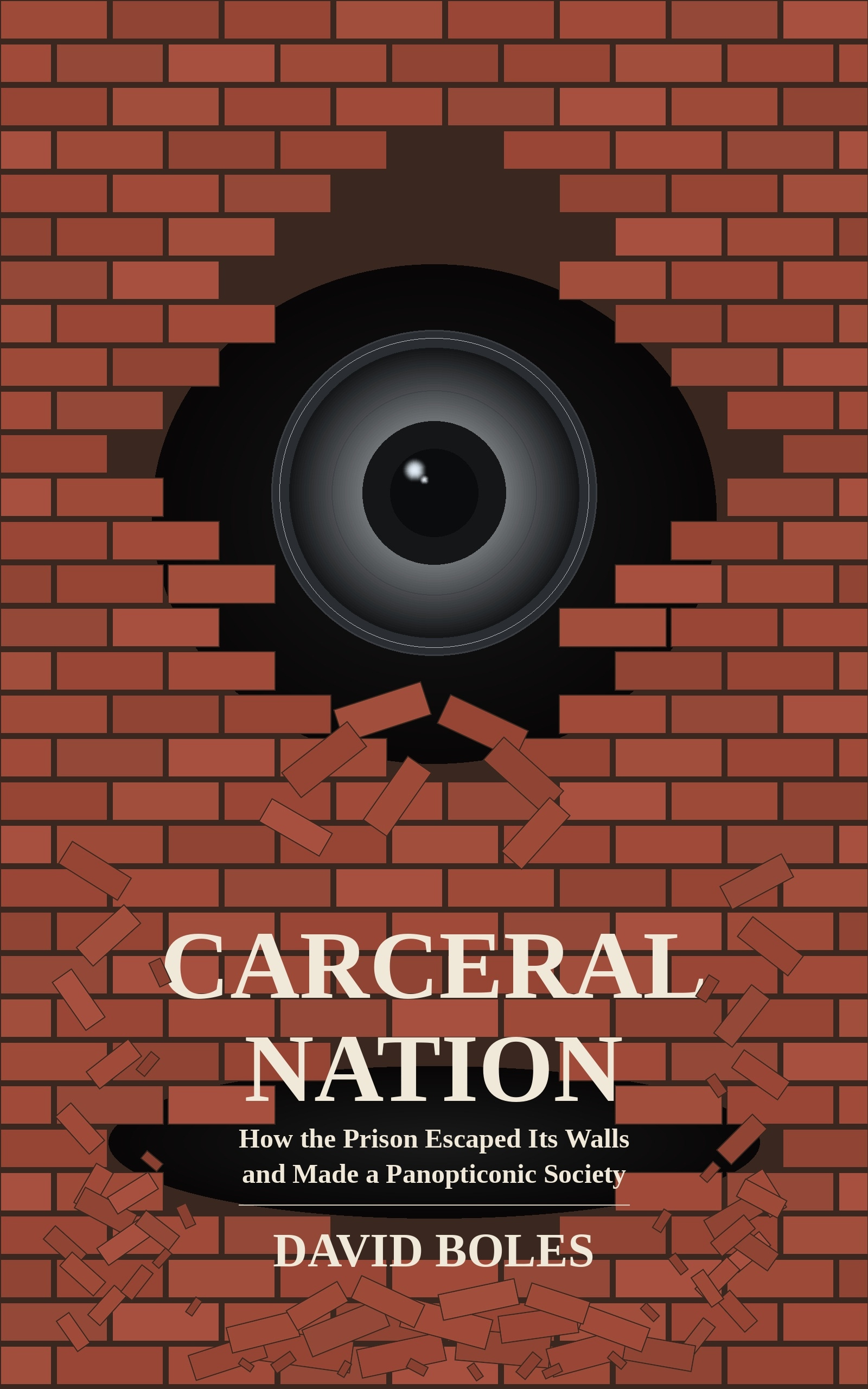
My new book, Carceral Nation: How the Prison Escaped Its Walls and Made a Panopticonic Society, traces three centuries of surveillance logic in America, from colonial lantern laws to the Ring doorbell. The argument spans cities and suburbs and federal agencies and Silicon Valley boardrooms. But the chapters I kept returning to during three years of research were the ones that touched ground in places Prairie Voice readers already know: counties where the correctional facility is the largest employer, where sheriff’s departments operate technology that would have required a federal warrant ten years ago, and where the line between public safety and population control has become difficult to locate.
The infrastructure arrived quietly. Flock Safety, the automated license plate recognition company, now operates in more than 5,000 communities across the United States. Many of them are rural. The company’s pitch to small-town police chiefs and county sheriffs is calibrated precisely to their budgets and their anxieties: low monthly cost, no upfront capital, cameras that photograph every vehicle on a given road and build a searchable database of movements over time. A two-lane county highway in central Texas or western Kansas can now generate the same kind of vehicle-tracking data that once required a dedicated surveillance team in a major metropolitan area. The cameras look like utility boxes. Most residents never notice them.
Senator Ron Wyden’s office has documented that Flock granted data access to federal agencies including Immigration and Customs Enforcement. In agricultural counties where the workforce includes significant numbers of undocumented laborers, this creates a specific and measurable consequence: the same camera that the sheriff’s office installed to catch cattle thieves also feeds a database that ICE can query to track the movements of the people who milk the cattle, harvest the crops, and process the meat. The infrastructure does not distinguish between its purposes. It collects everything and lets the queries sort it out.
This is the pattern Carceral Nation describes at the national level, and it carries particular weight in communities that have already organized their economies around incarceration. When a town of four thousand people hosts a state correctional facility employing six hundred, the logic of confinement does not stay behind the fence. It shapes the town’s relationship to authority, to outsiders, to the foundational concept of who belongs and who does not. Correctional culture leaks. Guards bring home the hypervigilance that the job demands. Municipal codes tighten. Zoning meetings become conversations about control. The prison’s gaze, the habit of watching and sorting and categorizing, becomes part of the civic vocabulary.
Rural schools have followed the same trajectory. The Bipartisan Safer Communities Act of 2022 directed federal funds toward school safety measures, and districts across the Great Plains used that money to install camera systems, access-control doors, and in some cases facial recognition software. The National Center for Education Statistics reported in 2024 that 91 percent of public schools used security cameras, up from 61 percent in 2009. In a one-school town, the surveillance system that watches students during the day watches the parking lot, the athletic fields, and the surrounding streets around the clock. The school becomes a surveillance node for the entire community through the simple physics of a camera that never turns off.
The book argues that this accumulation of watching infrastructure changes the interior life of the people who live within it. Academic research supports the claim. Studies published in the Journal of Communication, the Columbia Law Review, and by the Pew Research Center have documented measurable chilling effects: people who believe they are under surveillance modify their speech, their search behavior, their willingness to attend political gatherings, and their tolerance for dissent. The modification is pre-emptive. It happens before any authority acts, before any law is cited, before any consequence is imposed. The watched citizen disciplines herself.
Prairie Voice readers will recognize this pattern in a form the academic literature does not often name. Rural self-censorship predates the camera. Small towns have always exerted a kind of social surveillance through proximity, gossip, and the economic leverage that comes from everyone depending on the same few employers. What the new infrastructure adds is scale, permanence, and institutional memory. A neighbor who noticed you drove past the bar at midnight will forget by Thursday. A Flock camera that logged your plate will retain the record for a year, two years, indefinitely, depending on the retention policy of the subscribing agency. Gossip networks were analog, local, and perishable. Camera networks are digital, federated, and permanent.
That shift from perishable to permanent observation is one of the central arguments of Carceral Nation. Jeremy Bentham’s panopticon, the eighteenth-century prison design where a single guard could observe every cell, worked because the prisoner could never be certain whether the guard was watching at any given moment. The uncertainty itself produced compliance. In a rural community saturated with license plate readers, school cameras, Ring doorbells, and law enforcement data-sharing agreements, the same uncertainty operates at civic scale. The resident cannot know which cameras are active, which databases retain her movements, which agencies have access, or what queries might be run against the accumulated record of her daily life. Compliance follows from uncertainty, and uncertainty follows from opacity. The architecture of the small-town panopticon is complete.
I wrote this book because the surveillance economy is usually described as an urban and suburban phenomenon, as a story about smartphones and social media and Silicon Valley. The reporting in Carceral Nation demonstrates that rural America is wired into the same infrastructure, often with fewer legal protections, less public scrutiny, and a deeper economic dependency on the institutions doing the watching. The prairie has always been a place where people came to escape observation, to build lives beyond the reach of the state and the judgment of the crowd. That promise is dissolving. The camera on the county road does not care about your reasons for driving past. It only records that you did.
Carceral Nation: How the Prison Escaped Its Walls and Made a Panopticonic Society is available now from David Boles Books in paperback and Kindle editions at BolesBooks.com and Amazon.