

Beneath every forest floor runs a network that prairie people would recognize immediately. Not the visible infrastructure of roads and power lines, but the hidden system that actually moves resources from those who have to those who need. The mycorrhizal network, that web of fungal threads connecting trees into communication systems spanning acres, operates on principles that once governed prairie communities before efficiency became the only value worth measuring.
A single tablespoon of forest soil contains more mycorrhizal threads than there are miles of paved road in Nebraska. These threads carry water, nutrients, and chemical signals between trees that may be hundreds of feet apart. When one tree faces drought stress, neighboring trees send water through the network. When a mother tree is dying, she dumps her stored carbon and nitrogen into the fungal web, feeding her offspring and neighbors in a final act of generosity that foresters now call “legacy transfer.”
This is not metaphor. This is documented science, confirmed by researchers at the University of British Columbia, Oregon State, and dozens of forest ecology labs worldwide. Suzanne Simard, the ecologist whose work first mapped these networks in the 1990s, grew up in a logging family in British Columbia. She saw old-growth forests fall throughout her childhood. When she discovered how those forests actually functioned underground, how the trees she had watched being cut were nodes in communication systems older than any human settlement on the continent, she understood what had been lost in terms that went far beyond board feet of lumber.
The parallels to prairie economic history are not accidental. Before consolidation remade rural America, small towns operated on similar principles of resource sharing and mutual support. The handshake loan that once governed transactions in places like North Loup, Nebraska, or Ord, or Burwell, was not naive trust but recognition that community survival depended on networks of reciprocity that no ledger could fully capture. A farmer who helped a neighbor during harvest could expect help during his own crisis, not through formal contract but through the same informal accounting that trees perform through fungal intermediaries.
The mycorrhizal network has no central bank. It has no clearinghouse that tallies debits and credits. Yet resources flow through it with remarkable efficiency, from trees with excess to trees in deficit, modulated by chemical signals that researchers are only beginning to decode. The old-timers who built prairie communities understood something similar: that healthy economies are not zero-sum competitions but circulation systems where generosity today creates resilience tomorrow.
Industrial forestry treats trees as individual profit centers, optimizing each stand for maximum yield regardless of the underground connections being severed. Industrial agriculture treats farms the same way, and the consolidation that followed has produced the hollowed-out towns that now dot the prairie, places where the only remaining employers are dollar stores and nursing homes. The networks that once sustained these communities have been fragmented, just as logging roads and clearcuts fragment the fungal webs that forests need to survive.
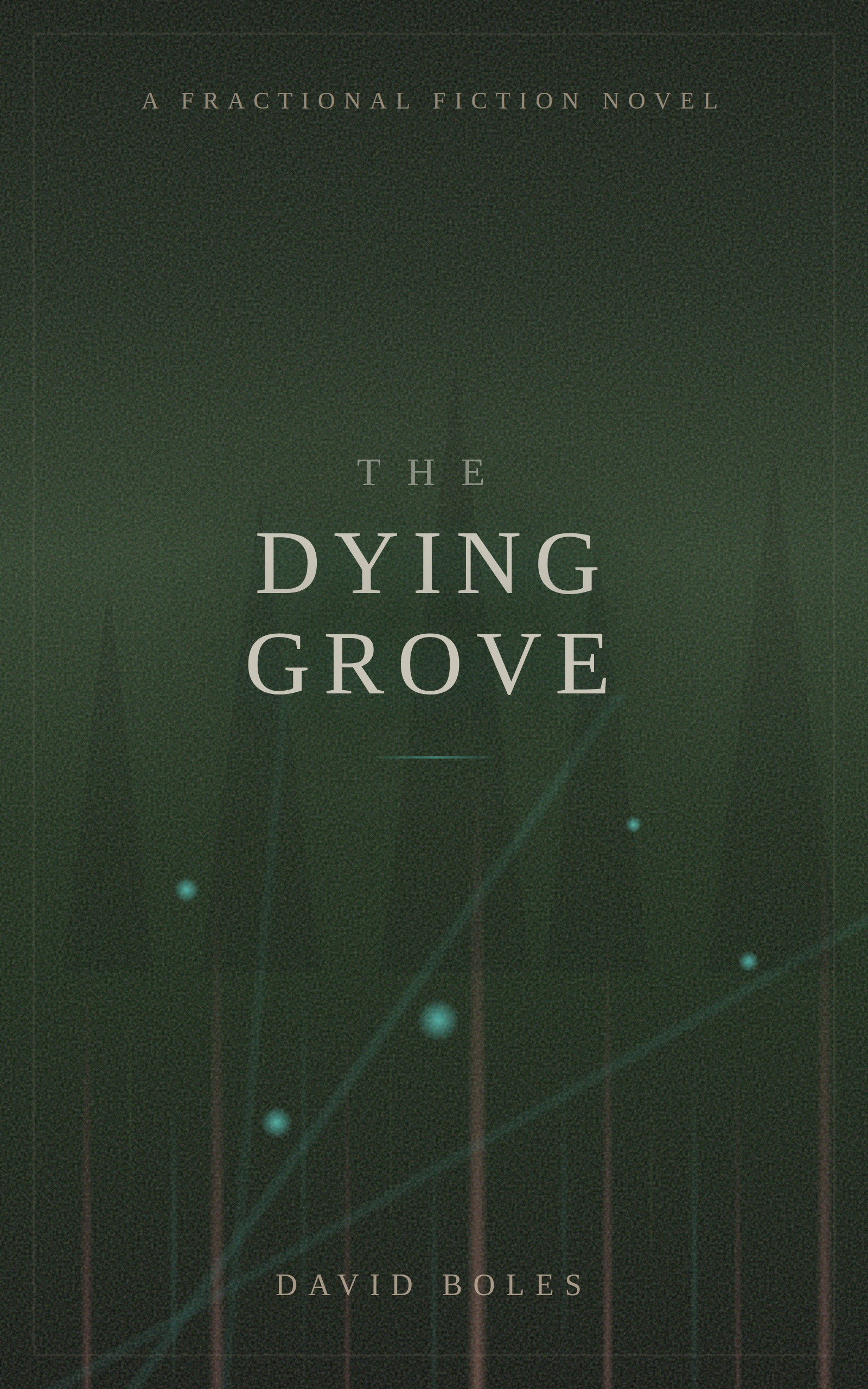
“The Dying Grove” is a novel about a forest network that has been thinking for four thousand years, now facing conditions that threaten its survival. The protagonist, a researcher named Eli Chen, arrives at a Pacific Northwest research station carrying grief he cannot name and questions his scientific training has not equipped him to answer. What he discovers forces him to reconsider everything he thought he knew about consciousness, memory, and the obligations we owe to systems that sustain us.
The book inaugurates a series called Fractional Fiction, which combines public domain literary works with contemporary scientific research to create original narratives. “The Dying Grove” draws on James Joyce’s “Dubliners,” with its anatomy of paralysis and institutional constraint, and on mycorrhizal ecology as documented by Simard and her colleagues. The collision between Joycean form and fungal science produces something neither source could generate alone: a story about what happens when an ancient network encounters threats it never evolved to handle, and what one human must become to preserve any part of what it knows.
Prairie Voice readers will recognize the underlying concerns. The hidden systems that sustain communities. The invisible infrastructure that collapses when profit becomes the only measure of value. The wisdom held in networks that operate on timescales longer than quarterly earnings reports or election cycles. The forest in “The Dying Grove” faces the same pressures that have remade rural America over the past half century: fragmentation, extraction, the prioritization of short-term yield over long-term resilience.
The mycorrhizal research suggests that forests are not collections of individual trees competing for resources but something closer to superorganisms, distributed networks capable of memory and response across scales that dwarf individual lifespans. The mother trees that Simard documented, hub trees connected to hundreds of neighbors through fungal threads, function as repositories of accumulated knowledge about their specific environment: which soil conditions favor which species, where water can be found during drought, how to respond to pest outbreaks the network has survived before.
When a mother tree is cut, that knowledge does not transfer cleanly to the next generation. The network fragments. The accumulated wisdom of centuries dissipates into chemical noise. This is what happens to communities when the institutions that held collective memory are allowed to fail: the church that kept records of births and deaths, the newspaper that documented local history, the general store where old-timers gathered to tell stories that preserved knowledge no textbook contained.
“The Dying Grove” does not offer solutions. Prairie Voice does not traffic in easy answers. But the novel holds open a question that seems worth asking: what do we owe to the systems that sustain us? The mycorrhizal network does not ask this question. It simply continues doing what it has done for millions of years, moving resources from abundance to scarcity, storing memory in chemical gradients that persist across generations. The asking is our burden, and perhaps our opportunity.
The network beneath the forest floor has been there since before the first humans crossed the land bridge into North America. It will likely be there after we are gone, in some form, adapted to whatever conditions we leave behind. But the specific networks that have been thinking in specific places for thousands of years, the ancient systems that remember ice ages and volcanic eruptions and the slow return of conditions favorable to growth, those networks are dying now, fragmented by development and stressed by climate change into conditions they never evolved to handle.
Eli Chen, in the novel, must decide what he is willing to sacrifice to preserve any part of what the dying network knows. The choice is not clean. It requires transformation, loss, the acceptance that some forms of preservation demand the surrender of what we were. Prairie communities have faced similar choices, and most have chosen surrender, accepting the loss of local institutions and local knowledge in exchange for the conveniences that consolidation provides.
But some have not. Some towns still maintain the mutual aid networks that once defined rural life. Some farmers still practice the crop rotations and soil stewardship that regenerate rather than extract. Some communities still remember that an economy is not a collection of individual profit centers but a circulation system whose health depends on flows that cannot be captured on balance sheets.
“The Dying Grove” is fiction. The forests it describes are imagined. But the science is real, and the questions it raises have implications that extend far beyond any single novel or any single ecosystem. What the land remembers when America forgets: this is the promise Prairie Voice makes to its readers. The underground prairie, that network of mutual support and accumulated wisdom that once sustained communities across the grasslands, has much to teach us about what we are losing and what might yet be preserved.
The novel is available now through David Boles Books. The series will continue with additional Fractional Fiction titles, each built from the same methodology of collision and synthesis. For readers who have followed Prairie Voice’s examination of hidden systems and invisible infrastructure, “The Dying Grove” offers a different angle on familiar concerns: the same questions asked not through journalism but through narrative, not through documentation but through imagination disciplined by research.
The trees have been talking to each other for millions of years. The question is whether we are willing to learn their language before they fall silent.