

A teacher at Hampton kept reading the Bible in German after Nebraska made the language a crime. A new book sets that small refusal inside the long history of the coerced word.
On a spring morning in 1920, in a one-room schoolhouse at Hampton, in Hamilton County, a teacher named Robert Meyer stood over a ten-year-old boy named Raymond Parpart and listened to him read a Bible story aloud in German. The Hamilton County attorney opened the door, heard the language, and charged the teacher with a crime. The crime was the German.
A year earlier the Nebraska legislature had passed a law that most people on the plains have since forgotten. It was called the Siman Act, approved in April of 1919, and its first section left no room to move. No person, it read, individually or as a teacher, shall, in any private, denominational, parochial or public school, teach any subject to any person in any language other than the English language. Below the eighth grade, the mother tongue was contraband. Nebraska was one of more than thirty states that wrote such laws in those years, and its statute became the one the Supreme Court would later choose to test.
The law was a child of the Great War. After 1917 the German that had filled Nebraska kitchens, pulpits, and newspapers turned into a mark of suspicion. Local committees and the state council of defense pressed German speakers to show their loyalty in public, in English, through bond drives and pledges and the quiet retirement of the old tongue. Churches that had prayed in German for two generations switched to English between one Sunday and the next. Families shortened and flattened their own surnames so the names would read as American on a mailbox. The language went indoors. It survived at the kitchen table and the graveside and in the low talk between grandparents and children, which is where a language goes when the street has been closed to it.
Meyer was tried, convicted, and fined twenty-five dollars, and he refused to pay. He carried the case to the Nebraska Supreme Court, which upheld the law and his conviction by a vote of four to two. The majority worried aloud about the baneful effects of letting immigrants raise their children in a foreign tongue, and the dissent answered that the statute was the work of crowd psychology. Meyer went on to the Supreme Court of the United States, and in June of 1923, in Meyer against Nebraska, the Court reversed his conviction and struck the law down. A state could not forbid a teacher to teach a language, the justices held, without invading a liberty the Constitution protects. Nebraska, almost by accident, had produced one of the first rulings in which the highest court drew a fence around the private life of a family and ordered the state to stay outside it.
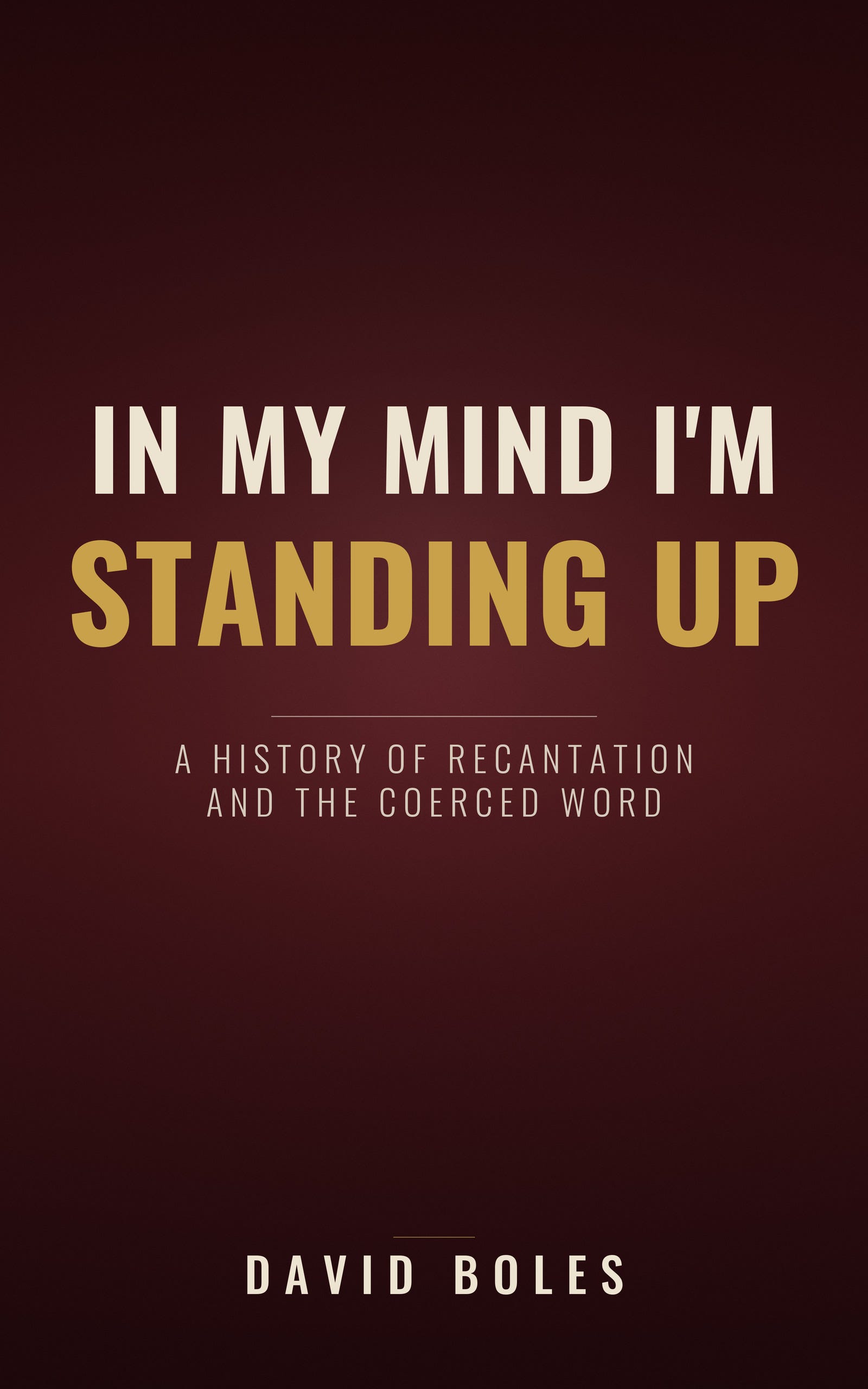
I have been thinking about that schoolhouse while finishing a book that has nothing to do with Nebraska and everything to do with what happened there. The book is called In My Mind I’m Standing Up, and its subject is recantation, the coerced word, the public taking back or putting away of a belief by a person who has been given no real choice. The verb recant carries an old music inside it. It comes from the Latin for singing again, and the act it names is a song performed backward, on command, in front of the people who demanded it. A confession written by someone else. An oath of loyalty sworn in a borrowed language. The mother tongue set down in daylight and picked up again after dark.
The book follows that act across more than four centuries and several civilizations. Galileo kneels before the Roman Inquisition and swears the earth stands still. Thomas Cranmer signs away his faith to save his life and then, at the fire, holds the signing hand into the flame first. Nikolai Bukharin confesses in a Moscow courtroom to crimes he never committed. Screenwriters in Hollywood buy back the right to work with the names of their friends. What the prairie adds to that record is its own quiet chapter. A German farmer who anglicized his name at the bank and then read scripture to his children that night in the old language was doing the thing the book is about. His public word bent while his inner word kept its feet. He was, in the phrase the book takes for its title, sitting down on the outside and standing up on the inside.
The coerced word keeps coming back. On the plains it has returned in every generation that lost its nerve, in the loyalty oath, in the school board that polices what a teacher may say, in the public apology staged for a crowd that has gathered to watch a person unsay himself. The book argues, and I think the prairie proves, that a community which prizes the performance of conformity over the substance of belief has already traded away something it will miss. A forced word tells you only what force can produce. It tells you nothing about what a person holds when the door is shut and the county attorney has driven home.
That is the wager of the book, and it is a prairie wager at heart. It sides with the teacher who would not pay the fine, with the grandmother who kept the language alive in a back room, with everyone who has ever said the required thing aloud and held the truth in reserve. In My Mind I’m Standing Up: A History of Recantation and the Coerced Word is available now through David Boles Books, at BolesBooks.com. Read it the way the prairie has always kept its own counsel, with the public face composed and the inner ground unsurrendered.