

On the eighteenth of August of 2026, a Tuesday, I was at my desk in Manhattan when the telephone went to speaker, and the voice that came out of it belonged to Russ, calling from North Loup, where it had been raining for days and was raining still. He called with the news a family dreads most, and he delivered it the way the plains deliver such news, first, plainly, and before anything else. Then came the inventory, in the flat voice the plains keep for damage. Trees down across the county. The grain silo at North Loup wrecked, in the week when every bin and elevator in the valley mattered, because the crop was coming and it had to go somewhere. More than a hundred poles down along the line from Arcadia. Thirty-four consecutive poles on one county road, snapped at ground level and thrown across into the lines and trees on the other side. Nathan leaned toward the speaker to add the day’s measure: four inches of rain at North Loup, and still raining.
Four inches is a season’s worth in some country. In the valley it was a Tuesday.
And Popcorn Days had gone on anyway. The festival is the town’s own, running since 1901, and this was its 125th year, held on its dates among the storm ruins, the streets cleared enough to walk and the damage piled past the curbs. A small town insisting on its own celebration with the evidence of the week standing at the edge of it. The celebration closed Sunday night. The Monday storm followed it by a day.
That call is where the book begins, because the call is where the book began. I have a new book out this week, and I want to tell you about it the way things get told here, from the ground up.
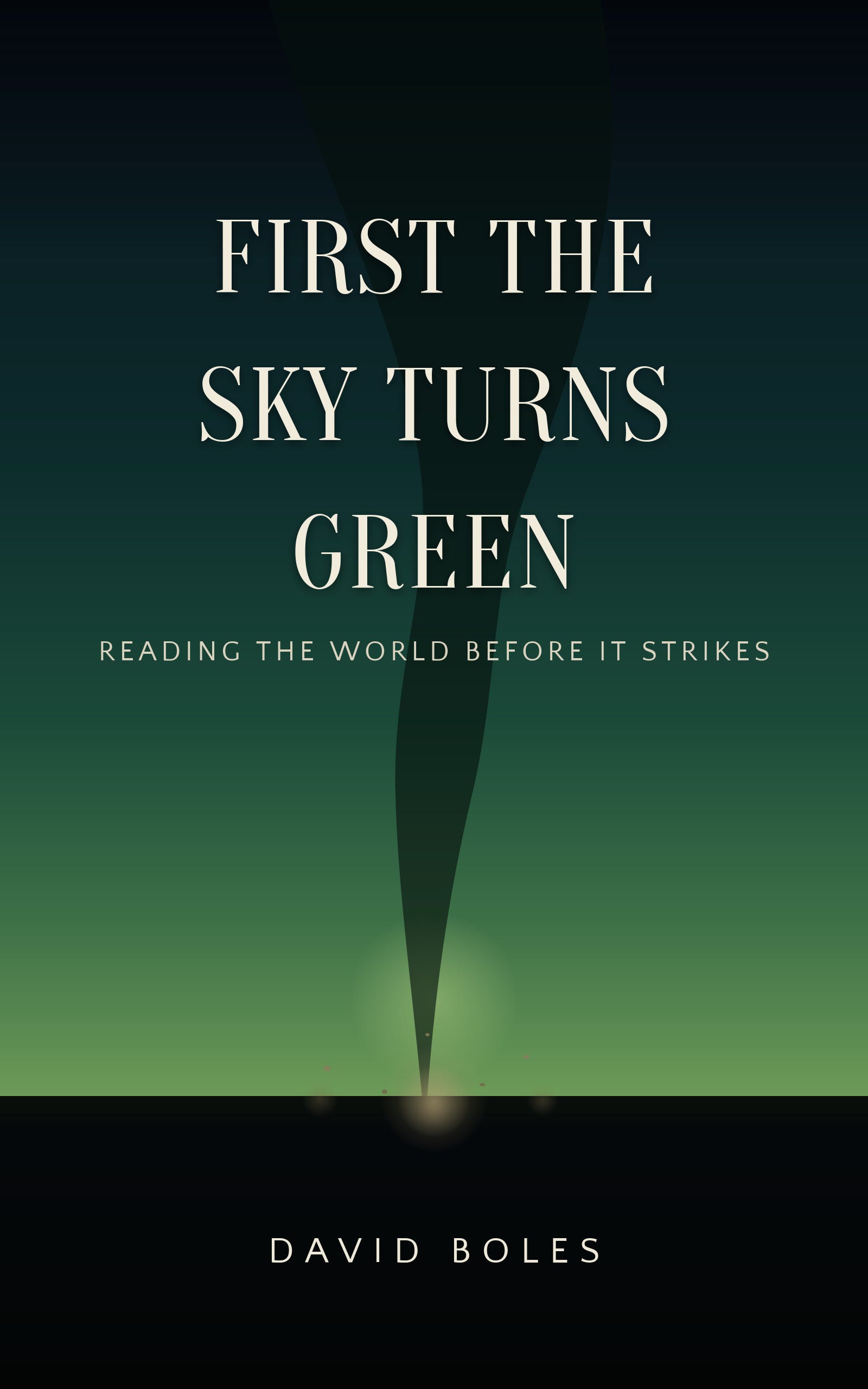
The book is called First the Sky Turns Green: Reading the World Before It Strikes, and it is about the oldest thing we do. Before humanity read letters, it read the world: the color of the sky, the grain of the wind, the temper of the season. It survived by the quality of its reading. A read, in the book’s working definition, is a prediction from partial signal under time pressure, and it differs from a guess because its priors were trained by consequence, and from superstition because its priors get corrected. The world grades the read. That is the whole arrangement, and it is older than writing.
I know the arrangement’s home address. The child at the porch in the first chapter, the one being handed an alphabet nobody called an alphabet, is me. The letters were color. Rain reads green across the horizon. Hail reads grey with streaks of blue. A thunderstorm reads a wicked, flashing black. There was no book and no chart and no lesson plan, because the teaching was older than the words for it. The prediction got spoken aloud, and then the weather arrived to grade the child in front of everyone. The plains sky is an exposed page, and a person standing in a field under it is the tallest object in the field. You learn early what the expensive letters cost.
I did not know, for most of my life, that what I learned at that window had a name. It does now, and the book walks the name through its native grounds, one room at a time, because the rooms are where the literacy lives. A lifeguard on a July beach, reading the four signs of the rip, knowing that the loveliest water on the beach is the mouth. A fire lieutenant who orders his crew out of an ordinary house fire a minute before the floor collapses into the basement, and cannot say why. A tracker on a dirt cutline at dawn, reading the ground the way you read a newspaper, print by print, because hurrying is how the eye starts skipping the line. A nurse passing a doorway at three in the morning, and then not passing it. A bouncer who has been still for an hour, and then gets down off his stool. The book calls them the unlicensed clerisy: the people who read the world for a living, whose knowledge does not credential, does not certify, and therefore does not price.
Then the book turns, because the world it was describing is being retired. We have built machines to read for us: the forecast app, the backup camera, the monitor over the bed. The gains are real, and the book prints them in full before it counts the costs, because a book that hides the gains is a pamphlet. But every readout retires a literacy, and the retirement is always silent. An engineer named Lisanne Bainbridge saw the shape of it in 1983: the system automates the readable work, deskills the watcher, and hands its worst moments, cold, to the person it has been deskilling all along. If you want to know why the book matters now, that sentence is why.
There is a chapter I will only point at. July 16, 1999. A small aircraft over the water off Martha’s Vineyard, at night, in haze, the horizon erased. The body’s instruments are lying, confidently, the way they were built to, and the panel is telling the truth. The ruling of that chapter is the ruling of the whole third movement: calibration, never nostalgia. The book is not against the instruments. It is against forgetting what the instruments cost.
And then it comes home. The last movement is the recovery, and the recovery is a kitchen window in the Loup River valley, a child, an adult, and a lesson one sentence long: look up, and say what you see out loud. Exposure, prediction, verdict, thousands of times. The window is the oldest classroom, and it is still open, and any household can run it. The book ends where it began, on the alley and the green horizon, because the world goes on writing, and the first word of the next sentence is already on the page.
I have published more than fifty books since 1975, and I will tell you plainly what makes this one different. Most of my books argue with the century. This one argues with the weather, and the weather was my family. The family’s testimony is printed as it was told, set beside the dated federal record, and the two are never corrected into each other, because the layers are the honesty. The death the call carried is never named. The week of the storms was also the week of the funeral, and the valley did both at once, the way the wire has always carried them at once.
The book is out now, as a Kindle eBook and a cream-paper paperback, three hundred and nineteen pages, with a real index mapped to the real pages. The audiobook is in preparation, with a companion for the narrator, because a voice carrying this book deserves to know where the ground is. All of it lives at bolesbooks.com.
The storm week is a year of cleanup behind the valley now. The silo is a photograph. The poles are back in the ground, thirty-four of them in a row on one county road, holding the line over the ditch. And the sky over the horizon is doing the thing it has done since before anyone alive was born, which is the point of the book and the reason for the window. It will rain again over North Loup. Somebody’s child will see the color first.
David Boles is the author of First the Sky Turns Green: Reading the World Before It Strikes, published by David Boles Books Writing & Publishing, New York City. He is a native of the Loup River valley.