

Abraham Lincoln signed two documents in 1862 that shaped rural America more than almost any others. The Homestead Act distributed continental land to settlers willing to live on it. The Morrill Act of the same year created the land-grant universities that became the agricultural and scientific infrastructure of the Great Plains. Lincoln was assassinated before he could see what those documents became. The town named for him in eastern Nebraska Territory, platted in 1867, became the capital of a state that would spend the next century and a half working out what a federal instrument of rural support could do when the instrument was taken seriously.
In 1954, at the University of Nebraska in Lincoln, Jack McBride built something called Nebraska Educational Television. It signed on as a single-channel station that could reach roughly one county with a clear picture. Thirty years later, NETV was a statewide network of transmitters, a full-service public broadcasting organization producing nationally distributed programs, and under Ron Hull’s production leadership, one of the most ambitious state-network production operations anywhere outside the coastal flagships. NETV produced segments for Great Performances, contributions to American Experience, and the national poetry anthology series Anyone for Tennyson?, directed by Marshall Jamison. A state network in a sparsely populated plains state was producing national culture for public distribution. That is what the federation made possible.
The federation was the instrument. A thousand locally licensed stations, federated through the Corporation for Public Broadcasting since its 1967 authorization under the Public Broadcasting Act, produced and shared programs across state lines under a non-commercial license regime that no other television system in American history has replicated. The design was specific. Federal distribution, local origination, national sharing. The architecture made it possible for a station in Lincoln, Nebraska to produce for audiences in Boston and Los Angeles and San Antonio on the same terms as stations originating from those cities.
Underwritten: The American Experiment in Public Broadcasting, 1967 to 2026, published this month by David Boles Books, is the first full institutional history of that federation, from the November 7, 1967 signing of the Public Broadcasting Act in the East Room of the Johnson White House through the January 30, 2026 filing of the Corporation for Public Broadcasting’s Articles of Dissolution with the District of Columbia. Fifteen chapters. Five appendices. A bibliography. One chapter, titled “The Heartland Node: NETV and the Production of National Culture from Lincoln, Nebraska,” is given over entirely to Nebraska Educational Television as a case study in what federation allowed a rural state network to do.
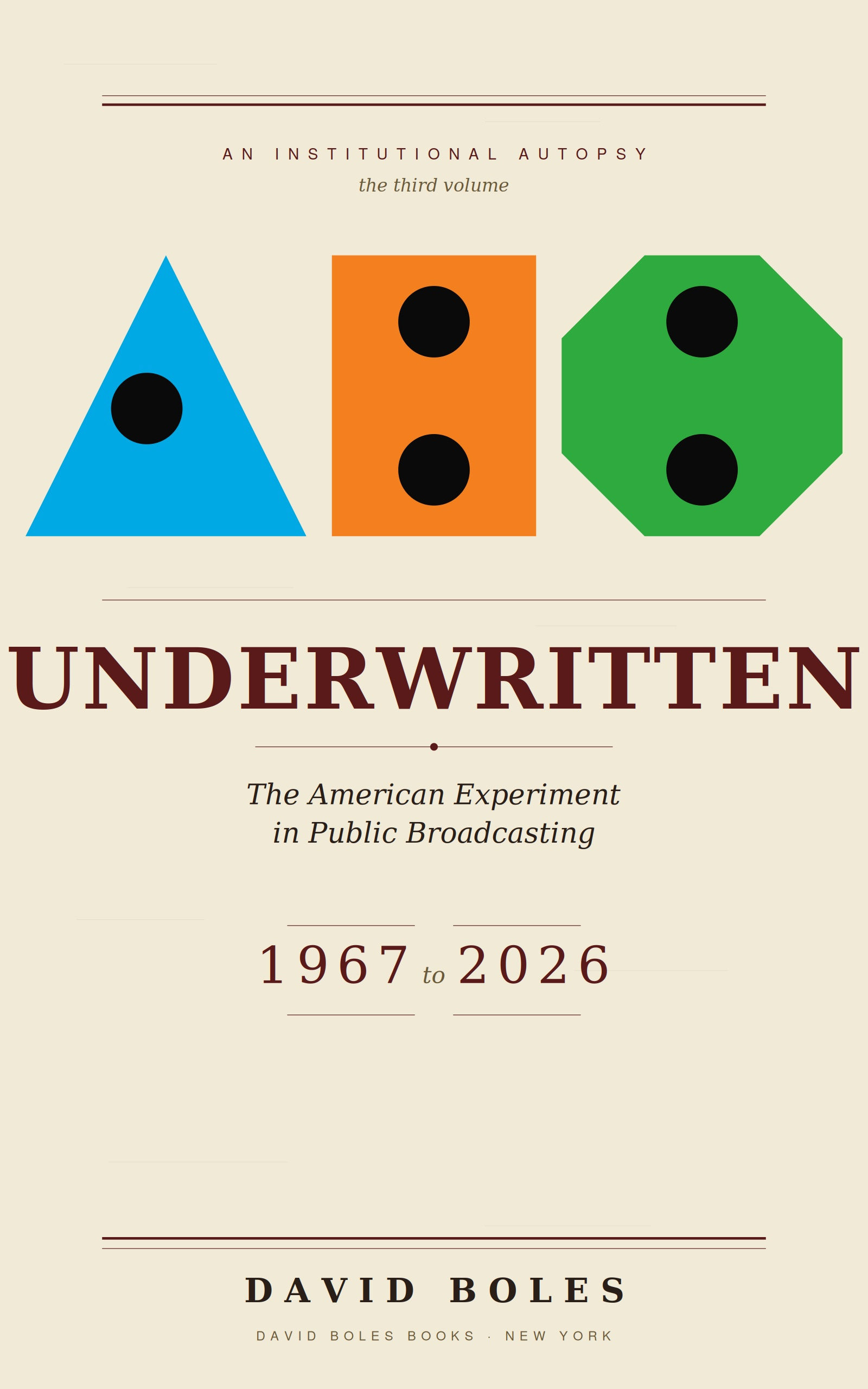
The book has a particular argument for rural readers. Public broadcasting, more than any other federal cultural program in the American twentieth century, did for communication what the Homestead Act did for land. It distributed a capacity that rural communities could never have built alone. State networks reached counties where commercial television offered three stations and an FM radio dial dominated by agricultural commodity reports. PBS and NPR carried programs that rural audiences had no other way of receiving: classical music, serious documentary, long-form interview, state-specific public-affairs coverage, children’s educational programming free of commercial content. The federation’s non-commercial license structure meant that a rural listener in Sheridan County, Nebraska, could hear the same All Things Considered broadcast as a listener in Manhattan. No commercial system has ever delivered that parity.
The federation also carried the Emergency Alert System across rural and tribal geographies where commercial coverage was thin or absent. A weather warning out of Boise or a wildfire evacuation notice out of Denver reached listeners in small towns across the Mountain West through chains of public-station retransmissions coordinated through the federation’s infrastructure. When the federation dissolved, those chains broke. Most public stations continue to broadcast under new funding arrangements. The coordinated federal-state-local mesh that pushed an emergency alert across a rural county in under two minutes no longer exists in the architecture it once did.
The dissolution hits rural America asymmetrically. Coastal flagship stations (WGBH in Boston, WNET in New York, WETA in Washington, KCET in Los Angeles) have large foundation endowments and major-market individual-giving bases sufficient to continue operations, in reduced form, through the transition. State networks and mid-market community stations serving sparsely populated regions lack those bases. The CPB appropriation that kept those stations on the air was often the difference between functioning and signing off. When that appropriation ended with the Rescissions Act of 2025, the rural stations were the first to feel the pressure. Some will continue through state appropriations and local foundations. Some will not. The federation’s erasure takes out the middle rungs of the system, leaving the flagships at one end and the locally improvised survivors at the other, with the state-network production tier that originated work like Anyone for Tennyson? largely gone.
Underwritten examines the architecture of the federation from the signing to the dissolution. Nebraska ETV is one of its most developed case studies, and rural service is the subject of a dedicated chapter. The book traces what the federation produced, how it was starved across five decades of political campaigns, why the sixth campaign succeeded when the five before it did not, and what survives in the post-dissolution landscape. Readers who remember the specific sound of a public station sign-off in a small town, or the specific sight of a state-network logo on a Sunday night cultural program, will recognize what the book is describing. So will readers who never had any other way to hear a symphony or see a documentary produced from inside the Great Plains.
The book is available in Kindle and paperback on Amazon, and for free direct download from BolesBooks.com. It is the third volume in the Institutional Autopsy sequence, following Carceral Nation and The Claimed Body.
Lincoln signed the Homestead Act in 1862. The town that took his name in 1867 built a television station in 1954. That station has broadcast for more than seventy years. The federation that made the broadcasting possible ended this year. Broadcasts continue under new funding. The federation is not coming back.