

The National Endowment for the Arts reported in its most recent Survey of Public Participation in the Arts that approximately 57,000 community theatres operate across the United States, the majority of them in towns under 50,000 population. The American Association of Community Theatre estimates that these organizations collectively generate over $1 billion in economic activity annually and draw more than 86 million audience attendees per year, a figure that exceeds the combined attendance of every Broadway show, every professional regional theatre, and every touring production in the country. Community theatre, by the raw numbers, is the dominant form of live theatrical production in America. It is also the form in which virtually no performer is paid.
The economics of this arrangement have been hiding in plain sight since the community theatre movement formalized itself in the early twentieth century. Performers donate their evenings, their weekends, their gasoline, their shoe polish, their cold cream. They arrive after work for rehearsals that run three hours a night, five nights a week, for six to eight weeks. They memorize lines on their lunch breaks. They build sets in garages on Saturday mornings. They supply their own character shoes. The compensation they receive for this labor is applause and, on good nights, a standing ovation.
The musicians in the pit, however, receive checks.
This fact is not controversial. It is not hidden. Ask anyone who has participated in community theatre in any American town, from Omaha to Broken Bow to North Platte, and they will confirm the arrangement without hesitation. The American Federation of Musicians has maintained minimum pay scales for community theatre orchestras since the mid-twentieth century. Even in communities where no other union contract touches the production, the musicians are paid. The lighting crew may volunteer. The costume shop may volunteer. The actors certainly volunteer. But the musicians are professionals, and professionals get money.
The question that nobody asks, or rather the question that everyone inside the system knows the answer to and declines to speak aloud, is why the musicians are the ones who get paid. The standard explanation is practical: musicians will not play for free, they have skills that are transferable to paying gigs, and if you do not pay them they simply will not show up. This explanation is accurate. It is also incomplete in a way that conceals the most important thing about it.
The musicians are paid because they are the ones who produce the standing ovation.
Not the actors. Not the director. Not the playwright. The musicians. Specifically, the orchestrator who arranged the curtain-call music, and the conductor who delivers it at the precise tempo and volume required to trigger a collective physiological response in the audience that the performance itself did not earn.
This mechanism has a history, and the history reaches back considerably further than the community playhouses of the Great Plains.
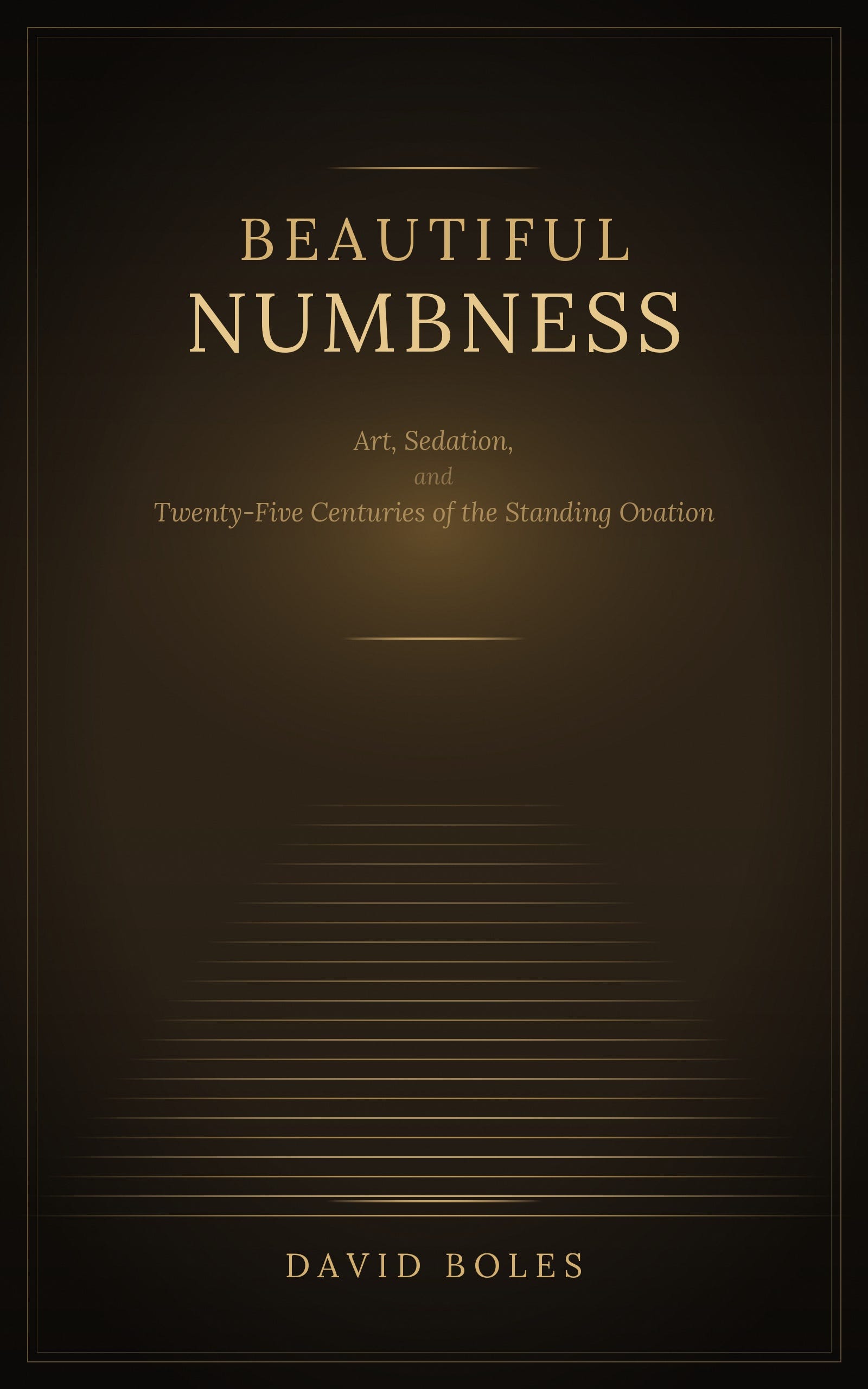
My new book, Beautiful Numbness: Art, Sedation, and Twenty-Five Centuries of the Standing Ovation, traces the economics of this arrangement from the Theatre of Dionysus in fifth-century Athens to the infinite scroll on the phone in your pocket. The argument is specific and evidenced. Institutional art in the Western tradition, art produced and distributed through the apparatus of state, church, patronage, market, and academy, has functioned primarily as a sedative: an analgesic for the pain of consciousness that keeps the patient still while the conditions producing the pain remain untouched. The beauty is real. The catharsis is real. The function is pharmacy.
The book opens not in Athens but in North Loup, Nebraska.
North Loup sits in the Loup Valley, a small village that counted roughly 300 residents during the Great Depression. Bill Vodehnal ran the pharmacy. His patients could not pay with money because they did not have money, so they paid with chickens, wedding rings, and nuggets of panned gold from the creek. He accepted all of it because refusing meant letting neighbors die. He held that community together by dispensing what was needed, in the dosage it could tolerate, and taking payment in the only tender available.
Bill Vodehnal was my grandfather. I grew up in community theatre in a town much like North Loup, where the playhouse served a function that resembled the pharmacy more closely than anyone at the time would have admitted. The community gathered. The community was administered an emotional experience calibrated to produce specific feelings at specific moments. The community left feeling better. The conditions that made them need to feel better, the economic precarity, the social isolation, the quiet desperation of small-town life that Thoreau diagnosed a century and a half ago, remained precisely where they were.
The parallel to other hidden systems that Prairie Voice has documented is structural rather than metaphorical. The rendering plant network processes the dead animals that industrial agriculture cannot acknowledge in public. The data centers buried in prairie towns process the information that the digital economy cannot store in cities. The missile silos standing in wheat fields process the nuclear deterrent that the defense establishment cannot position near population centers.
In each case, the prairie absorbs an essential function that the larger system needs performed but does not wish to examine too closely. Community theatre operates on the same principle. It processes the emotional surplus that consumer capitalism generates and cannot manage through economic means alone. The audience arrives anxious, isolated, fatigued. The audience leaves temporarily relieved. The mechanism that produces the relief is invisible to the audience, hidden in the orchestra pit, encoded in the arrangement of notes on paper, administered by paid technicians whose compensation is the system’s quiet acknowledgment of where the real value lies.
The larger community theatres, as I share in the book, eventually began paying actors too. Not because the system recognized the value of their labor, but because the importation of professional actors from major cities created a two-tier workforce that threatened to destabilize the institution. The solution was to pay everyone something. Not enough to constitute a wage. Just enough to quiet the complaint. Just enough, in the pharmaceutical language the book develops, to medicate the resentment. The community theatre, an institution devoted to the production of aesthetic sedation, applied the same technique to its own internal labor dispute.
The pattern recurs at every scale the book examines. Aristotle prescribed catharsis as a technology for managing the dangerous emotions that Plato wanted to suppress by expelling the poets from the ideal city. The Roman arena managed the emotional life of an empire through spectacle. The medieval church administered the aesthetic experience of the divine as a technology of political obedience. The Medici weaponized beauty. Opera was invented specifically to replicate the emotional control the ancients were believed to have exercised. Kant told the audience that the proper response to beauty was disinterested contemplation, free of desire and moral urgency, and called this absence of agency freedom. Television eliminated the last intervals between doses. The smartphone perfected the delivery system.
But the prairie connection is not incidental to the argument. It is foundational. The grandfather’s pharmacy in North Loup is not a framing device. It is the thesis in its smallest and most honest form. A community is in pain. The pharmacist has what the community needs. The pharmacist dispenses it. The community pays in whatever currency is available. The pharmacist does not ask whether the analgesic cures the disease. The pharmacist knows it does not. The pharmacist dispenses it anyway, because the patient is in pain now and the cure, if it exists, is not available now.
Every community playhouse on the Great Plains operates on this principle. Every church choir. Every Fourth of July pageant, every Christmas concert, every high school production of Oklahoma! in every auditorium in every town where the wind does not stop and the soil makes promises it cannot always keep. These are not entertainments. They are prescriptions. They are the cultural analgesic that manages the pain of rural existence in a country that has spent eighty years systematically defunding, consolidating, and abandoning the communities where that existence takes place.
The standing ovation is the receipt. It is the only evidence that the transaction between stage and audience has been completed. In the economy of amateur performance, it is what a chicken or a wedding ring was in Vodehnal’s pharmacy: the only tender available.
Beautiful Numbness is the first book to name this system for what it is, and it names it from the inside, written by a man who spent more than fifty years operating the apparatus he now describes. It is available as a Kindle ebook and paperback through Amazon, and as a free PDF download from BolesBooks.com for those who like to try before they buy.
The pharmacy is still open. The bell still rings. The question the book asks is whether the patients might benefit from reading the label on the bottle before they take the next dose.