

Before there was a single fiddler on the Great Plains, there was the wind. It was the first instrument anyone ever heard out there, the one that never stopped playing, the one that tuned itself against sod walls and barbed wire and the open throats of empty canyons. The wind was teacher and tormentor both, and every note of music that ever rose from the grasslands had to compete with it or surrender to it. The fact that people tried at all tells you something essential about the human need to make organized sound in the middle of organized silence.
The fiddle arrived first. It came west in saddlebags and wagon boxes, tucked between flour sacks and ammunition, because it was small and light and could fill a room or a clearing or a stretch of open prairie with more sound than its size had any right to produce. The Encyclopedia of the Great Plains records that the fiddle probably entered the region with the Lewis and Clark expedition, which employed two fiddlers whose playing maintained morale among the men and helped establish relations with the Indigenous peoples they encountered. In the nineteenth century, the instrument earned the title “the royal instrument of the frontier,” and that was not flattery but fact. Where crowds gathered on the Plains, whether at political rallies, militia musters, housewarmings, barn raisings, or the fiddle contests that became a frontier institution, the fiddler was present and indispensable.
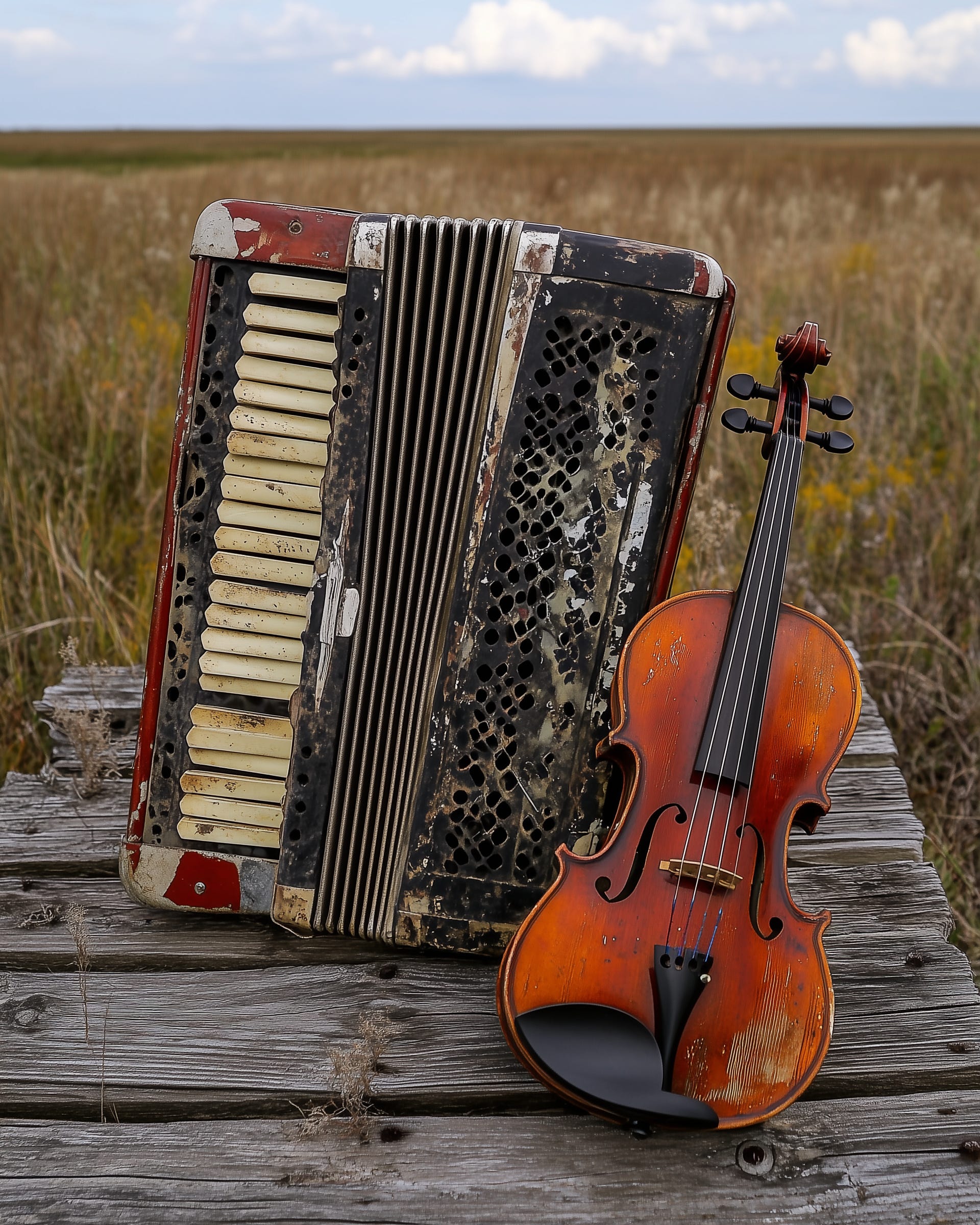
On the great cattle ranches of West Texas, people would ride fifty miles if word spread that a fiddler had been found and a dance was scheduled. The furniture would be dragged from the largest room in the house, and the dancing would last until dawn. In the Oklahoma and Texas Panhandles, in western Kansas and eastern Colorado and across the Nebraska prairies, settlers built wooden platforms for dancing, sometimes for a single occasion like the Fourth of July, after which the lumber was pulled up and repurposed for a barn floor or the planking of a sod house. These platform dances were the precursors to the barn dance tradition that would eventually migrate onto radio, beginning with WBAP in Fort Worth in 1923 and then WLS in Chicago in 1924 with the National Barn Dance, a program of old-time fiddling that set the template for what we now call country music.
The fiddle was democratic in ways that mattered on the Plains. It did not require a church or a concert hall. It required no electricity, no accompanist, no sheet music if the player had a good ear and a strong memory. The Scottish and Irish fur traders who moved through the Canadian Plains in the early 1800s introduced fiddle music to the Métis communities, where it merged with Indigenous musical sensibilities to create something entirely new: a hybrid form characterized by irregular phrase lengths, embellished cadences, and a rhythmic freedom that belonged to neither Europe nor the Americas alone but to the specific conditions of the northern grasslands. This was not mere cultural blending. It was cultural invention under pressure, music shaped by geography and necessity.
But the fiddle was only the first voice. The real musical revolution on the Great Plains arrived with the great immigration waves of the second half of the nineteenth century, when Germans, Czechs, Poles, Scandinavians, Slovenians, and Ukrainians poured into the region, drawn by the promise of cheap land and the Homestead Act’s offer of 160 acres to anyone willing to break sod and endure. They brought with them the polka.
The polka itself was barely fifty years old when it crossed the Atlantic. Born in Bohemia around 1830, attributed by tradition to a Czech woman named Anna Chadimova who danced a new step to an old folk melody, the polka had swept through the ballrooms of Prague and Paris before establishing itself as the popular couple’s dance of working-class Europe. The word comes from the Czech “půlka,” meaning half-step, a reference to the characteristic movement in 2/4 time that gives the dance its bouncing, irrepressible energy. When Czech and German immigrants settled the Plains, they brought this energy with them like a second language, one that required no translation.
The instruments that accompanied the polka defined the sound of the Plains for nearly a century. The accordion, in its various forms, became the dominant voice. Czech bands favored the diatonic button box or the modern piano keyboard accordion. German bands preferred the Chemnitzer concertina, a heavier instrument with a deeper, more blended tone. The distinction mattered, and it still does to those who understand the difference between an incisive, brassy Czech sound and the smoother, rounder German texture. The tuba provided the bass line in both Czech and Dutchman-style bands, its oom-pah anchoring the dance rhythm with a physical force you could feel in your sternum. Brass and reed instruments filled out the ensemble: trumpets, clarinets, saxophones layering melody and countermelody over that relentless two-beat pulse.
The Germans from Russia developed something entirely their own. These were ethnic Germans whose families had lived in the Russian Empire, many near Odessa, before emigrating to the Dakotas, Nebraska, Kansas, and Colorado. They created Dutch Hop, a polka style unique to the Great Plains, played mainly in western Nebraska and eastern Colorado. In Dutch Hop, the hammer dulcimer, an instrument most Americans associate with Appalachian mountain music, became a central voice, and the trombone replaced the tuba as the bass instrument. This was not imitation. This was adaptation, the kind of musical thinking that happens when people carry a tradition across an ocean and a continent and then discover that the new landscape demands a new sound.
No one embodied this transformation more completely than Lawrence Welk. Born in 1903 in Strasburg, North Dakota, to German-Russian parents who had emigrated from near Odessa in 1892, Welk grew up in a German-speaking household where his father played accordion at local barn dances. The family arrived in America with almost nothing: an accordion and some leather-bound Catholic missals. Their first North Dakota winter was spent inside an upturned wagon covered in sod. Welk left school after the fourth grade to work the family farm, did not learn English until he was twenty-one, and persuaded his father to buy him a mail-order accordion for $400, a staggering sum that he repaid through years of farm labor. On his twenty-first birthday, having fulfilled his promise, Welk left the farm with three dollars, a new jacket, and that accordion. He formed bands with names like the Hotsy Totsy Boys and the Honolulu Fruit Gum Orchestra, played polkas and waltzes at regional dances across the Dakotas, and eventually built the most commercially successful musical enterprise to emerge from the Great Plains. His television show ran for thirty-one years. He became an iconic figure in the German-Russian community, his success story personifying what those immigrant families had bet everything on when they crossed the Atlantic.
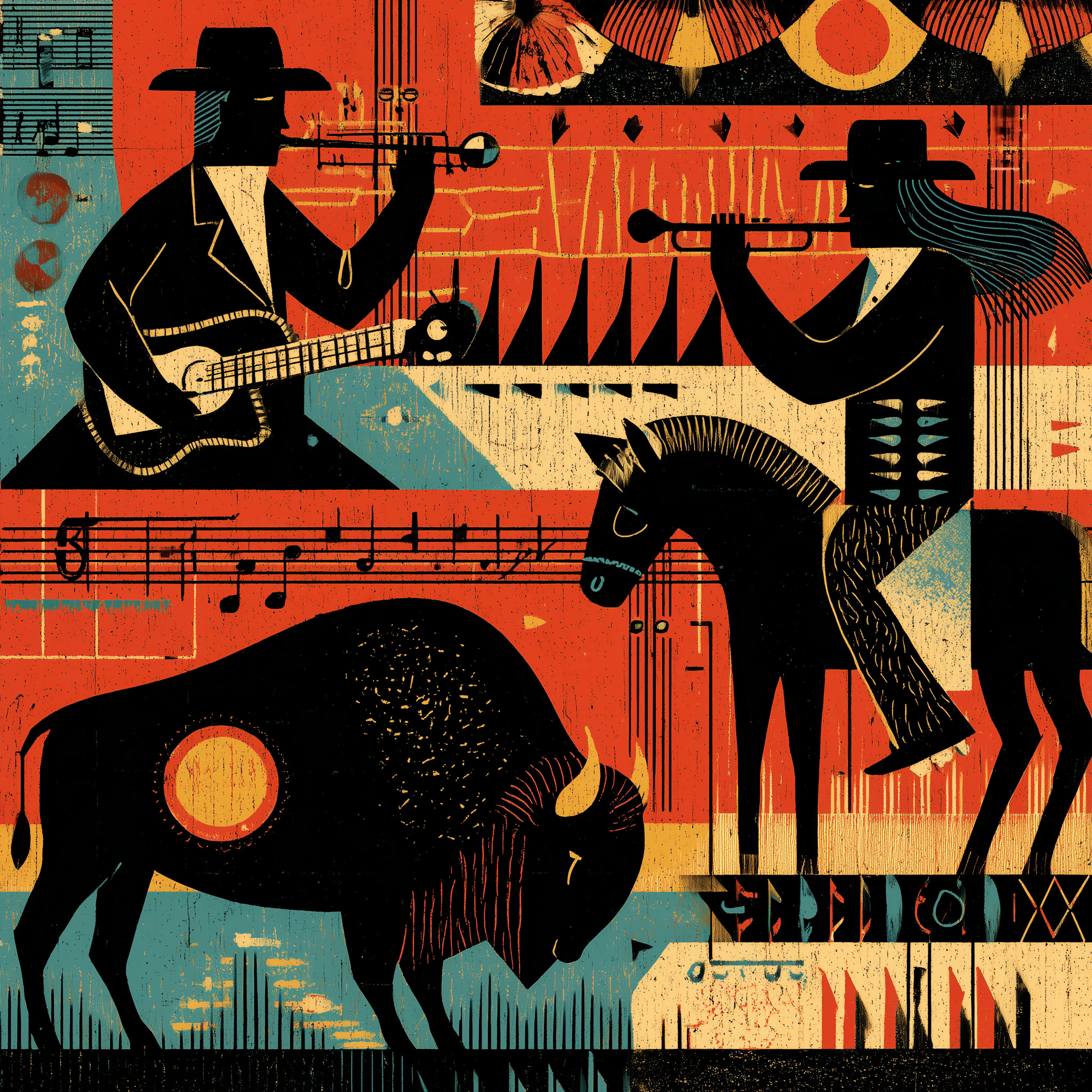
The polka did not stay European. This is the part of the story that most people miss, and it is the most remarkable part. German, Polish, and Czech immigrants who settled in southern Texas in the 1830s and 1840s brought their brass bands and their dance music into proximity with Mexican musical traditions. The accordion, transplanted from Central Europe, was adopted by Tejano folk musicians at the turn of the twentieth century. Narciso Martínez, known as the Father of Conjunto Music, learned tunes from German, Polish, and Czech brass bands and transposed them to the accordion in the 1930s. Santiago Jiménez, according to family accounts, was not permitted to enter the European dance halls as a youth, so a white friend would attend in his place and afterward whistle the melodies, which Jiménez would then hammer out on the accordion. The tuba’s bass line, a defining feature of the German oom-pah tradition, migrated into the bass registers of the accordion itself. The polka rhythm, that half-step bounce, became the rhythmic foundation of norteño and conjunto music, which spread from the Texas-Mexico border back northward across the Great Plains with Mexican-American migration throughout the twentieth century. The Rev. Gregory Carl, who led Hispanic ministry at Sacred Heart Catholic Church in Norfolk, Nebraska, observed that the polka sound older parishioners remembered as something Germanic was the same sound that incoming Hispanic immigrants were making as living, current music. The circle closed, and most people on either side of it had no idea it was a circle at all.
Meanwhile, the more informal traditions persisted. The jug band tradition, while more commonly associated with the Mississippi Delta and the urban South, had its echoes on the Plains wherever poverty and resourcefulness intersected. A jug, a washboard, a washtub bass made from a galvanized tub, a broomstick, and a length of cord: these were instruments that required no Sears catalog order, no four hundred dollars, no mail-order wait. They required only ingenuity and the will to make noise. The mouth organ, cheap and portable, was one of the main instruments of the American folk experience on the Plains, alongside the guitar, banjo, and mandolin. The play-party tradition, which flourished especially in Texas, Oklahoma, and Kansas where church opposition to dancing was strong, substituted singing games for instrumental dance music, allowing communities to gather and move together without technically violating the prohibition.
The Sears, Roebuck catalog played its own role in the musical settlement of the Plains. By the 1890s, the catalog’s Musical Goods Department offered guitars, violins, accordions, organs, and instructional books to homesteaders who might be a hundred miles from the nearest music store. A guitar could be had for $4.50 to $26.00, a pump organ for $22.00, a piano guaranteed for twenty-five years for $98.50. For isolated settlers in western Oklahoma, where the nearest freight depot was El Reno or Canadian, Texas, the catalog was the pipeline through which the raw materials of music arrived. The instruction books that came free with each guitar purchase were the conservatory education of the prairie, and if their pedagogy was crude, their effect was real. A farmer who ordered a guitar from Chicago in March might be playing polkas, waltzes, and marches from the Sears “Guitarist” songbook by harvest time.
The Ukrainian and Russian Doukhobor communities of the Prairie Provinces and the Northern Plains brought yet another dimension. Doukhobor music, the word meaning “spirit wrestler” in reference to the sect’s struggles against the Russian Orthodox Church, was largely choral, a capella tradition requiring no instruments at all, only voices raised in unison against the same wind that had greeted everyone else. The Swedish settlers of Lindsborg, Kansas, maintained their own distinct tradition of Scandinavian music and dance. Every ethnic enclave on the Plains was, in its way, a radio station broadcasting on its own frequency, and the landscape was wide enough to hold them all without interference, at least for a while.
What is harder to talk about, but necessary, is what happened to all of this. The generation that carried the accordion from Odessa to Strasburg eventually died, and their children and grandchildren assimilated into the broader American cultural mainstream. In towns across the Plains that were built by Czech and German families, towns where names like Zamanek and Janacek and Weighat were once plastered on every storefront and street sign, the polka disappeared. The language went first, then the food, then the dress, then the music. The baby boomers who ran these towns decided, consciously or not, to sever their communities from their European roots, turning them into anywhere, USA, where everyone spoke English, followed football, and listened to country or rock. The demographic for polka music in America today consists primarily of married men and women between sixty and eighty-five, with a median age of seventy-four. The Grammy Awards recognized polka with its own category from 1986 to 2009, then quietly eliminated it. The accordion, as one Texas musician of Czech descent observed, is now heavily associated with a rapidly diminishing demographic identity.
And yet the music has not died so much as migrated. The towns that preserved their Czech heritage, places like Ennis, Texas, and Wilber, Nebraska, still hold festivals where the polka is danced in all seasons. The conjunto and norteño traditions that absorbed the polka’s DNA are thriving in Mexican and Mexican-American communities across the continent. Bob Wills, who grew up in central Texas and organized his Fiddle Band in Fort Worth in the late 1920s, took the fiddle tradition and the dance-music imperative of the Plains and created western swing, which was the big band sound applied to country music, a form that added reeds and brass and drums and jazzlike improvisation to the core of what the frontier fiddler had always been doing: making people move.
The Great Plains did not invent music. It received music, as it received everything else, from people who arrived carrying what they could. An accordion in an ox-drawn cart. A fiddle in a saddlebag. A guitar ordered from a catalog. A melody whistled through a fence to a young man who was not allowed inside the dance hall. The Plains sorted and tested and blended these offerings with the indifference and generosity that characterize all large landscapes, and what emerged was not one sound but a conversation between sounds, a layering of traditions that continues to speak even as the original speakers fall silent. The wind, of course, is still playing. It was there first. It will be there last. Everything between is human effort, and on the Plains, human effort has always had to be louder than it expected.
David Boles is the publisher of PrairieVoice.com, where he writes about the enduring tensions between old-time morals and the modern world. He lives in New York City.