

Bernie Krause has spent more than fifty years recording the sounds of wild places, traveling from the Arctic to the Amazon with microphones and recorders, cataloging what he calls the biophony: the collective voice of living organisms in a given habitat. His archive at Wild Sanctuary contains over 4,500 hours of natural soundscapes and more than 15,000 identified species. Fully half of those recordings come from habitats that no longer exist, have been radically altered by human activity, or have gone altogether silent. When Krause began his work in the late 1960s, he thought he was documenting nature. Now he understands he was documenting extinction.
The prairie was never quiet. Before European settlement, the North American grasslands constituted one of the loudest ecosystems on the continent, a wall of sound that rose and fell with the seasons, the hours, the weather. Sixty million bison once roamed these lands, their hooves audible from miles away, their bellowing carrying across the open grass. The males’ low rumbling calls during rut season were felt as much as heard, vibrations that traveled through the ground itself. Prairie dog towns stretched for hundreds of square miles, their bark-chirp alarm calls creating an early warning network that rippled across the landscape. Wolves howled. Elk bugled. And from March through May, the booming grounds came alive.
The Great Animal Orchestra
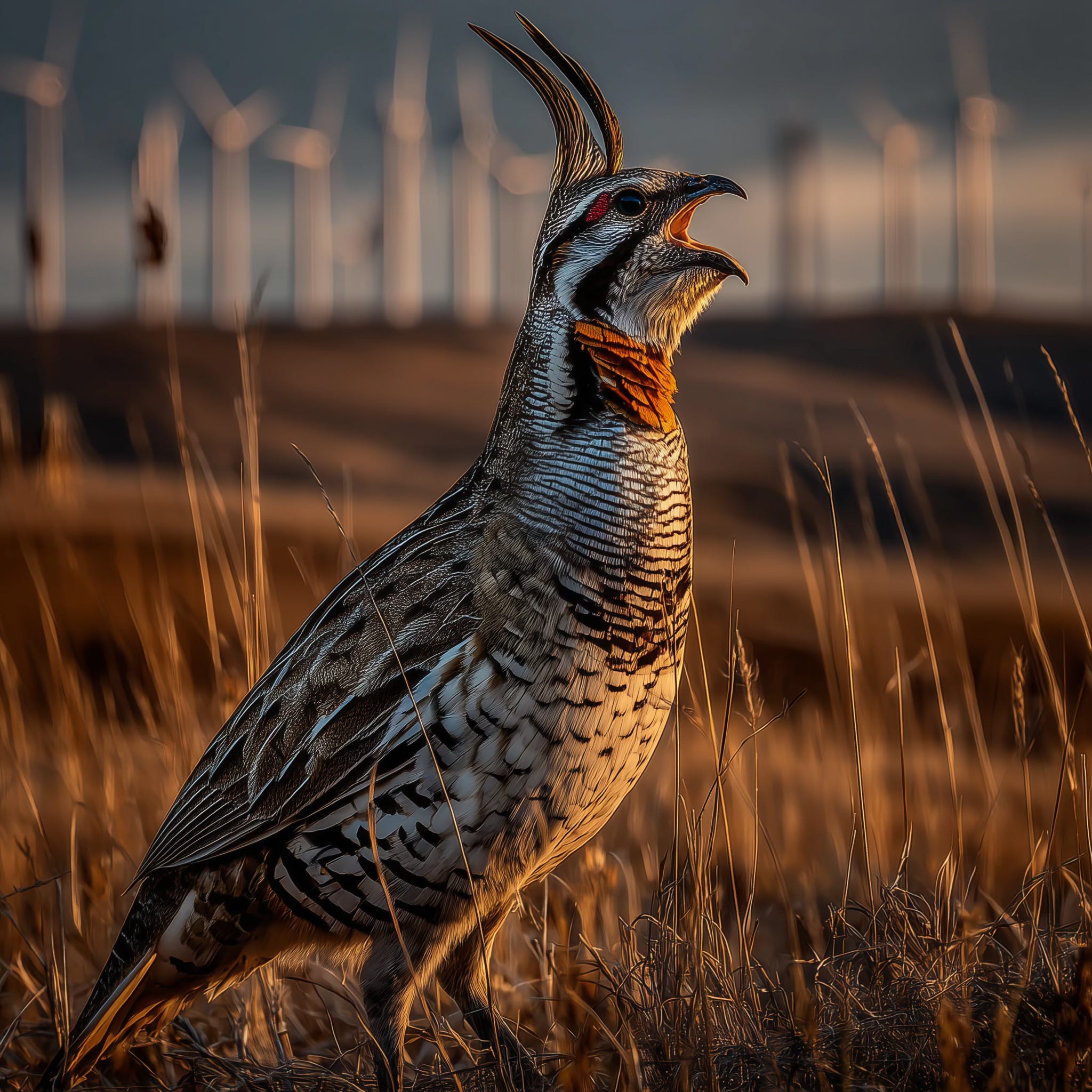
The greater prairie chicken’s courtship display is one of nature’s stranger performances. At dawn, males gather on traditional mating grounds called leks, some of which have been used for more than a century. There they inflate bright orange air sacs on their necks, erect feather tufts that look like horns, stamp their feet in rapid percussion, and produce a low booming sound that carries across the open grassland for a mile or more. Doug Ladd of The Nature Conservancy describes it as a haunting low resonance, like someone blowing across the top of an empty bottle. The distance it carries is phenomenal, Ladd says. He has heard that sound wafting across the prairie from a mile and a half away.
The booming served a purpose beyond attracting mates. It established acoustic territory. Krause developed what he calls the acoustic niche hypothesis: species in healthy ecosystems evolve to vocalize within specific frequency bandwidths and temporal patterns so their signals are not buried by other sounds. Like instruments in an orchestra, each species occupies its own acoustic space. The prairie chicken’s boom sits at approximately 296 hertz, a frequency low enough to travel far across flat terrain, distinct enough to cut through the higher-pitched calls of songbirds and the constant rustle of wind through grass. The dawn chorus on a healthy prairie was not chaos. It was composition.
Today the greater prairie chicken is a species of conservation concern, its population reduced by more than 90 percent since the 1800s. The heath hen, an Atlantic Coast subspecies, went extinct in 1932. Attwater’s prairie chicken survives only in small fragments of southeast Texas and is listed as endangered. What remains of the booming grounds exists on isolated patches of protected land, acoustic islands in a sea of industrial agriculture.
The Roaring of a Waterfall
In late July 1874, twelve-year-old Lillie Marcks watched the sunlight dim over Kansas. A whirring, rasping sound followed, and there appeared what she later recalled as a moving gray-green screen between the sun and earth. The Rocky Mountain locust had arrived. Swarms so large they blocked out the sun for six hours descended on the Great Plains, covering an estimated two million square miles from the Dakotas to Texas. A Kansas pioneer described them as a great white glistening cloud, their wings catching sunshine. Nebraska historian Addison Sheldon wrote that the vibration of their wings filled the ear with a roaring sound like a rushing storm.
The 1874 plague may have contained 12.5 trillion locusts with a combined weight of 27 million tons, the greatest concentration of animals ever recorded. One observer in Nebraska watched a mile-high stream of locusts pass overhead for five days straight, estimating the swarm at 110 miles wide and 1,800 miles long. The sound they made was compared to the roaring of a huge waterfall. Scientists described them as a metabolic wildfire. The noise their myriad jaws made when engaged in their work of destruction, reported the United States Entomological Commission, could be realized by anyone who had fought a prairie fire: a low crackling and rasping that filled the air.
The Rocky Mountain locust is now extinct. Agricultural settlement of the river valleys where it bred, the plowing and irrigation and trampling by livestock, destroyed its eggs and nymph habitat. By the 1890s, the species could no longer achieve the population density needed to swarm. The last verified specimen was collected in 1902. The locust that nearly ate agriculture off the Great Plains disappeared within thirty years of its worst outbreak, the only extinction of a pest species in agricultural history. The prairie lost one of its loudest voices, a sound that had filled the air since long before humans arrived on the continent.
The New Soundscape
The prairie hums now with different sounds. Center pivot irrigation systems click through their rotations, mechanical metronomes marking the passage of water from aquifer to crop. Highway traffic drones in the distance. Wind turbines generate a constant low-frequency pulse that can be detected for miles downwind. Researchers at the University of Nebraska measured sound levels near a 36-turbine wind energy facility in Brown County and found that at 100 meters from the turbines, under average conditions, wind turbine noise at 296 hertz was 25 decibels above ambient sound levels. At 500 meters, it remained 16 decibels above ambient. The frequency they measured, 296 hertz, is the average peak frequency of the prairie chicken’s boom.
The implications are significant. A 2025 study found that experimentally broadcast wind turbine noise reduced songbird vocal presence by 25 percent in affected areas, with a 43 percent reduction in bird abundance and a 63 percent reduction in the probability of vocal presence at the heart of the noise-polluted zone. The birds did not simply sing louder or at different frequencies. They left. Other research suggests that greater prairie chickens may have adjusted to turbine noise over time, but the more pressing threat is woody encroachment: trees spreading into grassland habitat fragment the acoustic landscape as surely as the turbines do, creating barriers that absorb and scatter sound.
Krause coined three terms to describe the components of any soundscape: biophony for sounds produced by living organisms, geophony for sounds from non-biological natural sources like wind and water, and anthrophony for sounds produced by humans. On the contemporary prairie, anthrophony increasingly dominates. The low-frequency rumble of machinery, the hiss of highway traffic, the whine of electrical infrastructure create what acoustic ecologists call a lo-fi soundscape, one in which quiet and distant sounds cannot be heard clearly because dominating noisy sounds mask them. The biophony retreats. The geophony persists. The anthrophony expands.
Listening to Loss
Soundscape ecology emerged as a formal discipline in the early 2000s, drawing on decades of work by researchers like Krause and the theoretical framework established by R. Murray Schafer’s World Soundscape Project at Simon Fraser University in the 1970s. The field treats soundscapes as ecological data, using recording devices and acoustic analysis to map biodiversity, track habitat health, and document change over time. A spectrogram of a healthy ecosystem shows frequency bands occupied by different species, temporal patterns that shift with dawn and dusk, seasonal variations as migrants arrive and depart. A spectrogram of a degraded ecosystem shows gaps, silences, the acoustic signature of absence.
Some governments now recognize soundscape preservation as a conservation priority. The U.S. National Park Service maintains a Natural Sounds and Night Skies Division dedicated to protecting acoustic environments. Researchers use passive acoustic monitoring to survey wildlife populations, deploying recorders that capture months of continuous audio and analyzing the data for species presence, breeding activity, and ecosystem health. The question soundscape ecology asks is simple: What does success sound like? The answer requires first understanding what has been lost.
Krause has described returning to recording sites over decades and hearing the density and diversity of wildlife acoustic signatures diminish markedly. At some sites, the biophony can no longer be heard in any form. These are not necessarily places that look degraded. The grass still grows. The sky still stretches to the horizon. But the acoustic richness that once filled the air has thinned to silence, a change invisible to the eye but unmistakable to the ear. There is a sense of loss that pervades this work, notes one analysis of Krause’s career. Those who know only the present soundscape cannot know the experience of living through the transformation.
The Measure of Silence
Prior to the arrival of European settlers, more than 40 percent of North America was covered by prairie. Today less than 1 percent of the original tallgrass prairie remains in states like Minnesota and Iowa. The mixed-grass and shortgrass prairies of the western plains have fared somewhat better in acreage but have been transformed by agricultural use, invasive species, and the suppression of fire that once maintained their ecological balance. Bison number roughly 500,000 in North America now, most of them raised as livestock. The 15,000 or so managed for conservation purposes represent a fraction of what once existed, and only the herds at Yellowstone and Wood Buffalo National Park in Canada are large enough to function as truly wild populations.
The restoration of prairie ecosystems increasingly includes attention to sound. Researchers recognize that bison and fire were not merely visual features of the historical landscape but acoustic ones as well, their presence creating the conditions under which prairie species evolved their vocalizations. The booming grounds of prairie chickens require not just short vegetation for visibility but landscapes where their calls can carry for long distances. Conservation efforts that focus solely on habitat structure miss the acoustic dimension, the need for soundscapes where biophony can flourish without being masked by anthrophony.
There is something irreplaceable about sound. A photograph captures a moment. A recording captures time itself, the actual pressure waves that moved through the air at a specific place on a specific day. Krause’s archive contains sounds that will never be made again, voices of species and habitats that no longer exist. When we lose a soundscape, we lose not just a sensory experience but a form of knowledge, an understanding of how the world once spoke to itself across the grass. The prairie was never silent. We made it so. And now we must decide whether silence is what we want to leave behind.