

Cherry County, Nebraska, runs to 5,961 square miles. That is more land than the state of Connecticut, spread across the Sandhills north of the Niobrara River in cattle range and blowout grass, and about 5,500 people live on it. The arithmetic comes out to fewer than one resident per square mile. Drive the county end to end and you will lose most of a day to it. Now picture the call that cannot wait: a rollover on a gravel section road at two in the morning, a rifle pulled inside a ranch house at the county’s far edge, a woman who has locked herself in a bathroom while someone works at the door. What decides her night has little to do with whether Cherry County has a sheriff; it does, duly elected and sworn. What matters is how many deputies are awake, where they happen to be standing, and how far the nearest one has to drive.
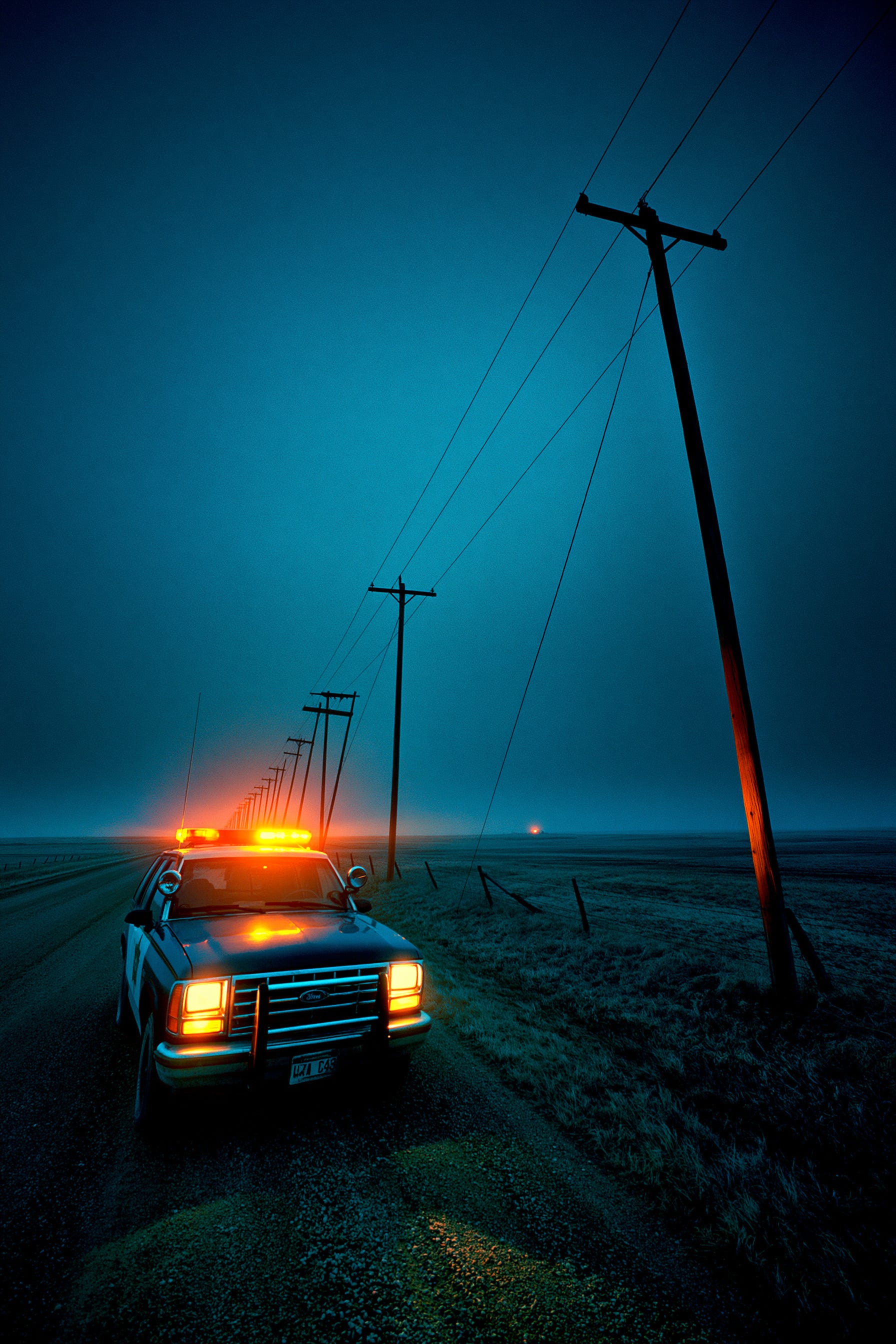
Across the Great Plains, that answer has worn down to almost nothing, and the wearing has been quiet. No single closure announced it. County by county, shift by shift, the distance between a person in trouble and the nearest armed, paid, on-duty responder has stretched past the point where the word “response” still means what people assume it means.
Start with the math of a shift, because the shift is where the promise of public safety either holds or fails. A county sheriff’s office does more than patrol. It runs the jail, staffs dispatch, serves civil papers, provides court security, and transports prisoners, all from the same small roster. When that roster holds six or eight sworn deputies, the sheriff included, around-the-clock patrol coverage becomes a problem with no clean solution. In Adair County, Iowa, Sheriff Jeff Vandewater has six sworn officers, himself among them, to cover 570 square miles; like many small offices, his can field one deputy per shift, and some nights it cannot staff the full twenty-four hours at all. The Iowa reporting that documented his office found the same pattern across the state’s rural counties: one deputy on, or none. In Merced County, California, the sheriff warned residents that on some daytime shifts four deputies were responsible for nearly 2,000 square miles. Across rural Minnesota, where roughly forty local police departments have closed since 2016 and towns have handed their policing to the county, a deputy’s beat can exceed 400 square miles, with a half-hour drive or longer just to reach the call.
Set those numbers against a county the size of Cherry, or larger, and the two-hour response stops being a worst case and becomes a Tuesday. A single deputy cannot stand in two places, and on the Plains the two places can sit ninety minutes apart on the same patrol log. The domestic-violence call from the far township is answered, if it is answered in time, by whoever is closest, and closest may be the next county’s deputy under a mutual-aid agreement, or a state trooper working a different highway, or no one until morning.
Federal figures confirm that the small agency is the norm. The Bureau of Justice Statistics, in its 2018 Census of State and Local Law Enforcement Agencies, the most recent complete count of its kind, found 17,541 state and local agencies in the country. Forty percent of them employed nine or fewer full-time sworn officers. Just 795 employed exactly one. Among sheriffs’ offices, more than half, 1,584 of them, ran on 24 or fewer sworn deputies, and those offices together held 9 percent of the nation’s deputies. The other 91 percent clustered in the metropolitan counties, and that clustering is the whole problem for the Plains. Montana’s 56 county sheriffs’ offices employed 807 sworn deputies in all; Nebraska’s 89 offices, 1,102; New Mexico’s offices, 1,266. Concentrate those modest totals in the few populous counties, and the frontier counties are left with a handful of deputies each, sometimes fewer.
Consider three of them. Garfield County, Montana, with its courthouse at Jordan, covers 4,675 square miles of land and holds about 1,150 people, a density near a quarter of one person per square mile, the lowest of any county in Montana. Catron County, New Mexico, is the largest county in that state, 6,929 square miles, bigger than Connecticut, with roughly 3,600 residents and a county seat, Reserve, of fewer than 300. More than 80 percent of Catron County is national forest, public land where a lost hunter or an overturned truck can sit for hours past the last bar of cell signal. The Catron County Sheriff’s Office, led for years by Sheriff Keith Hughes, is the primary law enforcement for that expanse, with the New Mexico State Police filling gaps under a mutual-aid framework, and the nearest hospital sitting in Silver City, about ninety miles south over mountain roads. Cherry County, already described, completes the set. These counties are the ordinary geography of the high Plains, where the lines were drawn for surveyors and railroads and never for the staffing tables of a modern emergency system.
When the deputy cannot come, the question becomes who else might, and here the floor drops again. Emergency medical service, the ambulance a person assumes will arrive when they dial 911, carries no such guarantee. Police and fire are treated as essential services a local government is expected to fund; in the majority of states, EMS holds no such designation, which means a county is not obliged to pay for an ambulance the way it pays for a jail. The American Medical Association’s own ethics journal, surveying the gap in 2025, describes a system in which response times have lengthened and “sometimes no ambulance arrives at all,” as the volunteers who built rural EMS in the 1960s age out and no one steps into their place. About 4.5 million Americans now live in what researchers call EMS deserts, more than 25 minutes from the nearest ambulance station. In Dutton, Montana, on the central plains, a man who fell from a tractor bucket and could not move waited while his daughter-in-law, the volunteer EMT who answered the call, phoned the next town for a crew large enough to lift him; that account, reported by Kaiser Health News, ended with the local crew chief, seventeen years a volunteer, unsure whether anyone would replace her. When Montana legislators floated a bill merely to study whether EMS should be declared essential, the bill died.
So the deputy may be ninety minutes out, the ambulance may not be coming, and the volunteer fire department may be three retirees and a tanker truck. This is what it means to say the public-safety floor has dropped through the floorboards. The structures a citizen pictures standing behind the number 911 are, across much of the rural map, a memory and a hope.
Now the part the crime statistics will never tell you. The Federal Bureau of Investigation’s annual crime data, the figures politicians cite and newspapers reprint, depend on local agencies choosing to report, and in 2021 the reporting itself broke. That year the FBI retired its century-old summary system and moved to a more detailed one, the National Incident-Based Reporting System. Nearly 40 percent of the nation’s law enforcement agencies, about 7,300 of some 18,000, filed no data at all, a gap documented by The Marshall Project and confirmed across newsrooms. The agencies that disappeared from the record largely blamed the same condition that thins their patrols: too little staff to make the switch. Reporting recovered in the years that followed, though unevenly. Congressional researchers noted, in careful language, that the gaps still left may vary by rurality, the polite phrasing for a hole shaped like the counties this article has been describing.
Layer onto that reporting failure a deeper one. Criminologists have long used the phrase “the dark figure of crime” for everything that happens and never reaches a police record. In a county with one deputy on duty and a ninety-minute drive to the scene, the dark figure becomes the main event. A burglary discovered after the fact, with no one free to take the report for two days, often never becomes a report. A victim who has learned that calling produces no one, or produces someone long after it matters, stops calling. The crime rate in such a place can look low, even enviable, on a chart, while the chart is measuring the absence of police capacity rather than the absence of crime. Rural safety, rendered in numbers, is in part a fiction, manufactured by the same thinness this story has been tracing. The Uniform Crime Reports cannot record what no one was there to write down.
Read plainly, this is a story about infrastructure. The marauder that sells on cable news has nothing to do with it. What the Plains are living through is duller and worse: the slow withdrawal of the state’s first promise, that if you call for help, help will come. That promise is the floor under everything else a government does. A county can lose its pharmacy, its delivery room, and its grain elevator and still be a place where people live. When it loses the assurance that someone will answer on the worst night of a life, it has lost something closer to the bone, the minimum guarantee of membership in a working republic. The map of one-deputy and no-deputy shifts is a map of where that guarantee has quietly lapsed, and it runs across the Plains in counties most Americans will never drive through, widening one unanswered call at a time.