

On the night of September 28, 1919, a mob of somewhere between five and fifteen thousand white Omahans burned the Douglas County Courthouse and lynched a Black packinghouse worker named Will Brown from a lamp pole at Eighteenth and Harney. Brown was forty-one years old and suffered from acute rheumatism severe enough that historians doubt he could have committed the assault he was accused of. He was given no chance to prove it. The mob shot his hanging body, dragged it behind a car, burned it, and sold pieces of the rope for ten cents each. The United States Army arrived that night and photographs identified ringleaders by face, and every suspect was eventually released. Orville D. Menard documented the whole catastrophe in Nebraska History, the journal of the state historical society, and the record he assembled includes one detail that outlasts the flames: the county buried Will Brown in an unmarked pauper’s grave at Forest Lawn, and the grave stayed unmarked for ninety years. A headstone finally arrived around 2009. It reads, “Lest we forget.” The county had forgotten for nine decades, on paper, in the one place paper is supposed to hold.
Prairie Voice has spent its run examining the systems that keep rural and plains life running underneath the systems that claim to. The rendering route that is the region’s true sanitation system. A data center rising out of the wheat as the county’s new cash crop. The missile field asleep under the section lines. This is another of those systems, older than most, and it has been keeping the plains’ most important set of books for more than a century: the Black funeral home.
The history is documented and it is blunt. Suzanne E. Smith’s To Serve the Living, published by Harvard’s Belknap Press in 2010, established what the trade press and the census had long implied: under segregation, the funeral director was among the only economically independent figures in any Black community. White morticians would rarely take a Black body, and Black families would rarely offer one, so the trade belonged to the community outright, and the people who owned it answered to no bank downtown and no courthouse ring. Smith traces the consequence across a century: the funeral home became the room where civil rights work could be planned, funded, and sheltered, a lineage she follows back to the hush harbors of the slave quarters, where enslaved people first used the funeral to bury their dead and to plan a path toward freedom. The homegoing ceremony honored the dead. The house that staged it protected the living.
An institution that independent does one more thing, and the plains context of 1919 shows why it mattered. Omaha’s Black population had doubled in a decade, from 5,143 in 1910 to 10,315 in 1920 by Menard’s figures, drawn north and west by packinghouse recruiters and the promise of wages Jim Crow states would never pay. What those families found waiting was a white political machine, a newspaper that ran manufactured hysteria about Black crime, and, when the worst arrived, a public record that handled their dead the way it handled Will Brown: a number in a fee book and an unmarked hole. The official ledger recorded that such people died, and nothing in its design could hold that they had lived, or how, or at whose hands. Whatever fuller account a community wanted would have to be kept in rooms the county did not run: the church register, the lodge book, the family Bible, and the establishment that washed the body, knew the wounds, and wrote the funeral in its own hand. Where the county’s paper thinned, the community’s paper thickened, and the thickest paper in town belonged to the undertaker.
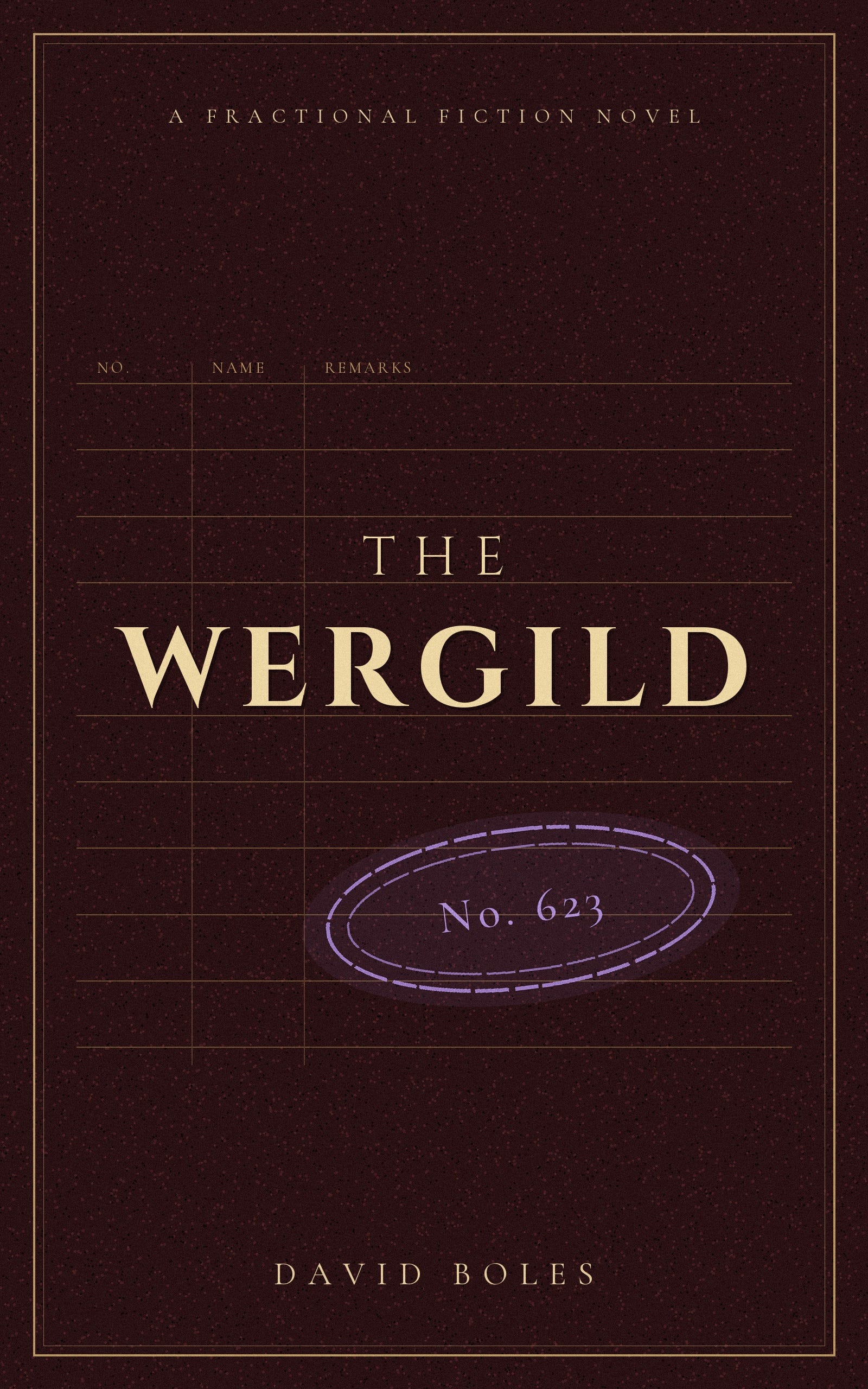
A new novel takes that second ledger as its architecture. The Wergild, the tenth book in David Boles’s Fractional Fiction series from David Boles Books Writing & Publishing, is set in Verlin Bluffs, Nebraska, a Missouri River town the copyright page is careful to call an invention down to its newspapers, and the history pressing against that invented town is the documented history above. The novel’s Black funeral house keeps two books. One is the county’s register, the official columns of name, age, trade, cause, and fee. The other is the private column, the Remarks the county never asked for, written for the family and held for a century. In June of 1919 a drowned stranger comes off the river and is entered as No. 611, man unknown. In September of that same year, the house buries a young Army cook in its own family row as No. 623, name unknown, and the private column writes: held here in our row until he is called for. Set that sentence beside the potter’s field at Forest Lawn and the novel’s argument is complete before its plot has started. The county’s answer to an unclaimed Black body in 1919 was an unmarked hole and ninety years of silence. The house’s answer was a place in its own row and a promise in its own book.
Four generations carry the keeping. August Wardlaw opens the register in 1919 and Marvel Wardlaw keeps it with him and after him. Their son Early stands keeper in 1968, the year his sister Odessa rises in a council chamber and makes the demand that gives the book its center: “You owe me the name of the man who killed Odell Rooks, and I will take nothing in its place.” For eleven months the county bids against her, a scholarship fund, a televised service of unity, a park drawn and rendered, an envelope carried to her door at night, and in every chamber that keeps minutes she answers with the same sentence, unchanged, because a sentence repeated without variation is an instrument. Wren Wardlaw, the fourth generation, keeps the book now, in the novel’s present day, when the oldest entries begin demanding completion. The title is the oldest word in the book’s vocabulary: the wergild was early English and Germanic law’s man-price, the payment a killer or the killer’s kin owed the family of the killed, the settlement that closed a feud. The same law kept a second word, morð, for the killing done in secret and left unacknowledged, the one death the whole system could never settle, because no price can change hands until the killer has a name. Every unmarked grave on the plains sits in the gap between those two words, and the novel builds its three movements, 1919, 1968, and the present, inside that gap.
Readers of this publication will recognize the method. Prairie Voice has argued from its first issue that the plains run on institutions the official map refuses to draw, and that the moral information of a place is stored where the county cannot audit it. That argument, written as fiction, is The Wergild, and its deepest claim is a quiet one: record-keeping as justice deferred rather than denied. The county wrote “Lest we forget” over Will Brown ninety years after it forgot him. The novel imagines the house that never needed the reminder, because forgetting was never among its services.
Find The Wergild now in Kindle, paperback, and web reading editions through BolesBooks.com.