

On Saturday mornings in the mid-1970s, the Bethany library in Lincoln kept a kindergarten rug. A nine-year-old volunteer sat at its edge with a picture book held outward, because that was how the rug could see the page. The children learned the repeated line before the lesson. When the reader approached the chorus, the room arrived first. Nobody taught them to do that, and everything taught them to do that. The room outlasted everything else in the week, one Saturday at a time. It taught the teacher before the teaching.
Fifty years later, that volunteer has written a book about what the rug was doing. The rug was manufacturing the first person plural: on purpose, by design, on schedule, with strangers. A child who says we with the story has performed the oldest civic act at the scale of the lap, joining the plural by voice, on time, with others, and learning that the line belongs to whoever shows up to say it.
The book arrives with receipts for a hard decade. The union local that conjugated we on the second Tuesday of the month has halved in forty years, from a fifth of the country’s wage and salary workers to a tenth. The congregation, near seventy percent of Americans at the century’s turn, crossed below half in 2020. Time spent with friends in person fell from an hour a day to twenty minutes across the years 2003 to 2020. The county paper, the daily printed shared object of attention, has been closing at more than two a week for twenty years; since 2005 the country has lost close to 3,500 papers, and 213 counties, most of them rural, have no local source at all. In 2023 the Surgeon General of the United States issued a loneliness advisory in the genre the office reserves for cigarettes. A room everyone calls load-bearing, which a fifth still watch, which almost no one pays for.
Into the vacancy came the counterfeits. The brand chorus of April 2020, dozens of companies reciting one identical together-sentence over the same piano. The platform’s terms of service, the constitution you ratify with your thumb. And at the decade’s end, the machine that learned to say we at three in the morning, on demand, to anyone who asks: a we of one member and one mirror. Seventy-two percent of the country’s teenagers have used one. The mirror cannot lose anything with you, and that asymmetry is the whole exhibit.
What the book found standing is plainer and older. The twelve-step basement with its laminated card, certified at the strictest standard the decade’s medicine could apply: high certainty in 2020, the plural of need the sturdiest plural there is. The volunteer fire company answering on a thinning roll, at the lowest membership rate on record, still answering. The choir that bonds strangers in a month. The theater company that builds a country in six weeks of evenings and strikes it on schedule, with grief as the receipt. And the branch library, the last public room the county owns that admits everyone and sorts no one, where the chess two become three and the citizenship class adjourns with next week’s assignment.
The book’s name for the survivors is the remnant, and their conditions fit on one hand plus a thumb. A roll. A schedule. A shared good. An admitted vulnerability. No them, or a them that is a condition and never a people. And no extraction model: the money buys the room and never the bond. The rug at Bethany ran on all six before anyone counted them.
The plains can claim some of the raising of this argument. The volunteer at the rug was a Lincoln kid, paid first by a Lincoln newspaper in 1975, trained in the university’s theater and its literary quarterly, and the production record in the book reads like a map of this watershed: a play carried from a local stage to a television airing, a musical at Columbia, a film shot on location, a program of study built in New York for the language of the Deaf community. The essay that opens the book went up on his own site in June of 2016, in the morning, and that night he registered the domain. Nine hours and nine minutes between the argument and the address. He spent the next ten years counting what the decade did to the word.
The count is the book’s spine, and its honesty is the whole of its value. The 2016 essay ran at fifty-five plurals per thousand words, hotter than the founding documents; the book that audits it runs at twelve. The essay about the failing us was written in inaugural-grade we. The audit runs cooler than its subject, every run printed, including the runs that cut against the argument, the rules registered in advance so that anyone in 2036 can recount the pronoun and extend the graph. The verdict is said early, because this book does not trade in suspense: the genuine plural survives at rescaled size; the counterfeit thrives at national and commercial size; and the two machines that still manufacture the genuine article on purpose are the classroom and the stage.
The rug is the first of the machines. The book’s last image is its first one: the circle on the rug meets tonight, on a schedule, in a room, off a page. What survives the subtraction is the circle, and the circle is taking names.
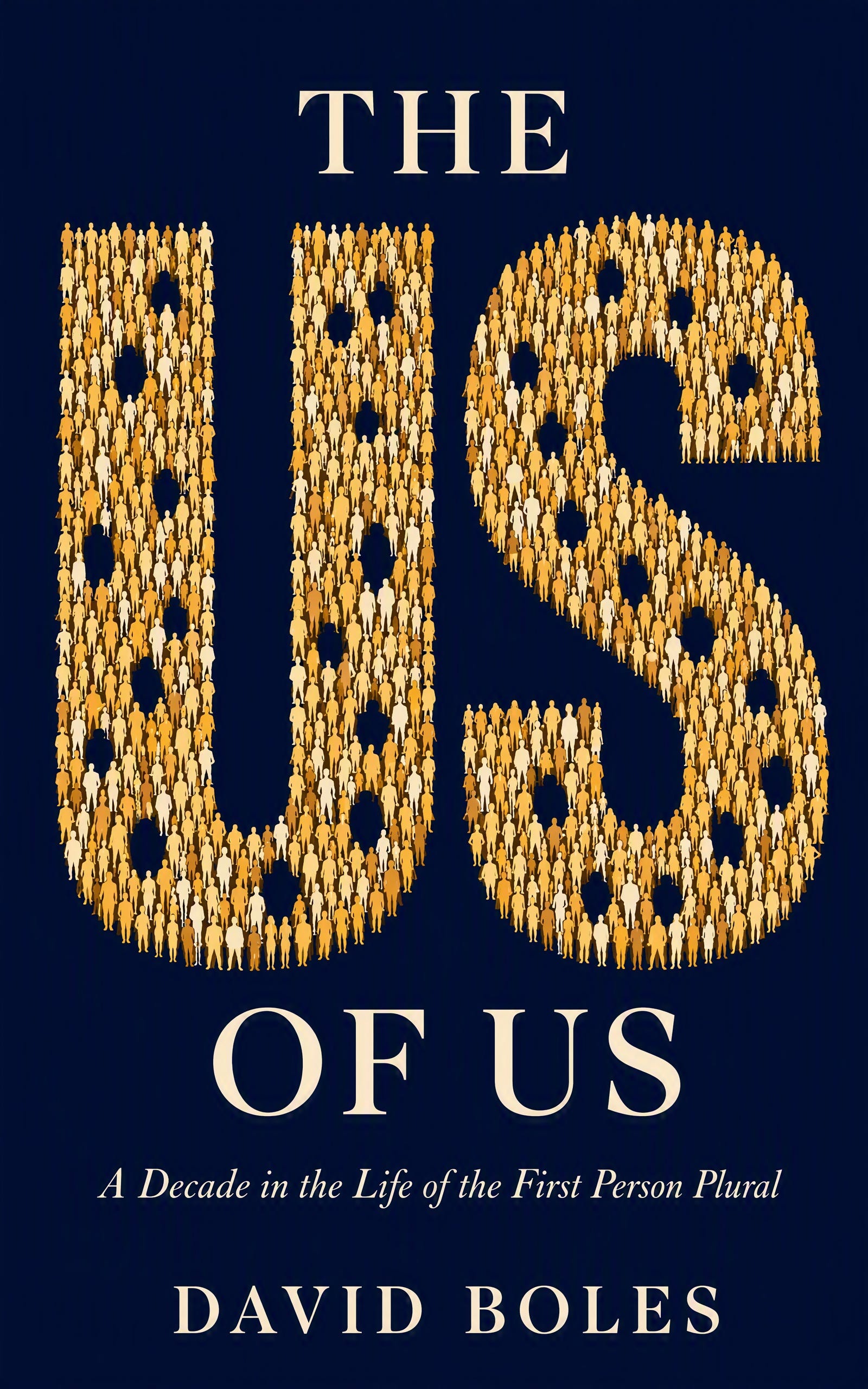
The book is The Us of Us: A Decade in the Life of the First Person Plural, published this month by Boles Books. If you want the counts, the receipts, and the ten-year ledger of one pronoun, they are at BolesBooks.com and wherever books are sold. The branch library keeps its own hours. The story hour is on the door.