

One April morning in Omaha, a man asked to become a voter, and the answer took forty-four years.
On an April day in 1880, a Winnebago man named John Elk walked up to a registrar’s window in Omaha, Nebraska, and asked to be added to the rolls of voters. He had left his tribe and renounced its allegiance. He lived and worked in the city like any of his neighbors, and he wanted the one document that would say so. The registrar of voters, one Charles Wilkins, refused him. Four years later the Supreme Court of the United States looked at the refusal and blessed it, seven to two: John Elk was no citizen, because he had been born into a tribe.
I am a son of that prairie. I spent my boyhood summers in North Loup, Nebraska, at my grandfather’s place, and I had my first paid byline in Lincoln at the age of ten. The window where a man standing on American ground was told he was nobody in particular sits in my home state, and I have just spent a book’s worth of years learning what that window was for. The book is called The One-Way Drop: Zero Tolerance and the Rules We Write for Other People, and it is out now.
◆
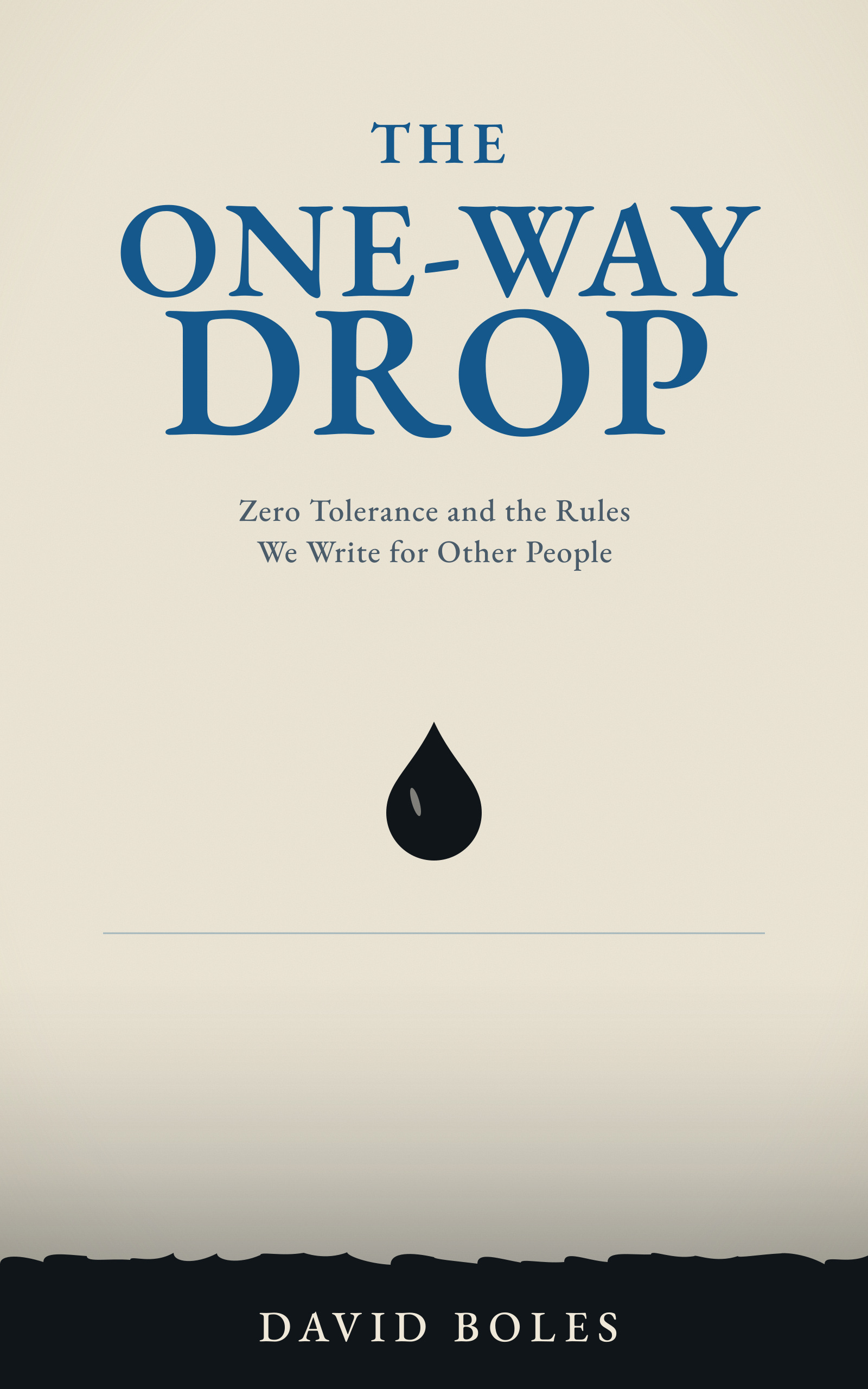
The book follows a single piece of arithmetic through four centuries: one drop of the wrong thing ruins the whole. A drop of ink in a glass, a great-grandmother in a bloodline, a conviction in a life, a listing in a file. Its method is simple enough to carry in a pocket. Read the direction of a rule and you have read the intention of its maker. Who writes, who is written on, which way the harm flows.
The prairie’s chapter is the strangest one in the book, because on the prairie the arithmetic ran backward. In the East, one drop of African ancestry assigned a whole person, forever, no minimum required. In Indian country, the same government demanded a minimum: a quarter, an eighth, certified degrees of blood, prove it or lose it. The direction reversed because the money reversed. Exclusion cost the excluders nothing. Recognition cost land, annuities, and settlement rolls, so belonging was made hard to keep. Elk fell into the gap between the two machines, an Indian by birth and therefore no citizen, a citizen by conduct and therefore no Indian.
◆
Then came the tent towns. Beginning in 1893, the Dawes Commission set up its tables in Indian Territory to break the communal lands of the Five Tribes into individual parcels, and families waited in line outside the canvas to be written down. Names, ages, parents, ancestry, neighbors called in to vouch, testimony taken while the line shuffled forward. The interview lasted minutes. The entry it produced sat under every enrollment decision a nation would make for the next century. Clerks at folding tables, deciding forever, at speed.
The half of the story the prairie can be proud of took its time arriving. Thousands of Indian men served in the world war as noncitizens, soldiers who could die under the flag at Belleau Wood and could not vote for the government that sent them. On June 2, 1924, Congress finally closed the question with the Indian Citizenship Act. From the window in Omaha to the signature in Washington ran forty-four years, a working lifetime, John Elk’s answer arriving on paper long after the asking.
◆
And here is the turn I did not see coming when I started writing, the one that earns this book its place in this newspaper. The ledgers built to divide became the evidence of belonging. In February 2021, the Cherokee Nation’s own supreme court struck the words by blood from its constitution and every law beneath it, the final order in the Freedmen descendants’ long fight for the citizenship an old treaty promised.
Principal Chief Chuck Hoskin Jr. backed the result. A new constitution protecting Freedmen citizenship went to Washington and stood before the secretary of the interior, Deb Haaland, herself the first Native American ever to hold that office. And Marilyn Vann, the Freedmen descendant whose candidacy and litigation had forced the question, watched the fraction lose. The Dawes clerks wrote two ledgers to sort people apart. A century later, the entries proved a people together.
◆
I want to be honest about the celebrating, because this paper’s readers can smell a parade float a mile off. My home state hosted the failure in this story. The prairie likes to remember its rules as plain and fair as weather, the same sky over every head, and the hardest lesson this book taught me is that the weather was written. Somebody drafted the sky. I grew up comfortable on the sunny side of windows I never had to knock on, and writing sixteen chapters about who built the glass has been the least comfortable and most necessary work I have done.
The book does not end on the prairie. It ends in a kitchen, with a dietary law two thousand years old that forgives an accidental drop in a pot of sixty parts, because the people who wrote that rule had to eat the dinner. Rules written for other people run to zero. Rules written by their own subjects grow a threshold, a procedure, and a way home. Every room in the book, including the one in Omaha, is a demonstration of the difference.
◆
John Elk asked a simple question at a window in my home state, and the machinery took forty-four years to say yes, and another century to mean it. The One-Way Drop: Zero Tolerance and the Rules We Write for Other People is available now from David Boles Books, in every form a reader could want. Bring your own rules to it. You will leave knowing who wrote them.