

I was born in Lincoln, Nebraska, and I mention that only because the prairie explains something I spent the better part of a year writing a book to understand. Out there, a person’s word is supposed to be enough. You say what you mean, you say it once, and you stand still afterward. Nobody asks you to prove your honesty by performing it. A handshake on a gravel road still closes more business than a notary stamp, and the stamp works anyway, because the person behind it learned to talk on that same road. The prairie hears ceremony the way it hears bragging: as a reason to wonder what the person is covering.
So when I tell you the prairie’s native tongue was first spoken on a hillside two thousand years before there was a prairie to speak it, I mean it as a compliment to both places. The sentence is in the Sermon on the Mount, and it is four words long: swear not at all. Jesus says it right after the teaching on anger and right before the teaching on enemies, in the middle of the hardest sermon ever preached. He does not leave a loophole. You cannot swear by heaven, because it is God’s throne, or by the earth, because it is his footstool, or by your own head, because you cannot make one hair white or black. The whole machinery of swearing is named and foreclosed, object by object. Then comes the replacement, and it is the plainest sentence ever offered as law: let your communication be, Yea, yea; Nay, nay.
No courtroom in the world could run on that, said the courtroom. And then the courtroom spent fifteen centuries proving itself half wrong.
The learned men of Christendom went to work on the verse almost immediately, because the work was necessary. Borders need treaties. Courts need testimony. Strangers need a bridge. Augustine called the oath a crutch permitted to a lame world, Aquinas gave it three companions and a license, and the oath system rose over the verse the way a courthouse rises over a spring. The building works. Nobody thinks about the water underneath. And the verse stayed down there like a charge that had never gone off, because every generation or so, somebody would read those four plain words and simply believe them, and the apparatus would have to answer for itself all over again.
The first full detonation came in a village called Schleitheim, in February of 1527, where a small company of hunted people wrote down seven articles of faith and made the oath the seventh. Their reasoning was the sermon’s own: you cannot promise what only God can perform, so swearing is not a lawful tool that sinners sometimes abuse. It is a creature reaching for God’s power, and Christ forbids it, in the magistrate’s court as much as anywhere else. The establishment answered with its two instruments, scholarship and fire, in that order and at once. Michael Sattler, the confession’s principal author, was burned at the stake within three months. Zwingli translated the articles into Latin the same year in order to refute them. The articles survived both.
The position traveled, the way any sentence travels when people are willing to be punished for it. It reached England, and the people who carried it there were the Quakers, and they paid the schedule in full. The Quaker Act of 1662 aimed at them by name: fines, imprisonment with hard labor, transportation at the top of the ladder. Beside the ladder stood the praemunire, the old civil death, out of the king’s protection, for the man who would not swear the allegiance. Their own account of the decades runs near fifteen thousand persecuted, about one in three of all the Friends then living, for declining a formula. They would not fight back, and they would not swear, and they kept the count of what the swearing state spent trying to make them, because a people that keeps records is a people that expects to be believed someday.
Someday came, as a statute, in 1696. Parliament offered the Friends a substitute sentence, the affirmation, and here is the detail that makes the whole story honest. In the very same act, in its third section, the state wired the new sentence to the old penalty: a false affirmation would carry the same punishment as willful and corrupt perjury. Mercy with a tripwire. The form changed. The consequences stayed. And when the purest Friends objected that the new form still called God to witness, Parliament cut once more, in 1722, and produced the sentence that is still on the forms today: I do solemnly, sincerely, and truly declare and affirm. Three adverbs, two verbs, no God, no book, no kiss. It is the plainest sentence in the law, and the people who would not swear wrote it by refusing everything fancier.
Then the plain sentence crossed the ocean and proved itself at scale. Pennsylvania, the colony the Friends founded, ran its whole public life on the affirmation: witnesses, jurors, officers, all of it, for sixty years, and no courtroom collapsed for want of an oath. When the framers of the American Constitution sat down to write the oath clauses, the rehearsal was already two generations old. They wrote the affirmation straight into the founding text. The president swears or affirms. Every officer is bound by oath or affirmation. The warrant runs on oath or affirmation. And in the same breath, in the same sentence, they banned the religious test forever, because they had watched the tests sort the dishonest into office and the conscientious out of it, and they chose the honest side. The last state religious test fell in 1961, in a case about a man who wanted to notarize documents. He wanted to say his piece plainly and be believed. The Supreme Court said he could, unanimously.
I keep circling back to the hillside. The verse asked for the thing no institution can administer: simple truthfulness, everywhere, for free, from people whose yea means yea. That is a harder requirement than any oath, and the whole long record says so. The oath distrusts the speaker and arms the listener. The verse trusts the speaker and disarms the system. Institutions cannot afford the disarmament, and the record shows what they paid instead, and to whom. But here is the part that feels like home to a man from the prairie: the plain sentence won anyway, in the end, by inches, over centuries, forced into the statute book one refusal at a time. The law learned to take a plain word for payment, and the sky over every courtroom that tried it held.
Out on the gravel roads, nobody is surprised. Say what you mean. Say it once. Stand still afterward. The hillside knew it first, the hunted people carried it, the law grudgingly wrote it down, and the prairie has been living it the whole time, without ever needing to be told.
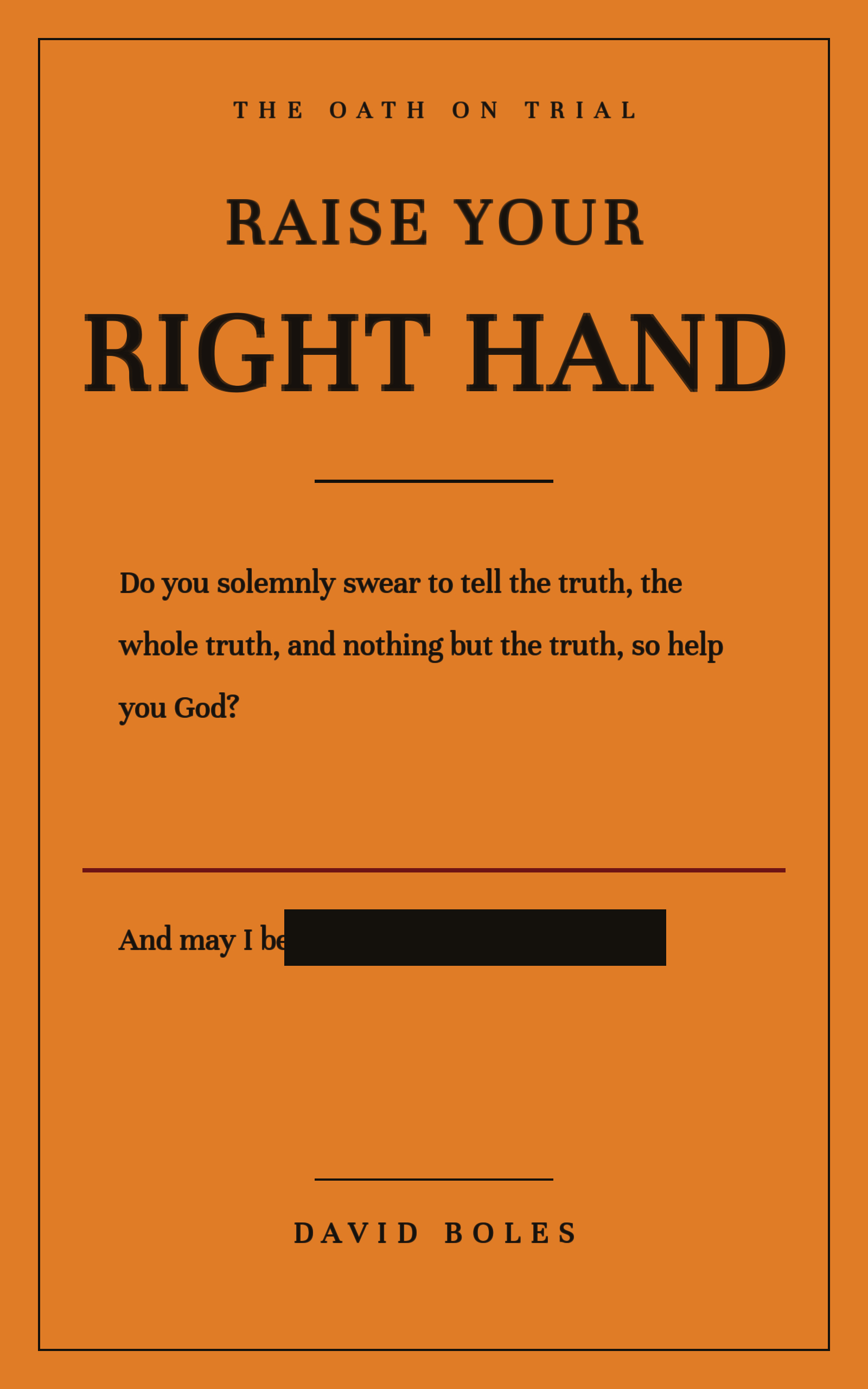
All of this is the long way of saying that I wrote a book about it, and the book is out now. It is called Raise Your Right Hand: The Oath on Trial, and it tells the whole story from the first clay tablet to the latest federal form: the curse the oath used to carry, the machine the law built to replace it, the people who would not swear at all, and the signature line where it all comes to rest. The Schleitheim story is in it, and the Quakers’ ledger, and the clean sentence of 1722, and everything the plain word had to go through to get itself believed. You can find it at bolesbooks.com, and wherever books are sold.