

Kansas handed American law its test for the words of the dying. My new book goes back to the room where the belief had to prove itself.
On the twenty-second of May, 1929, in officers’ quarters at Fort Riley, Kansas, a woman named Zenana Shepard asked her nurse to bring her the bottle of whiskey she had drunk from just before she collapsed. Clara Brown fetched it. Mrs. Shepard said the smell was strange and the taste was strange, and she asked whether enough was left in the bottle to test for poison. Then she said, “Dr. Shepard has poisoned me.” She died that June. Fort Riley sits where the Republican and the Smoky Hill run together to begin the Kansas River, prairie ground with a parade field on it, and in that room the oldest belief in the law of evidence was spoken onto the plains: the belief that the dying do not lie.
I am a child of this same grass, one state north. My boyhood summers belonged to North Loup, Nebraska, and my first paid byline arrived in Lincoln when I was ten. The prairie is where I learned that a plain sentence, plainly witnessed, is the whole of journalism and most of the law. So when I went looking for the room where America decided what a dying sentence is worth, I confess some satisfaction that the room turned out to be here, on the flat honest middle ground, a long way from marble.
◊
The belief itself is older than the country. In 1789, in a poisoning case called Rex versus Woodcock, England’s Chief Baron Eyre told a jury that a person at the point of death has every motive to falsehood silenced, and stands under an obligation equal to the oath itself. Behind his charge sat a Latin maxim the law still recites: nemo moriturus praesumitur mentiri. No one about to die is presumed to lie. On that faith, courts have let the dying testify through the mouths of the living for centuries, in murder trials above all, where the witness who knows the most is the one the crime removed.
The American test, though, was made from this Kansas room. When Zenana Shepard’s sentence reached the Supreme Court in 1933, Justice Cardozo wrote the opinion that still guards the door: a dying declaration is admitted only when the speaker acts under a settled hopeless expectation of death. Hope contaminates. Despair qualifies. The prairie supplied the facts that forced the rule to say, at last, exactly what it meant.
◊
The Prairie Voice names failures alongside virtues, so here is the failure first. In December 1930, a jury at Kansas City convicted Major Charles Shepard of murdering his wife, and among the evidence it weighed was her accusation, admitted as a dying declaration. The Supreme Court held that admission wrong. When she spoke, hope had yet to leave her, so her sentence came through a door that should have stayed shut, and the prairie’s first verdict rested on words the law later ruled no jury should have heard.
And here is the virtue. Kansas took the correction. Retried at Topeka under the repaired rule, the case ended in acquittal in February 1935. Whatever else those two verdicts prove, they prove a place willing to be wrong in public and then to try the question again in the open, which is more than most institutions ever manage, and which is the prairie habit I trust most.
◊
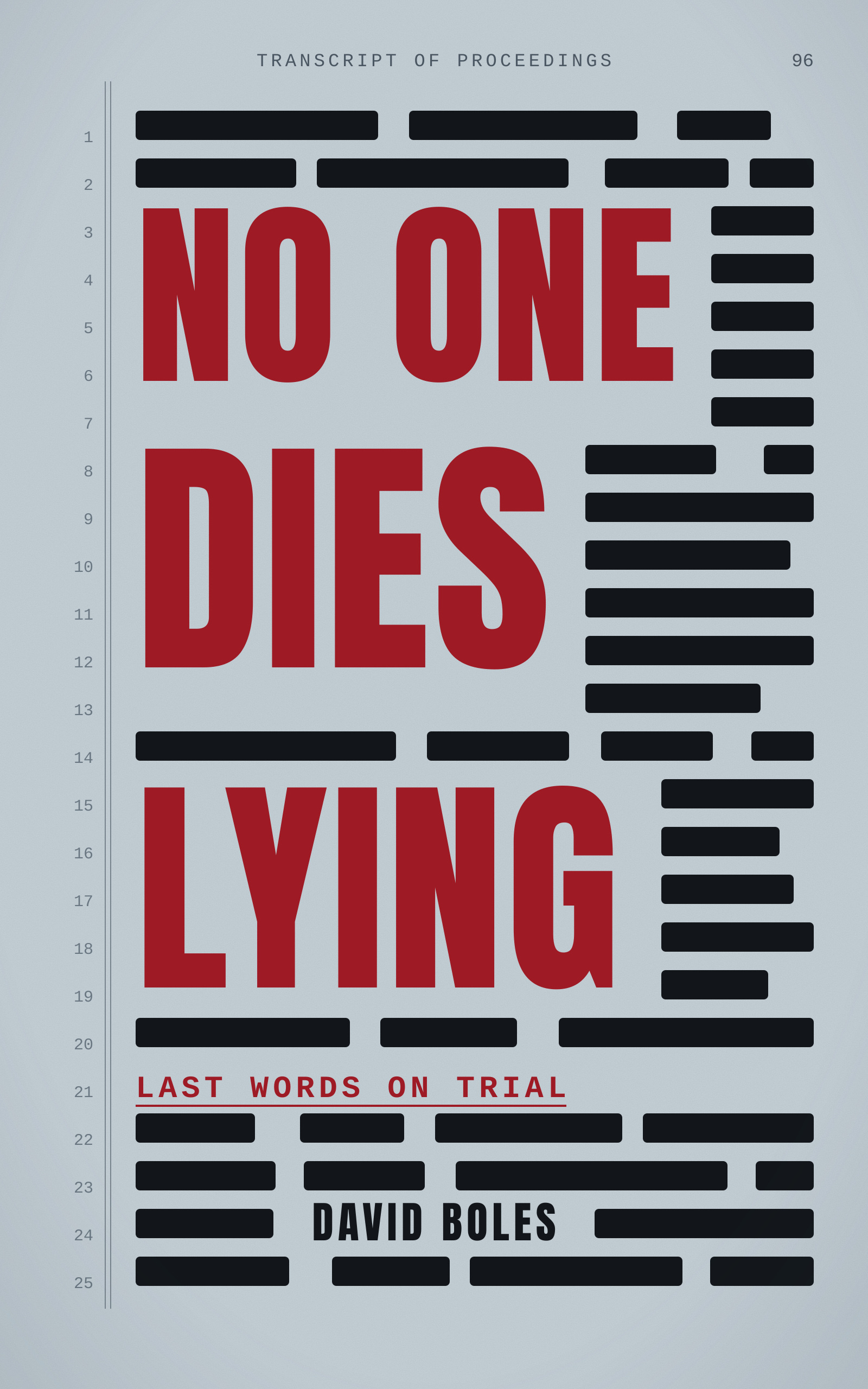
That room kept pulling at me for years, and the pull became a book. No One Dies Lying: Last Words on Trial is out now from David Boles Books: fourteen chapters, a history of the belief and a cross-examination of it.
The account runs from the Kansas sickbed to the Tudor scaffold, where the crown liked its dying speeches scripted, then to the modern gurney at Huntsville, where a microphone waits on the last statement. It walks into the theatre, where Desdemona spends her final breath on a lie told in love, the one thing the law swears cannot happen.
It weighs the deathbed conversion Charles Darwin never made and the private 1922 letter in which his own daughter conceded that the man who carried the false story had probably carried it faithfully. And it follows the doctrine into the present, to the 911 call and the body camera, and to one modern silence that startled me more than any case: no American reported decision has yet received a dying text message as a dying declaration. The most common way a person in trouble now reaches for help has never once carried the doctrine’s weight in a published American opinion.
◊
Now the part the Prairie Voice would ask about anyway. The woman this book orbits never speaks in it firsthand, because she cannot. Zenana Shepard reaches us only through other mouths: the nurse who carried the sentence, the record that carried the nurse. A book against secondhand certainty is built, unavoidably, from secondhand material, and I kept that discomfort on the page instead of sanding it away.
The front of the book states the rule I wrote under. Quotations were verified against primary reports and scholarship. Claims were shrunk to what the sources prove. A dozen good stories were left out entirely because no source could be found for them, and a few of the excluded are named at the back, with the reasons. On the last day before press, I ran one final search for a court ruling the book had been waiting on, found nothing published, and printed the empty return with the date on the page. The prairie taught me that habit before any law school could have: when the field gives you nothing, you report the nothing.
◊
Somewhere on this flat honest ground tonight, somebody will lean toward a bed and listen. The law has an opinion about what they will hear. After the officers’ quarters, the scaffold, the gurney, the stage, and the silence in the reports, I have one too, and the book gives it in its last chapter, where a verdict belongs.
No One Dies Lying: Last Words on Trial is available now in Kindle and paperback, with a free PDF edition, complete with its index, at bolesbooks.com.