

At night, the western counties of North Dakota glow as if someone built a city where no city exists. The light comes from gas flares, thousands of them, burning at the tops of steel stacks across the Bakken shale formation. The same eerie luminescence stretches across the Permian Basin of West Texas and southeastern New Mexico, across the Eagle Ford in South Texas, and into the Powder River Basin of Wyoming and Montana. Every point of light marks waste: natural gas that costs more to capture than the oil it accompanies is worth in delayed production. From orbit, the VIIRS satellite instrument aboard the Suomi NPP and NOAA-20 platforms detects each flare as a discrete thermal anomaly, cataloguing roughly 10,000 upstream flare sites worldwide every year through the Nightfire algorithm developed by the Earth Observation Group at the Colorado School of Mines. The American prairie, once defined by darkness and wind, now registers on satellite imagery as a chain of industrial bonfires stretching from the Canadian border to the Rio Grande.
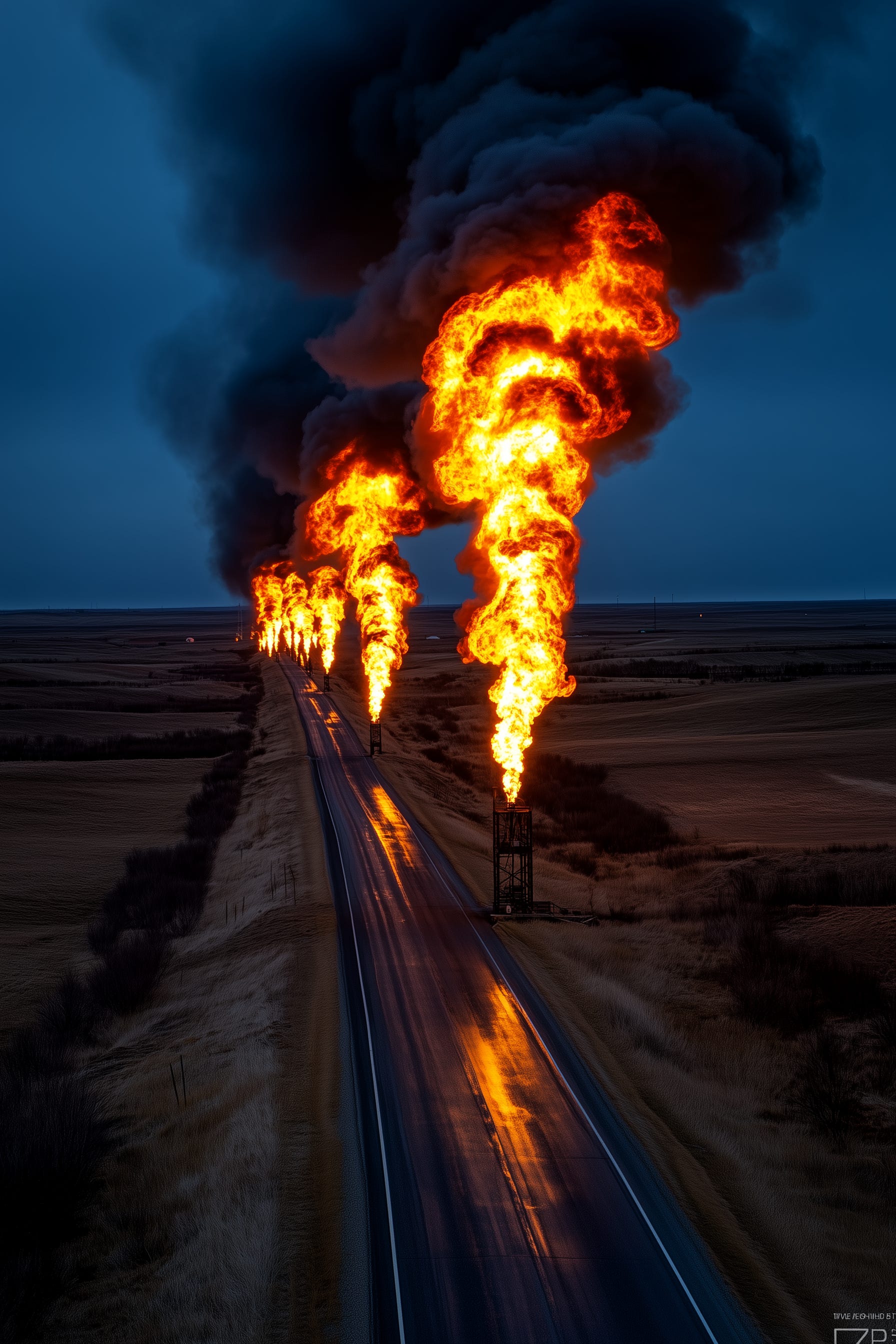
The physics are straightforward. When a well is drilled for crude oil in a shale formation, natural gas rides up with the oil as an associated byproduct. If pipeline infrastructure exists to gather and transport that gas, operators can sell it. If the pipeline has not been built, or if existing pipelines are running at capacity, operators face a choice: shut in the well and lose oil revenue, or burn the gas at the wellhead and keep the oil flowing. For most of the shale boom era, operators have chosen to burn. Flaring is, in one narrow sense, less destructive than the alternative: if the gas were simply vented into the atmosphere as raw methane, the short-term warming impact would be roughly eighty times worse per molecule than the carbon dioxide that combustion produces. Regulators and operators invoke this comparison often, and it is accurate on its own terms. What the comparison omits is that neither burning nor venting accounts for the third option of building capture infrastructure in advance of production. In North Dakota, where the Bakken formation produces roughly 1.45 million barrels of oil per day at its peak, the state’s gas-to-oil ratio hit an all-time high of 3.03 Mcf per barrel in July 2025, meaning each barrel of crude now brings more associated gas to the surface than at any point in the play’s history. The North Dakota Industrial Commission has pushed gas capture targets from 74 percent in 2014 to 91 percent by late 2020, and flaring rates have dropped to around 6 percent of total production in recent years. That sounds like progress until you realize that 6 percent of a rapidly growing denominator still represents an enormous volume of gas converted to heat, carbon dioxide, and particulate matter every hour of every day.
The Permian Basin operates on a larger scale and with fewer regulatory constraints. Covering 86,000 square miles from south of Lubbock past Midland and Odessa and into southeastern New Mexico, the Permian produces nearly half of all U.S. crude oil and a quarter of the nation’s natural gas. To its credit, the Permian has achieved measurable reductions: flaring intensity fell from above 4 percent of gas production in 2019 to roughly 1.2 percent in 2022, driven by pipeline buildout, changed well-completion practices, and voluntary industry initiatives. Those gains, however, have eroded. Flaring surged to five-year highs in early 2026 as pipeline capacity constraints returned and gas prices at the Waha Hub turned negative. The Texas Railroad Commission, the misnamed agency that regulates oil and gas operations in the state, nominally prohibits routine flaring under State Rule 32. In practice, the Commission grants thousands of exceptions each year and has never denied an operator’s request to increase flaring. A March 2026 analysis by the Rocky Mountain Institute examined twelve months of Texas self-reported data ending in late 2024 and concluded that the actual volume of gas vented and flared may be four and a half times higher than what operators report. The reported figure was 120 billion cubic feet; the estimated actual figure was 551 billion cubic feet. Converted to emissions, that gap represents roughly 7.6 million metric tons of methane, a greenhouse gas impact equivalent to 100 million passenger vehicles driven for a year.
The satellite record confirms what the self-reports obscure. MethaneSAT, launched in 2024 by the Environmental Defense Fund and Harvard University, found in a February 2026 report that methane emissions from Permian Basin production facilities between May 2024 and June 2025 were four times higher than the EPA’s official estimates. Senator Sheldon Whitehouse of Rhode Island opened a formal investigation in March 2026, requesting information from eight leading Permian operators, including ExxonMobil, Chevron, ConocoPhillips, and Occidental Petroleum, about how each company monitors its emissions and what steps it is taking to close the gap between reported and observed releases. The discrepancy between corporate pledges and satellite measurements has become a recurring theme. Companies in the Oil and Gas Decarbonization Charter have committed to reducing methane emissions to 0.2 percent of total marketed gas by 2030; MethaneSAT measured an overall Permian rate of 2.4 percent, twelve times the target.
The economics that produce this situation are blunt. When natural gas prices at the Waha Hub in West Texas average negative $0.37 per MMBtu, as they have so far in 2026, operators lose money on every cubic foot they send to market. Pipeline capacity out of the Permian has not kept pace with production growth, and the resulting bottleneck drives prices below zero during periods of seasonal maintenance. Analysts project that prices could approach negative $10 per MMBtu during those maintenance windows. Under these conditions, flaring is the rational economic choice for a producer whose revenue depends on crude oil. The gas is an obstacle, and fire is the cheapest disposal method.
Building capture infrastructure changes the equation, but the capital costs are front-loaded and the payback is uncertain. In the Bakken, the WBI Energy Bakken East Pipeline project, approved with up to $500 million in state support from the North Dakota Industrial Commission, aims to carry gas from western production areas to eastern demand centers, with a first phase targeting November 2029 service. A separate joint venture by Intensity Infrastructure Partners and Rainbow Energy Center will build a 344-mile pipeline across North Dakota to increase takeaway capacity and support local processing. In the Permian, the 2.5 billion cubic feet per day Blackcomb Pipeline is expected to enter service in late 2026, and Kinder Morgan’s Gulf Coast Express expansion will add roughly 570 million cubic feet per day around mid-2026. Collectively, the industry expects approximately 4.5 billion cubic feet per day of new pipeline capacity to arrive in the second half of 2026 and early 2027. Those numbers sound large, but the Permian’s gas production has nearly tripled since 2018, and the gassier zones of both the Permian and the Bakken are the zones operators are moving into as prime oil acreage matures.
A 2023 study by researchers at the University of North Dakota and the Energy and Environmental Research Center examined whether reinjecting associated gas back into Bakken wells could reduce flaring while simultaneously boosting oil recovery. The results were promising: gas reinjection increased oil recovery by 34 percent and was judged economically feasible. Proven technology exists to treat the associated gas as a resource rather than a nuisance. What remains unresolved is whether the cost of deploying reinjection infrastructure, well by well and pad by pad across thousands of sites, can compete with the zero marginal cost of lighting a match.
A March 2026 paper by economists at the Environmental Defense Fund and UC Davis calculated the social cost of flaring across the three major U.S. basins. The climate damage per thousand cubic feet of flared gas runs between $17 and $24, depending on basin and gas composition. Compare that to the $2 to $7 market value of the same gas. In 2023 alone, the market value of gas flared in the Bakken, Permian, and Eagle Ford was $559 million, enough gas to heat approximately 2.5 million homes for a year. The climate damages from that same flaring exceeded $4 billion, nearly an order of magnitude larger than the market value. Contrary to the regulatory focus on methane, the paper also found that carbon dioxide is responsible for the majority of climate damages from flaring, because CO2 persists in the atmosphere for centuries while methane, though far more potent per molecule, breaks down over roughly a twenty-year period.
The people who live nearest to the flares carry the costs in their bodies. A joint study by the USC Keck School of Medicine and UCLA Fielding School of Public Health, published in Environmental Health Perspectives, examined 23,487 live births in the Eagle Ford Shale region between 2012 and 2015. Women living within three miles of ten or more nightly flare events had 50 percent higher odds of delivering a premature baby than women with no flare exposure. The study used satellite-detected proximity to flares as a proxy for actual air pollution exposure, a methodological limitation the researchers acknowledged and which the Texas Oil and Gas Association cited in challenging the findings. Proximity is an imperfect stand-in for measured particulate concentrations, but measured concentrations are unavailable in most of these counties because of the sparse air monitoring network described below. The magnitude of that increased risk was comparable to what researchers have documented for women who smoke during pregnancy. Premature infants face complications including underdeveloped lungs, feeding difficulties, and long-term neurodevelopmental problems. The study found that Latina women, who constituted 55 percent of the study population, bore the heaviest exposure and the greatest increase in preterm birth risk, a finding the researchers attributed to both proximity and the compounding effects of poverty, limited healthcare access, and lifetime exposure to environmental stressors. Flares release benzene, a known carcinogen; formaldehyde; nitrogen oxides, which cause chronic lung damage; hydrogen sulfide, which produces nausea and headaches; fine particulate matter; carbon monoxide; and black carbon. A broader assessment by USC and UCLA found that more than 535,000 Americans live within three miles of flaring sites, with 39 percent of those, roughly 210,000 people, exposed to more than 100 nightly flare events. The Rocky Mountain Institute has mapped flare locations against census data and concluded that flares and their emissions are linked to preterm births, pediatric asthma, pulmonary disease, smog formation, and cardiovascular harm.
The air monitoring in these regions is thin to the point of absurdity. Across the entire Eagle Ford Shale, an area roughly the size of Delaware, the Texas Commission on Environmental Quality maintains seven air monitors, the same number stationed in the single city of Dallas. Only two of those Eagle Ford monitors track pollutants released by flares. In the Permian, monitoring gaps are equally wide. When Senator Whitehouse questioned oil companies about their emissions, Chevron responded by expressing appreciation for his interest. ExxonMobil and Occidental pointed to their voluntary charter commitments. The gap between the corporate communications and the satellite record remains unresolved.
What the prairie experiences is a transfer of value. The wealth generated by crude oil extraction flows to shareholders, royalty holders, and state tax coffers. The costs of flaring, the carbon dioxide warming the atmosphere for centuries, the methane amplifying that warming over the next two decades, the benzene settling into the lungs of pregnant women in Karnes County or Dunn County, those costs are externalized. They show up in Medicaid spending on neonatal intensive care, in rising insurance premiums, in the slow alteration of climate patterns that will reshape agricultural viability across the same plains where the wells are drilled. A March 2026 EDF-UC Davis paper found that health expenditures from local air pollution near flaring sites vary by a factor of eighteen across basins, driven by differences in population density near the flares. In the sparsely populated Bakken, the health bill per unit of flared gas is low because fewer people breathe the emissions. In the denser communities of the Eagle Ford, the same volume of flared gas produces an outsized medical burden. The arithmetic is grotesque in either case: the value of the gas being burned is a fraction of the damage its burning causes.
Regulation is shifting, though the direction is uncertain. A federal Waste Emissions Charge, designed to impose a fee on methane releases, has been delayed. North Dakota has invested hundreds of millions in pipeline infrastructure to move its gas to market rather than burn it, a strategy that depends on continued demand for natural gas in power generation and, increasingly, in data center operations. The Permian waits for new pipelines that will take years to complete while production continues to grow faster than infrastructure. In the meantime, the satellites keep counting. Every night, the VIIRS instruments aboard three separate NOAA platforms scan the prairie, recording each flare as a point of thermal light against the dark ground. Data from every pass is processed at the Payne Institute at the Colorado School of Mines and published for anyone to see. Beneath that orbital gaze, the prairie glows because the economics of extraction have outrun the infrastructure of capture, and the people who live beneath that glow have no mechanism to make the producers account for what they breathe.
The question is whether this arrangement can persist. Pipeline construction is underway. Gas reinjection technology works. Satellite monitoring has made concealment impossible. The cost of doing nothing is quantifiable and large, $4 billion in climate damages from one year’s flaring in three basins, plus the unquantified but documented burden of premature births and respiratory illness in adjacent communities. Against that cost stands the industry’s preference for the cheapest disposal method and the state regulators who have never told them no. The methane prairie is a landscape of visible waste, a place where the market’s logic and the atmosphere’s physics are locked in a conflict that the atmosphere will win, eventually, at everyone’s expense.