

There is a house at the edge of Lincoln, Nebraska, that the prairie built and the country forgot. William Jennings Bryan called it Fairview. He raised it in 1902 on open ground at the edge of town, a wide porch looking out over fields that ran to the horizon, and from that porch a farmer’s son who had already lost the presidency once, and would lose it twice more, ran the closest thing the American heartland ever had to a national church.
I know the house because I played a piano in it once, at eight years old, in a parlor that had become a museum, in front of a room of Nebraska parents who had pressed their children’s collars for the occasion. I made a fool of myself that afternoon in a way I will spare you, except to say that it taught me something about performing under the weight of other people’s expectations, and that the lesson arrived in the home of a man who carried that weight better than anyone the prairie ever produced.
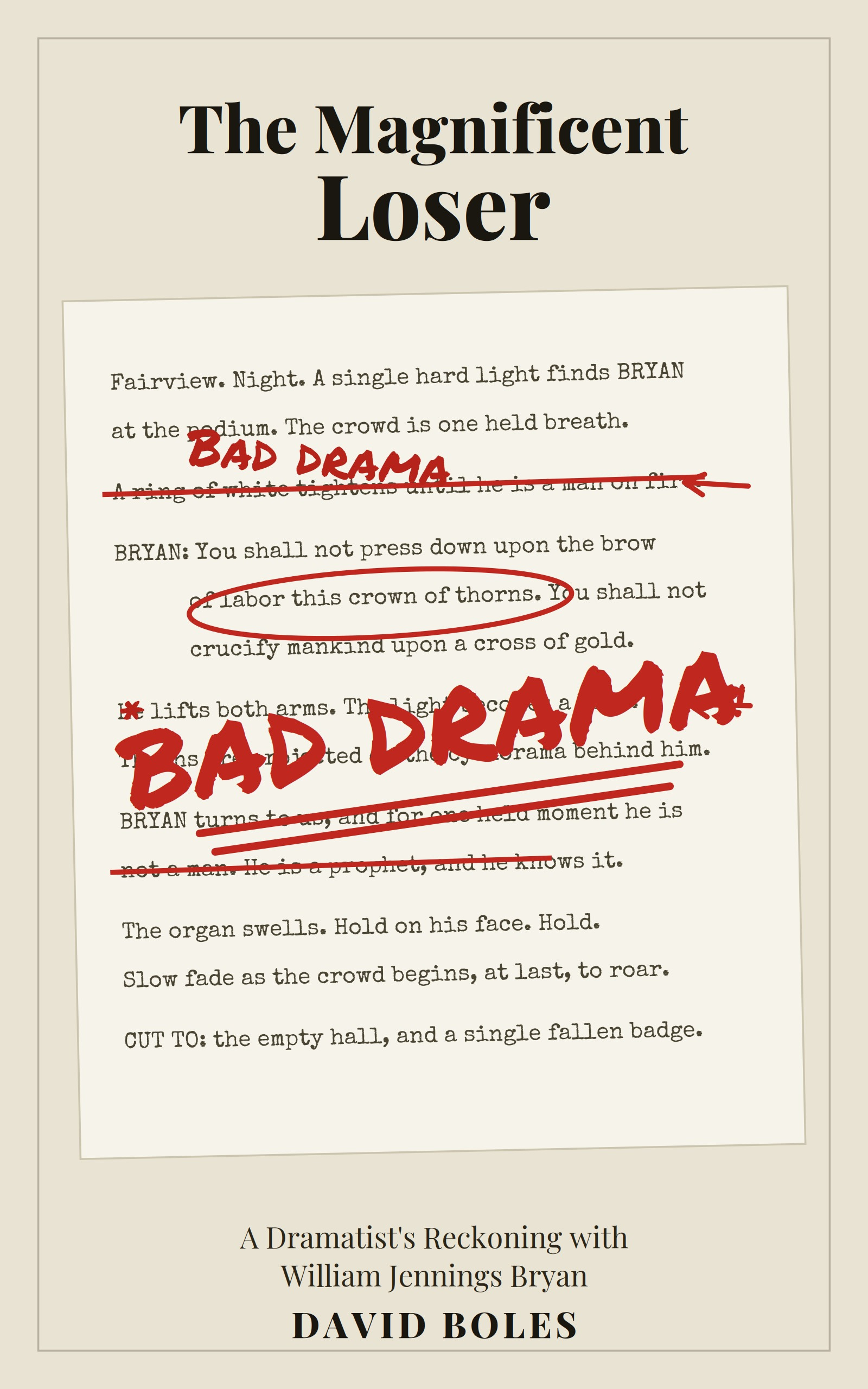
This week I published a book about him. It is called The Magnificent Loser, and it is the reason I am writing to you here, because Bryan’s story is a prairie story, and the way the country has remembered him is a prairie problem.
◊
Start with what the prairie sent him east to say.
In the 1890s the land that this publication covers was in a slow economic strangulation. Crop prices fell year over year. The money supply was pinned to gold, which meant farmers borrowed in dollars that were cheap and repaid in dollars that grew dearer every season, while the railroads set the freight rates and the eastern banks held the paper. A man could work a full section of Nebraska ground and finish the year deeper in debt than he began it. The pain was real, it was measurable, and it had a geography, and the geography was the Great Plains.
In 1896, at thirty-six years old, Bryan walked onto the floor of the Democratic convention in Chicago and gave that pain a sentence. He told the men who ran the country’s money that they would not press down upon the brow of labor a crown of thorns, that they would not crucify mankind upon a cross of gold. The room came apart. They nominated him on the spot, the youngest man either major party had ever put forward for president, and the prairie believed, for one summer, that it had finally been heard.
He lost. The money power spent what it had to spend, and he lost. He ran again in 1900 and lost again, and once more in 1908, and three times the country looked at the man the plains had sent and told him no.
Then look at what happened to the platform he kept losing on. Within a single generation the country wrote into law the program it had refused to elect: the income tax, the direct election of senators, the vote for women, a federal department for labor. The farmer’s son from Fairview had been reading a future the clever men in the eastern papers could not see. He lost the elections. He won the century.
◊
So how did a man who was that right end up as the national punchline?
The answer is the reason this belongs in PrairieVoice.
In the summer of 1925, in a small Tennessee town called Dayton, Bryan agreed to help prosecute a schoolteacher under a law against the teaching of evolution. It was the worst decision of his public life, and I do not soften it in the book. A lawyer named Clarence Darrow put the old man on the witness stand and exposed the limits of his thinking in front of the country. A newspaperman named H. L. Mencken filed dispatches that turned him into a figure of fun, a sweating relic of a backward people. Five days after the trial ended, Bryan died in his sleep in Dayton, and Mencken wrote an obituary that buried the man under the cartoon. The prose was brilliant. It was also a kind of murder.
Read those dispatches now and you will know the music, because it never stopped playing. The sneer Mencken aimed at Bryan, the contempt for the credulous rural mind, the certainty that the people of the interior are a comic and faintly dangerous species, is the same contempt the coasts still aim at the country this publication writes about. When a maternity ward closes in a county of nine thousand and no national paper notices, that is the Mencken music. When the last pharmacy in a town locks its door and the nearest replacement is forty miles of two-lane road away, that is the music again. The grain elevators coming down, the volunteer fire departments that cannot find volunteers, the towns the maps still print out of habit: the country decided a long time ago that it was allowed to find these places funny, or sad, or simply beneath its notice, and it learned that lesson watching what it did to the man from Fairview.
◊
I want to be careful here, because PrairieVoice does not trade in heroes, and Bryan does not deserve to be made into one.
The same man who warned a rising empire against the habit of conquest, who resigned as Secretary of State rather than sign a note he believed would walk the country into war, stood on a convention floor in 1924 and would not say the words Ku Klux Klan out loud. His own party tried to name the Klan in its platform and condemn it, and Bryan, afraid of splitting the rural and southern voters he counted on, helped talk the plank down. The prophet of the common man would not defend the most common decency when it threatened to cost him. The prairie produced both of those men in one body, the courage and the cowardice together, and any honest account has to hold both. Mine does. A people is not improved by being flattered, and neither is the memory of the man who claimed to speak for it.
There is a difference, though, between an honest reckoning and a cheap dismissal, and the country has spent a hundred years choosing the dismissal. It kept the cartoon Mencken drew and threw away the record, because the cartoon was lighter to carry, and because a fool from the prairie asks nothing of you.
◊
That is where my own small story meets his.
In 1985 I wrote a teleplay about Bryan and sent it to a historian for his judgment. It came back with two words in red marker across the title page. BAD DRAMA. No argument, no note, a verdict handed down the way a man waves off a fly. I buried the play. It took me forty years to understand that those two words had been a judgment on the man as much as on the writing. The historian had already decided that Bryan was not worth the trouble, and he had handed me that decision in red.
The Magnificent Loser is the long reply. It braids Bryan’s life together with that forty-year argument, and it asks the question I think the readers of this publication live inside: how does a country decide whose voices are serious and whose are a joke, and what does the decision cost the people on the wrong side of it? Bryan paid that cost for the prairie. The book is my attempt to reopen the case and let a new jury, which is to say you, decide whether the verdict holds.
◊
The house at the edge of Lincoln is still there. They kept the porch and the parlor and the piano, and on a clear afternoon the light still crosses the fields the way it did when a defeated man sat on that porch and refused to believe the country was finished with him.
He was never president, so no one can call him a great one. What he was, the prairie understands better than the coasts ever will: a man who was right too early, who failed in the open, and who was laughed at by people who were wrong. The book is out this week, wherever you find my work and at BolesBooks.com. Read it, and decide for yourself who the fool was.