

A teenager in Lincoln, Nebraska, in 1980, spends his Saturday mornings on a television soundstage at KOLN-KGIN, performing a program called Kidding Around. He is fifteen years old. The set is modest, the lights are hot, and the production is local television at its most local: a children’s show produced for a market that reaches from the Missouri River to the Nebraska Sandhills. The young performer reads his lines, hits his marks, and learns without knowing he is learning that performance is a craft one can be inside of rather than watch.
Forty-six years later, that performer has written a musical drama about an apothecary in sixteenth-century Mantua.
I am that performer. I want to explain how one becomes the other, because the route is not what people from the coasts imagine when they think about writers who come out of the prairie, and the answer has something to say about what the prairie trains its young people to do.
The conventional coastal story about a Great Plains artist is a flight narrative. In it, the artist comes from somewhere flat, leaves for somewhere coastal, and arrives at the real work only after departure. The prairie becomes a condition to be escaped, and the coast the destination. An arc bends away from home and never bends back, except perhaps in late-career nostalgia.
That story is wrong, and it has been wrong for as long as anyone has told it.
The prairie did not produce a writer who writes about Mantua in spite of being from Lincoln. Lincoln is precisely why such a writer can now sit down and write about Mantua. The two facts stand in a causal relation that the flight narrative refuses to acknowledge.
Consider what a children’s television show in Lincoln in 1980 teaches a fifteen-year-old performer. A story has a run time, a camera angle, a director who expects him to be in a particular place at a particular count, and an audience whose attention must be held from one beat to the next. An improvisation responds to the thing preparation made possible, rather than covering for a failure of it. A mark on the floor matters, and light falls where it falls whether or not anyone has asked it to. These are the lessons of production. They are the lessons a prairie teenager learns in the small studios that still exist in small cities because the local stations have not yet been swallowed by the national network consolidations that came later. In 1980 Lincoln, a fifteen-year-old could be on television twice a week. By 2000, that studio was gone and that role was gone and the local production capacity that made children’s television possible in a mid-sized prairie city had migrated to the coasts where the money had already gone.
I grew up inside a production culture that is now largely defunct. The prairie in which I learned to perform was a prairie of local stations, community theaters, high school drama departments with full-time directors, university theater programs attached to land-grant institutions, and radio stations whose afternoon hosts treated local poetry as a legitimate segment. None of this was accidental. The prairie funded its own culture because the coasts were too far away to import one. A child who wanted to learn performance could find the training because the infrastructure was local and the practitioners were working.
When I left for Columbia in the early 1990s to study at the Oscar Hammerstein II Center for Graduate Theatre Studies, I did not leave the prairie behind. I carried the prairie with me. What I found at Columbia was not a replacement for what Lincoln had given me. It was an extension. Columbia taught me the scholarly apparatus, the critical vocabulary, the historical depth, the rigor of the dramatic literature tradition. Lincoln had already taught me what performance was and why it mattered. The combination is what produces a writer who can sit down, four decades later, with a twenty-line minor character from Shakespeare’s Romeo and Juliet and build a two-act musical around him.
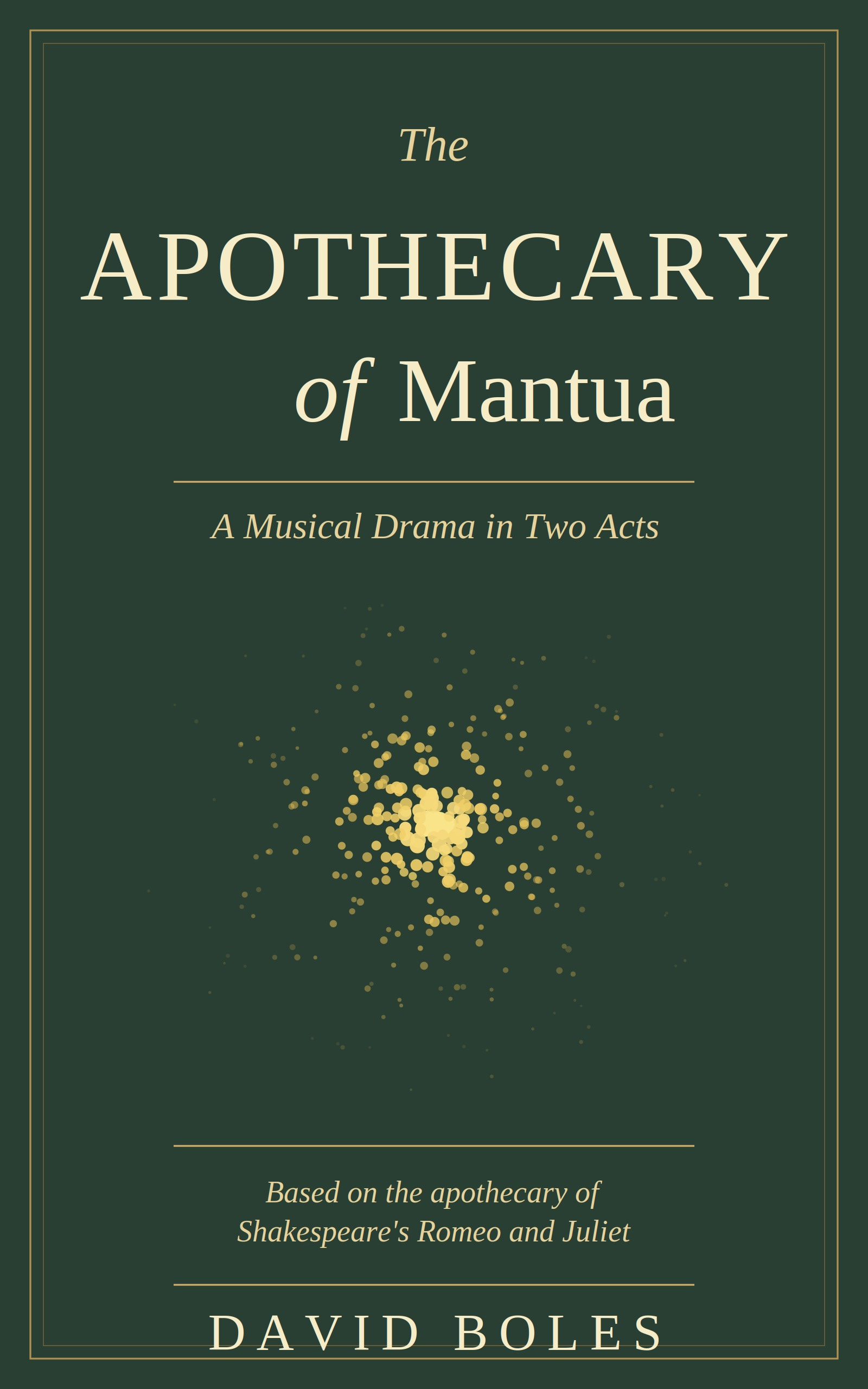
That musical is called The Apothecary of Mantua. It is out now from David Boles Books, with book and lyrics by me, in paperback, Kindle, and as a letter-size download edition for composers who might want to set it.
Shakespeare wrote the apothecary twenty lines in Act Five and disappeared him from the text. The musical asks what happened to that man in the morning after Romeo left the shop with a vial of poison and forty ducats on the counter. It imagines him as Tommaso Vesperi, a Paduan-trained physician stripped of his guild license for Paracelsian sympathies, running a clandestine clinic for the poor behind the public face of his apothecary shop. His dead wife Fiammetta, a folk healer who died in the plague of 1527, returns in the second scene as an orchestral theme. His young apprentice Nerezza runs the back-door clinic where the patients arrive after dark. The Watch Captain is on his way to the piazza because a stranger from Verona has been seen leaving the shop, and the law of the city punishes the sale of mortal drugs with death.
This is not a small story. The apparatus alone runs to four scholarly essays on Mantua in 1537, on the apothecary trade and Paracelsian medicine, on the Mantuan Jewish community, and on Shakespeare’s source text. There is a full production bible, a composer’s reference with meter assignments by character, a rhyme family inventory, a scene-by-scene musical specification.
The question I want to pose to Prairie Voice readers is why this kind of work gets written in the first place, and where the training that produces it actually originates.
A coastal MFA program does not, by itself, produce this kind of work. The coasts teach finishing. They do not teach foundation. Foundation gets laid somewhere earlier, usually in a place where a child was taken seriously as a performer or a reader or a maker at an age when coastal children were still being treated as consumers. Laying it requires local institutions that believe in their own cultural legitimacy enough to spend real money on children’s television, on community theater, on high school drama, on university programs that take their regional mission seriously. It also requires parents who drive their children to rehearsals across distances that coastal parents would refuse on principle.
The prairie laid my foundation. Lincoln did. KOLN-KGIN did. Community theaters did. University drama programs did. Prairie poets whose readings I attended before I was old enough to understand what I was hearing did. By the time I arrived at Columbia I was not a blank student to be shaped into an urban writer. I was a finished prairie intellectual being refined into a particular instrument.
The musical I have written is an instrument of that kind.
If you are a composer looking for a new musical to score, this one wants you. Four hundred and twenty-nine years of silence is a long tuning note. The libretto is ready, the characters are waiting, and I would be delighted to talk with you about setting it. Reach out through BolesBooks.com. Composers from the prairie especially welcome; the apothecary has waited four centuries for a voice, and the prairie has always known what it means to give voice to what the metropolitan imagination has declined to hear.
And to Prairie Voice readers who are not composers: the musical is available now in all three editions. Read it for the story. Pick it up for the scholarly apparatus. Or open it because the apothecary has been waiting a long time for someone to ask him what happened after Romeo left the shop, and because the answer turned out to require a writer who learned his craft in Lincoln before he refined it in Manhattan. The prairie made this possible. I am saying so plainly because the coasts will not, and because the record deserves to be corrected.