

Frank Olsen’s road doesn’t appear on any map. Not on Google, not on county surveys, not even on the property deeds that define his 800 acres in Wheeler County, Montana. For forty-three years, Frank has maintained sixteen miles of gravel trail that winds through coulees and over ridgelines, connecting his ranch to an abandoned mining camp where his grandfather once pulled copper from the earth. He calls it a goat trail. The satellite imagery shows nothing but unbroken grassland.
This is intentional. This is necessary. This is about to end.
The history of American roads is a history of promises broken and reformed.
The Appian Way taught us that roads meant empire, that Roman soldiers could march from Rome to Brindisi in thirteen days, that commerce and control followed parallel paths.
The Oregon Trail taught us that desire carves its own passages, that wagon wheels cutting through prairie grass could etch a highway of hope and death across half a continent.
Route 66 promised us freedom while delivering us to designated destinations, each town a staged performance of authentic America. The Interstate system brought us speed in exchange for place, turning journeys into transitions, communities into exit numbers.
Now the Information Highway promises us everything while locating us nowhere, tracking our every movement while insisting we’re free to browse.
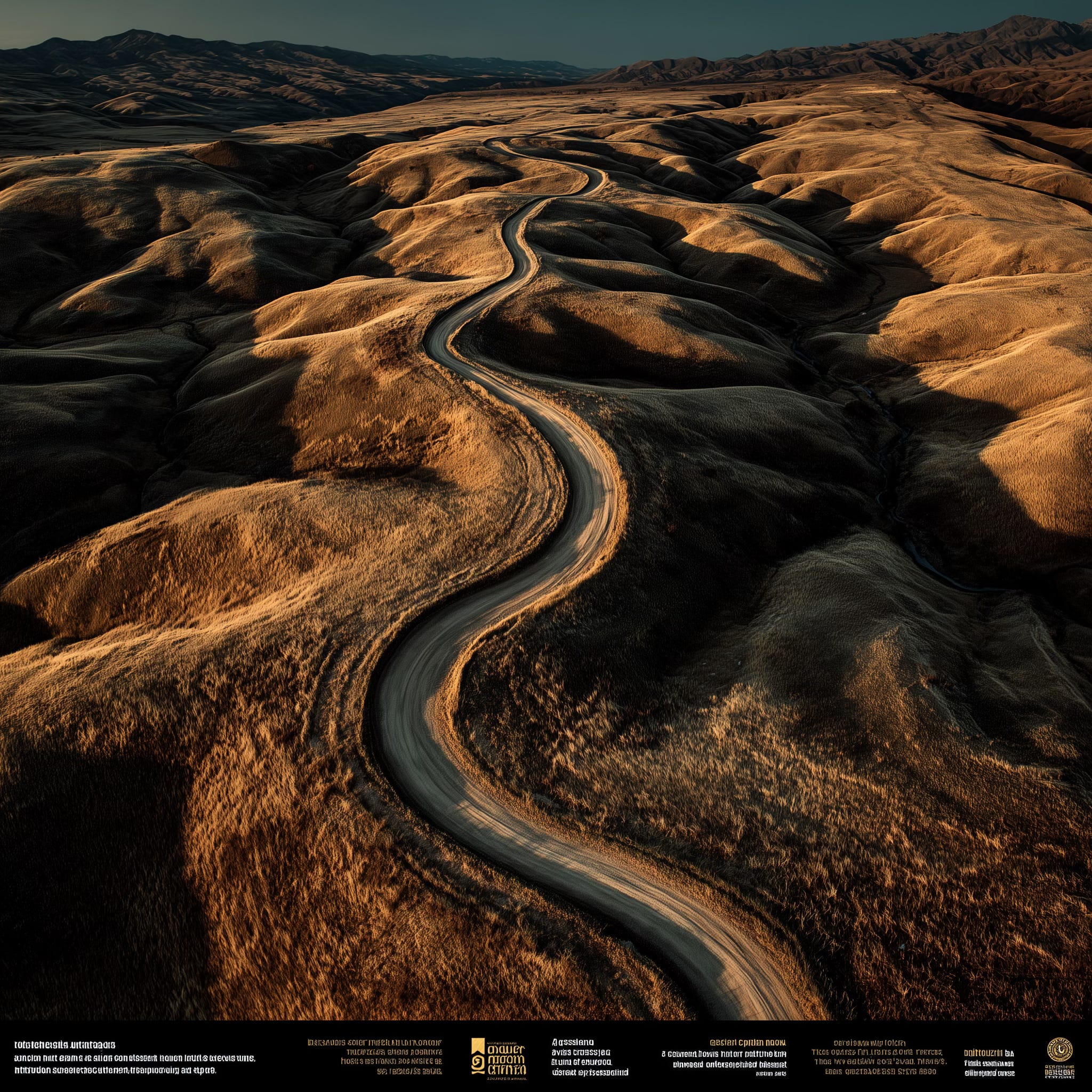
Frank learned about roads from his grandfather, who learned about them from the mining companies that built private passages through these hills in the 1920s. Those companies extracted copper for thirty years, then extracted themselves, leaving behind toxins that still poison Swift Creek and roads that weather into suggestions of roads, that become trails, that become memories of movement.
“A road is a confession,” Frank tells me as we drive his invisible trail in a truck older than the Internet. “It says where you need to go. It says what you’re willing to destroy to get there. It says who you’re willing to let follow.”
Frank’s road confession is this: after his son died in Afghanistan in 2003, he stopped believing in public destinations. He pulled his grandson out of school, taught him on the ranch, showed him how to read the land instead of screens. The boy, now twenty-four, has never had a social media account, never used GPS, never driven on a road that someone else maintains.
He knows every game trail in Wheeler County. He can navigate by stars. He builds websites for cryptocurrency traders from a satellite connection that bounces through servers in Moldova and Singapore before reaching his laptop in a cabin that doesn’t officially exist.
The road Frank maintains leads to this cabin, to a life deliberately unwired from the grid while completely connected to the network. The grandson, who asks me not to use his name, makes six figures annually from digital work while living in physical space that denies the existence of the digital world.
His commute is sixteen miles of unmarked trail that three people know about. His office overlooks a valley where cellular signals can’t reach, where delivery drivers won’t venture, where the last surveyor came in 1987 and left with Frank’s rifle pellets in his truck’s tailgate.
But here’s what Frank didn’t count on: every private road leaves traces in the data. His grandson’s satellite internet requires coordinates. The cryptocurrency transactions create patterns. The supply runs to town generate purchase histories. The absence itself becomes presence in the databases that map American movement.
Three weeks ago, Amazon delivered a package to Frank’s nonexistent road.
The driver, following directions that shouldn’t exist, drove directly to the hidden turnoff, navigated every careful curve Frank had designed to discourage discovery. The package contained something the grandson hadn’t ordered: a proposal from a technology company offering to buy the entire ranch for three times its agricultural value.
They want to build a data center here, in this valley without cell service, precisely because it’s unmapped, unregulated, a blank space in the surveillance grid that makes it perfect for activities that require geographic ambiguity.
“They found us because we hid,” the grandson says, showing me the network traces he’s discovered since the delivery. “Every time I bounced our signal to avoid detection, I created a pattern. Every absence registered as presence. The road we didn’t build became the road they followed.”
This is the paradox of the private trail in the age of ubiquitous mapping.
The Appian Way was public power made visible, stones announcing empire.
The Oregon Trail was collective desire wearing grooves in the earth.
Route 66 was manufactured nostalgia, a commercial corridor disguised as adventure.
The Interstate was federal control at seventy miles per hour. But the Information Highway inverts all previous road logic: it tracks without traveling, maps without moving, finds every path by analyzing the spaces between known routes.
Frank’s grandfather’s mining roads are being reclaimed by prairie grass and erosion, returning to earth at a rate of three inches per year. But Frank’s hidden road, the one that never appeared on any map, has been permanently etched into datasets maintained by companies he’s never heard of, in server farms powered by copper mined from places like Wheeler County, processed through fiber optic cables that follow the old railroad routes that followed the wagon trails that followed the game paths that followed the water.
Every road we’ve ever built has been a bet that connection is worth more than isolation. Frank bet the opposite and lost, not because his road was discovered, but because in the age of data, the attempt to remain unmapped is itself a form of mapping. The goat trail becomes visible precisely because it tries to remain invisible. The private road announces itself through the effort of privacy.
The grandson has a different plan. He’s going to sell the ranch to the technology company, but with a provision: they must maintain Frank’s road exactly as it is, unmarked and unmapped, a sixteen-mile corridor of analog space in their digital facility.
He’s negotiating not for money but for absence, for the right to remain unrecorded in the very machines that will surround his grandfather’s trail.
“Every generation thinks they’ve found a new way to move through the world,” he says, standing where his great-grandfather once stood, where copper miners once carved the first roads, where buffalo once moved in patterns that preceded all human planning. “But the truth is, we’re all just trying to get from where we are to where we think we need to be, hoping the path we choose doesn’t choose us back.”
The data center will break ground next spring. Frank’s road will continue to not exist, a ghost trail through a server farm, maintained by contract but traveled by no one, a monument to the impossibility of unmapped movement in a world where every absence is presence, every trail is data, every choice to step off the known path creates a new path for others to follow.
The Information Highway leads everywhere and nowhere simultaneously. It promises infinite routes while tracking every movement. It offers freedom while creating profiles. It connects us to everything while locating us precisely. Frank’s road, invisible for forty-three years, has become more permanent than the Interstate, encoded in databases that will outlast the asphalt, preserved in the very systems he tried to avoid.
We leave the ranch as sunset turns the grassland gold. The truck follows trails only Frank can see, muscle memory and landmark navigation in a world that no longer believes in unmarked passages. Behind us, the road disappears into grass.
Ahead of us, satellites record our every turn, transforming a grandfather’s grief and a grandson’s rebellion into coordinates, into commerce, into confirmation that every trail, no matter how carefully hidden, leads eventually to the same destination: a server farm in a valley that doesn’t exist, processing paths for people who will never travel them, mapping journeys that will never be taken, following roads that lead everywhere except away.