

Red Cloud, Nebraska, population 962, draws a steadier stream of pilgrims than any town its size on the southern Plains. Willa Cather grew up there, and the National Willa Cather Center on Webster Street pulls writers, scholars, and crane-watchers off Highway 281 all year long. Two doors down from the Center stands Village Pharmacy, where the owner, Heather Ockinga, fills prescriptions for the town that built American literature’s idea of the prairie. Ockinga, who also serves on the Nebraska Rural Health Board, told reporters in 2024 that if her Red Cloud location and her second pharmacy in Franklin, twenty-three miles west, were forced to close, her patients would face at least an hour’s drive to reach a prescription counter.
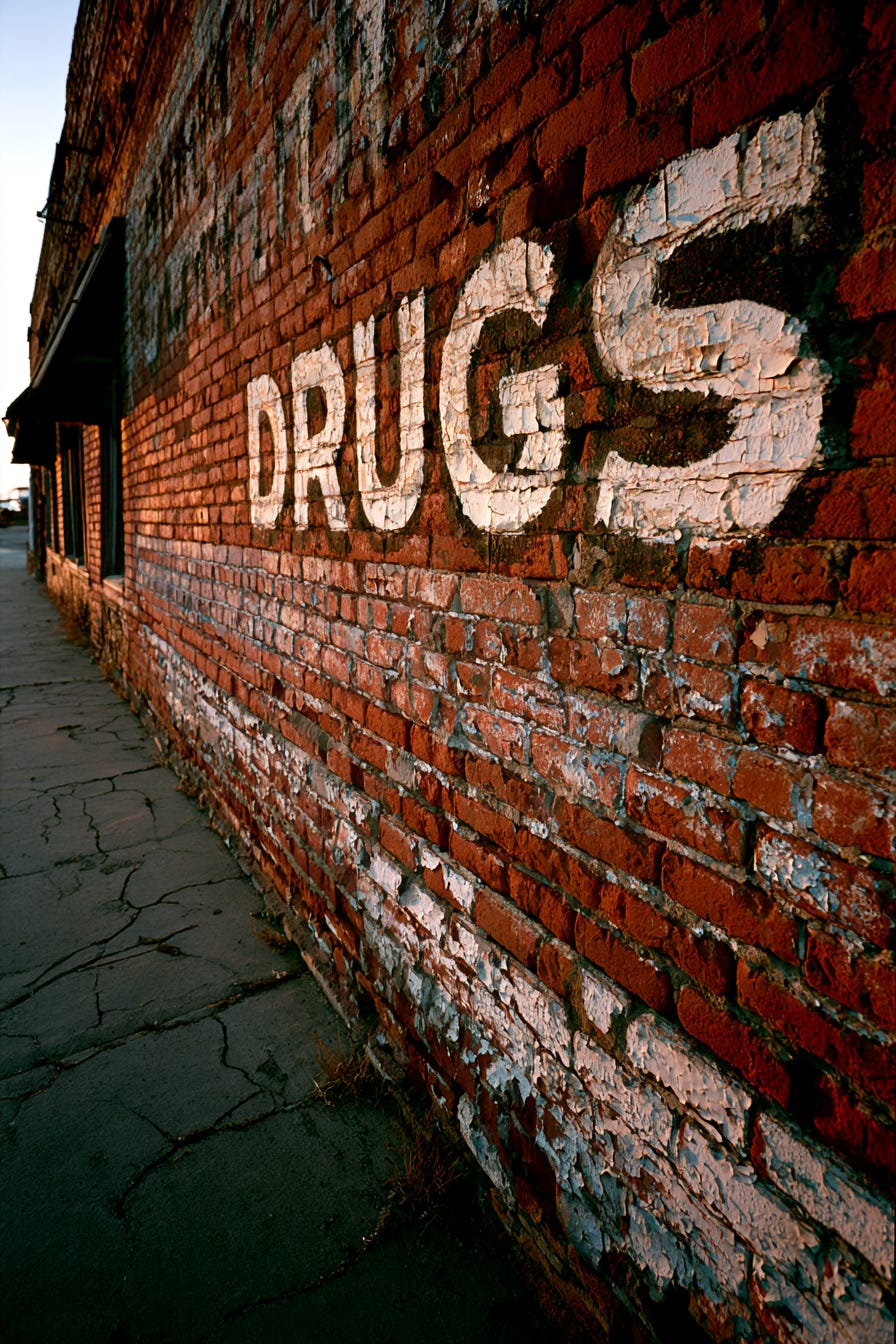
Across the state in the panhandle, that future has already arrived. Hay Springs has no pharmacy. Its prescriptions come by delivery run from Dave’s Pharmacy in Hemingford, a drive of up to forty miles, made on behalf of a community where the druggist’s counter went dark and never came back. David Randolph, who owns the Hemingford store and another in Alliance, started his career in the mid-1990s at his uncle’s pharmacy in Scottsbluff. Four towns in Scotts Bluff County had drugstores then. Two have them now, and the county’s population grew over the same period. In Box Butte County, where Randolph makes his rounds, more than thirty percent of residents are over sixty, the age at which prescriptions turn from occasional to daily.
The void spreading between Red Cloud and Hay Springs has a shape, a cause, and a paper trail. The cause is a payment system that reimburses the filling of a prescription for less than the medicine costs the pharmacy to buy. Everything else in this story follows from that single fact.
◊
Between 2010 and 2021, nearly thirty percent of the retail pharmacies in the United States closed, and since 2018 the closures have outrun the openings. Roughly 48.4 million Americans, one of every seven, now live more than ten miles from a pharmacy. The chains supplied the headlines. Walgreens closed about 500 stores in 2025 and has scheduled 700 more by 2027. CVS finished a 900-store reduction in 2024 and announced 270 additional closures for the following year. Rite Aid, a chain of more than two thousand stores when it entered bankruptcy in October 2023, filed a second time in May 2025 and ceased to exist; in Pennsylvania alone, the liquidation put twelve percent of the state’s licensed pharmacies at risk of disappearing.
The independents supplied the pattern. The National Community Pharmacists Association counted a net loss of roughly one independent pharmacy per day through 2024, the national total falling from 19,432 stores to 18,984 in a single year, and its January 2025 member survey found 30.3 percent of owners considering closure within the year. Rural counters absorbed the worst of it. Researchers at the RUPRI Center for Rural Health Policy Analysis at the University of Iowa documented a 5.9 percent decline in rural retail pharmacies between 2018 and 2023, against 3.4 percent in urban communities, and by 2021, 116 nonmetropolitan counties had no retail pharmacy at all. An earlier RUPRI count found 630 rural communities that had a pharmacy in 2003 and none fifteen years later. Deserts form in city neighborhoods too, mapped block by block in Chicago and Los Angeles, and the urban variant is real; distance is what makes the rural variant dangerous, since a gap measured in blocks can be crossed on foot and a gap measured in forty miles cannot.
Set those figures beside the institution rural America has spent two decades mourning. The Sheps Center at the University of North Carolina has tracked 153 rural hospital closures since 2010, with the worst single year, 2020, recording nineteen. A hospital closure draws a congressional hearing, a vigil, a documentary crew; a pharmacy closure draws a sign taped to the door and a phone number forty miles away. Yet the counters are emptying at many times the hospital pace. Kansas alone lost ten pharmacies in 2024, one state approaching in twelve months what the entire country’s rural hospitals lose in a bad year. In February 2025, ninety-two Kansas independents shut their doors for a single day and drove to Topeka, a strike of the medicine counter, to ask the legislature to keep them alive.
◊
The mechanism has a name most patients have never heard at the counter where it operates. Pharmacy benefit managers stand between drug plans and drugstores, deciding which medicines are covered and what a pharmacy gets paid for dispensing them. Three corporations, CVS Caremark, Express Scripts, and Optum Rx, process roughly eighty percent of American prescriptions and collect seventy percent of specialty drug revenue. Each belongs to a health insurance conglomerate. Each also owns pharmacies. The arrangement means the entity setting the reimbursement rate for the druggist in Hemingford competes against him for the same prescription.
The federal government publishes a benchmark called the National Average Drug Acquisition Cost, a survey of what pharmacies actually pay for each drug. In the NCPA’s January 2025 survey, 40.8 percent of independent pharmacists reported being paid below that acquisition cost on more than forty percent of the Medicare Part D prescriptions they filled, and 29.2 percent reported below-cost payment on half or more. Part D makes up thirty-six percent of the average independent’s business. A RUPRI analysis found eighty percent of rural independent pharmacies receiving reimbursement beneath the combined cost of buying and dispensing the medication. Translate the percentages into a morning at the counter: the till loses money when the door opens.
January 2024 turned the slow squeeze into a cliff. Medicare restructured its direct and indirect remuneration fees, the clawbacks PBMs had collected from pharmacies months after each sale, moving them to the point of sale. The transition forced pharmacies to pay 2023’s retroactive fees while absorbing 2024’s reduced payments in the same months, a double withdrawal from one account. The NCPA warned federal regulators that the existing closure rate of one store per day would escalate under the 2024 terms. It escalated.
The Federal Trade Commission documented the other side of the ledger. Its second interim staff report, released in January 2025, found the three largest PBMs marking up specialty generic drugs dispensed at their own affiliated pharmacies by hundreds and thousands of percent. Capecitabine, a chemotherapy tablet, carried a 3,289 percent markup in 2021. Across 2017 to 2022, the affiliated pharmacies collected more than 7.3 billion dollars above estimated acquisition cost, a figure growing 42 percent a year, while the PBMs reimbursed their own stores at higher rates than unaffiliated stores on nearly every specialty generic the agency examined, and pocketed another 1.4 billion dollars billing health plans more than they paid the pharmacies that filled the prescriptions. Hold both findings in one hand. The same corporations paying an independent druggist less than his cost for one generic pay their own subsidiaries thousands of percent above cost for another. Both numbers issue from a single business model, the conversion of market position into margin, with the sign flipped depending on who owns the counter.
The chains tell part of this story against themselves. Walgreens and CVS cite reimbursement pressure in their own closure announcements, and CVS owns the largest PBM in the country, which means the squeeze it describes is partly a squeeze it administers. Shoplifting, oversized footprints, and the collapse of front-of-store retail all matter in a city. In a county of three thousand people, the prescription counter carries the whole store, and the counter is where the reimbursement lands.
◊
Last year this publication mapped the veterinary desert: 243 federally designated shortage areas across forty-six states, a profession down roughly ninety percent of its large animal practitioners since the end of the Second World War. Lay the pharmacy map over the veterinary map and the voids align. The Nebraska panhandle, where Ockinga says drugstores sit “few and far between,” matches the high plains counties where the nearest large animal vet is a half-day round trip. Research out of Kansas counts 210 towns in a rural pharmacy desert, their residents averaging thirteen miles from the nearest counter, across the same shortage territory the USDA shades for veterinary medicine year after year.
A critic will say the overlap proves nothing beyond population density, and the critic will have conceded the argument. Density is the one variable no county can change. Payment rules are written by people and can be rewritten by them. The veterinarian leaves because debt service against rural livestock income makes the practice unsurvivable; the pharmacist leaves because reimbursement set below acquisition cost makes the counter unsurvivable. Two professions, one structure: each must cover fixed costs from a thin population while the price of its service is set somewhere far from the county line. When the same structure empties the same counties of two different professions, the desert carries a return address.
The map keeps extending. Entering 2025, the Chartis Center for Rural Health counted 432 rural hospitals vulnerable to closure, and maternity units retreat along identical corridors. The drugstore matters within that sequence because it was the cheapest node in rural health care to operate and therefore the last to go. A town can lose its hospital and keep most of its health if the clinic, the druggist, and the ambulance hold the line. When the drugstore goes dark, the county loses its last daily walk-in contact with a health professional, and the loudness of that signal is the point: when even the cheapest node fails, the system has stopped pretending.
◊
When a pharmacy closes, its patients stop taking their medicine, and the evidence behind that sentence is unusually strong. A 2019 study in JAMA Network Open led by Dima Qato followed 3.1 million Americans over fifty and found statin adherence fell 5.9 percentage points within three months of a pharmacy closure and stayed down across a full year of follow-up, with beta-blockers and oral anticoagulants tracking the same curve. Among patients who had been fully adherent before the closure, 15.3 percent quit their statins, against 3.5 percent of comparable patients whose pharmacies stayed open. The steepest declines belonged to patients of independent pharmacies and residents of areas with few remaining drugstores, which describes a Plains county with documentary precision. Cardiology has measured what follows the missed refills: discontinued anticoagulants and statins surface later as strokes, heart attacks, and hospital admissions, on a schedule the actuarial tables already price.
The standard rebuttal is the mailbox, and the rebuttal assumes a customer who orders online, a drug that survives transit, and a postal network that arrives on time. All three assumptions fail at scale. About nineteen million Americans over sixty-five, roughly one in three, lack wireline broadband at home, and rural seniors trail their urban counterparts even within that gap. Insulin spoils in a July mailbox on the high plains. Controlled substances carry shipping restrictions that mail order handles poorly or refuses outright. An antibiotic prescribed for a child’s ear infection on Tuesday cannot wait in a sorting facility until Saturday. Kansas pharmacists already describe lifesaving medication getting, in the words of one, “hung up half a state away,” and when a single independent closed in Garden City, waits at the remaining counters stretched to five days.
The counter performed work the reimbursement never itemized. Rural pharmacists deliver vaccines, check blood pressure, catch the interaction between a new prescription and an old one, and notice when a regular customer seems confused counting change. That unpaid clinical labor disappears from a county with no line item marking its exit, and the replacement workforce is shrinking at the source. The country graduated about 14,000 pharmacists in 2023, a figure deans project will fall toward 8,000 within four years, against federal estimates that 13,500 new pharmacists are needed annually to replace the ones leaving. Telepharmacy, legal in twenty-eight states, can return a counter to a town under remote supervision, as it did in Heber-Overgaard, Arizona, where a pharmacist forty miles away reopened the long-vacant local drugstore in 2019. The patch is real and worth building. It also requires a host pharmacy close enough to supervise, a state law permitting it, and a host that survives the same reimbursement that killed the original.
◊
The states moved first because the counties vote there. More than forty states introduced pharmacy protection measures in 2025. Arkansas went furthest: Act 624, signed April 16, 2025, made it the first state to ban PBMs from owning pharmacies outright, with a deadline of January 1, 2026. The Big Three sued within weeks, and on July 28, 2025, a federal judge enjoined the law on Commerce Clause and TRICARE preemption grounds; Arkansas appealed, and the first structural remedy in the country now sits frozen in litigation while the closures it targeted continue on schedule. Montana set a floor instead, requiring commercial reimbursement at acquisition cost plus a fifteen dollar dispensing fee starting in October 2025. Nebraska’s LB 198 bans mandatory mail order and lets a pharmacist decline to fill a prescription priced below cost. North Carolina barred PBM contracts from forcing any pharmacy in a desert to accept below-acquisition reimbursement.
Washington has the FTC’s findings, an agency action over insulin pricing, and a pair of bills aiming to separate PBMs from pharmacy ownership, one from Senator Elizabeth Warren, the other from Representative Adrian Smith of Nebraska, whose sprawling third district contains both Hay Springs and Red Cloud. Broader PBM reform was stripped from the December 2024 spending package in its final hours. The fix on the table requires no invention. Medicaid’s fee-for-service program already pays pharmacies their actual acquisition cost plus a professional dispensing fee surveyed against real overhead. The federal government knows how to price the filling of a prescription. It prices it honestly in one program and permits the opposite arithmetic in the programs where most rural seniors live.
Cather wrote Red Cloud into her fiction under borrowed names, and the town’s institutions, the depot, the opera house, the drugstore, anchored a literature about who stays on the land and who gets priced off it. A century later the question has come for the drugstore itself. Heather Ockinga still fills prescriptions two doors from the Cather Center. David Randolph still drives the forty miles to Hay Springs. Behind each of them sits a ledger, written far from the county line, that pays them less than their cost to keep a town’s medicine within reach, and behind the ledger sit corporations collecting thousands of percent above cost at counters they own. The last pharmacist in a county holds a job title that doubles as a countdown. When the count reaches zero, the federal payment system that produced the outcome will record it as efficiency, and the county will record it the way the Plains have always recorded such things: another light off on the main street, another forty miles added to staying alive.