

Before the Civil War, Americans died at home. They were washed by their families, dressed in their best clothes, and laid out in the front room of the house. The front room was called the parlor, from the French “parler,” to speak, because it was the room where you received visitors. When a death came, the parlor became the viewing room, and the community came through to see the body and to sit with the family and to bring food and to say what needed to be said and, just as often, to say nothing at all, because the act of showing up was the message and the message did not require words.
The grave was dug by neighbors. The body was carried to the burial site by men who knew the dead person’s name. The women cooked. The children watched. The preacher spoke, or the family spoke, or nobody spoke and the silence was the ceremony. When it was over, the mourners walked back to the house and ate the food and sat in the chairs and stayed until they were no longer needed, and sometimes they were needed for days, and they stayed for days. Nobody sent a bill. Nobody offered a package of services with a base fee and optional upgrades. Death was handled the way a barn raising was handled, or a harvest, or a flood: by the people who lived there, with the tools they had, because there was nobody else to call.
I grew up knowing this world without understanding it. Every weekend of my adolescence was organized around a three-hour drive from Lincoln to North Loup, Nebraska, Friday evening out, Sunday evening back, to visit my grandfather as he died slowly in the hospitals and care homes of the Great Plains. I knew the smell of his decline and the sound of his breathing as it thinned. I watched the trajectory of his body as it retreated from the world over years. By the time he died, I had already absorbed the loss in increments, and the funeral felt like a formality, a ceremony marking something that had happened long ago in a series of spare bedrooms in small towns whose names I can still recite.
My cousin wept at his funeral with an intensity that stunned me. She had not made the weekend drives. Her father was in the military, and the family moved constantly. She arrived at the church having last seen our grandfather alive and vital, and the distance between that memory and the body in front of her was more than she could hold. She grieved in a single afternoon what I had grieved across years. Neither of us was wrong. We had simply been given different amounts of exposure to the same death, and the exposure determined the shape of the grief.
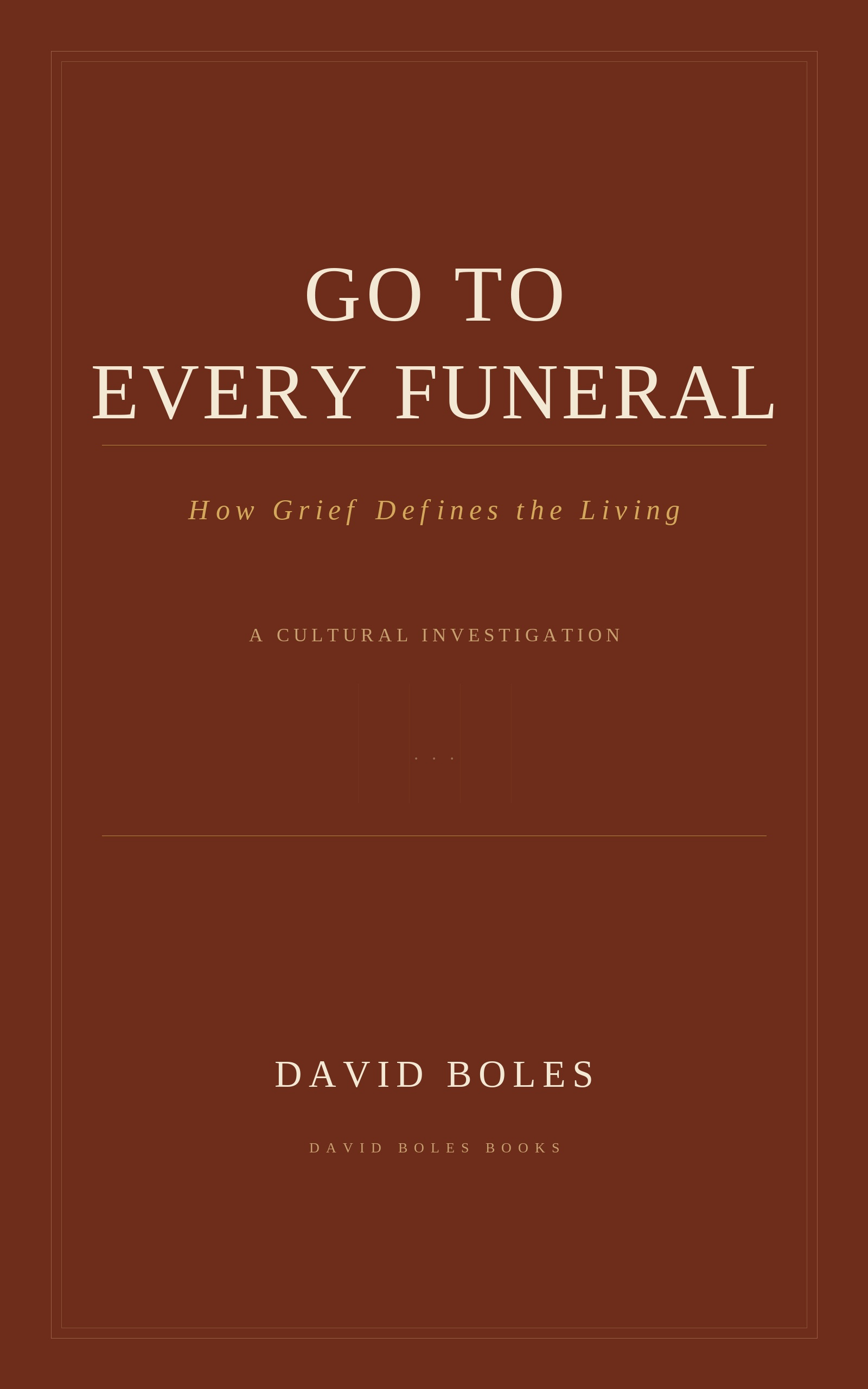
I have written a new book about this. It is called “Go to Every Funeral: How Grief Defines the Living,” and it is published by David Boles Books Writing and Publishing, and the title comes from something I overheard in a cafe in Newark, New Jersey, about twenty-five years ago. A mother pointed at her college-age daughter, tapped the table with her finger, and said: “Go to every funeral. Even if you don’t want to. Even if you don’t know them. If you know the people around them, you go.”
Six words. An entire philosophy of human obligation compressed into a single instruction. And when I heard them I realized that nobody had ever said anything like that to me, that my entire education and upbringing had failed to deliver the one piece of practical wisdom that every rural community in America already possesses and has possessed for generations: you show up for the dead because the living need you there.
The book traces grief across biology, history, culture, economics, and the deeply personal. It begins in the neurons and the hormones, where grief activates the same circuitry as physical pain, and it moves through the animal kingdom, where elephants return to the bones of their dead and crows gather in formations that researchers can only call funerals. It examines the Victorian performance of mourning, the twentieth-century suppression of grief, the commercialization of death by the funeral industry, and the question of who is allowed to grieve and who is told to stop. It contains pieces of my own life: the deaths of my grandmother, my mother, my grandfather, my mentor Howard Stein, my friend Marshall Jamison, my friend Jamie Mussack, and a ten-pound bicolor Persian named Jack who sat on my desk for fifteen years.
But the chapter of this book that Prairie Voice readers will recognize in their bones is the chapter about infrastructure. The argument is simple, and it is the argument of this book: grief is infrastructure. It requires physical space (the parlor, the church, the cemetery), human labor (the washers, the diggers, the cooks, the sitters), institutional support (the congregation, the lodge, the neighbors who know without being told that the casserole goes on the counter and the children go to the yard), and cultural permission (the understanding that grief takes as long as it takes and that the community owes the mourner its presence until the mourner can stand on their own).
Rural America built all of this. It built it out of necessity, because when your nearest neighbor is two miles away and the funeral home is in the county seat forty minutes down a gravel road, you do not outsource grief. You handle it yourself. The women wash the body. The men dig the hole. The church opens its doors. The food appears. The community shows up, uninvited, because showing up is what you do, because absence would be noticed and remembered and held against you, not as spite but as evidence that something had gone wrong in the fabric of obligation that holds a small town together.
This is what the mother in the Newark cafe was trying to teach her daughter. This is the knowledge that urban and suburban America has spent a century forgetting. The professionalization of death, which moved the body from the parlor to the funeral home, and the commercialization of death, which turned a communal obligation into a consumer transaction, did not eliminate the need for communal grief. They eliminated the mechanisms that made communal grief possible. The result is a culture in which millions of people grieve alone, in private, without a community to distribute the weight, because the community’s role was sold to an industry and the industry charges by the service.
The average American funeral now costs between seven and twelve thousand dollars. In a rural county where the median household income sits below forty thousand, that figure represents a financial catastrophe arriving inside an emotional one. Families liquidate savings, take out loans, open credit cards, and make decisions about caskets and vaults and embalming under the pressure of a grief that has not yet had time to settle into anything the mind can process. The funeral industry calls this service. What it is, in structural terms, is the monetization of a role that communities once filled for free, because the communities were intact and the obligation was understood and the idea of paying a stranger to do what your neighbors had always done would have been incomprehensible.
And now the infrastructure itself is disappearing. The rural churches are closing. The congregations that once organized the funeral dinner are aging out. The small-town funeral homes, family operations that served a county for three or four generations, are being acquired by corporate chains or shuttered outright because the population base can no longer sustain them. The cemeteries are running out of caretakers. The knowledge of how to prepare a body, how to build a coffin, how to dig a grave in frozen ground in January, is leaving with the generation that held it. What remains is a set of commercial services available at commercial prices in towns that are forty, fifty, sixty miles away, for families that may no longer have enough people nearby to fill the pews.
I think about this every time I drive through the small towns of Nebraska and Kansas and Iowa and the Dakotas, which is to say I think about it often, because these are the towns I grew up driving through and these are the cemeteries I grew up driving past, and the headstones in those cemeteries tell a story that no obituary page captures. The stones get older as you walk toward the back. The dates compress. The family names repeat and then stop repeating and then appear once more, alone, at the far edge where the newer graves are, with longer gaps between them, because fewer people are being buried there because fewer people are dying there because fewer people live there anymore.
The cemeteries are the last census of a rural community, and they are more honest than the official count, because the official count measures who is living and the cemetery measures who stayed long enough to be buried. The families that left, the young people who went to Omaha or Kansas City or Denver and did not come back, do not appear in the cemetery. Their absence is the story. The cemetery tells you who was here and who remained, and the empty plots at the edge, the ones that were purchased decades ago by families that have since scattered, are the physical evidence of a community that expected to continue and did not.
What happens to grief when this infrastructure collapses? The book argues that it does not disappear. It persists, unprocessed, in the bodies and minds of the survivors. It reappears in forms the culture does not always recognize as grief: in alcoholism, in domestic violence, in chronic illness, in an emotional inheritance passed to the next generation that carries the weight without understanding where it came from. The opioid crisis, which has devastated rural counties with a precision that looks less like an epidemic and more like a targeted strike, is in part a grief crisis, because the communities that lost their economic infrastructure also lost their grief infrastructure, and the two losses compound each other, and no public health intervention has adequately addressed the combination.
The mother in the Newark cafe was not from a small town, as far as I know. She may have been. It does not matter. What matters is that she knew something that rural America has always known and that the rest of the country has been systematically taught to forget: that grief is not a private medical condition to be managed by professionals. It is a communal event to be witnessed by the people who show up. The funerals are for the living. The visitor book should not be empty. The casserole goes on the counter. The neighbors stay until they are no longer needed, and sometimes they are needed for a long time, and they stay for a long time, because that is what it means to live in a place where people know your name and know your dead and understand that the only appropriate response to another person’s loss is the physical fact of your presence.
Go to every funeral. Rural America knows this. It has always known it. The question is whether it will still have the infrastructure to practice it in twenty years, or whether the last parlor will close and the last grave will be dug by a machine operated by a contractor from a company based in a city three hundred miles away, and the casserole will not appear because there is nobody left to bring it.
The book is available at BolesBooks.com as a free download, and on Amazon in Kindle ($9.99) and paperback ($15.99) editions.