

Land auctioneers are dying out as a profession, and the room where the prairie got its price is closing with them.
On the first Monday of December 2025, thirty-five and a half acres of Sioux County, Iowa, sold for thirty-two thousand dollars an acre. The tract sits northwest of Orange City, 35.51 acres by the survey, 33 of them tillable, with a CSR2 soil rating of 94.5 against a county average of 86. Zomer Company Realty and Auction ran the sale live, in a room, on behalf of the seller, Audrey J. Gesink. By the company’s own account the bidding was active and the bidders were many. A local farmer won, paid about $1.13 million, and the ground will grow corn and beans. Jim Rothermich, a vice president of Iowa Appraisal who tracks land sales across the state, says it is the highest price per acre he has ever recorded in Iowa. The record it broke, thirty thousand an acre for 73.19 acres, stood for three years and came from another tract in the same county, sold live by the same firm.
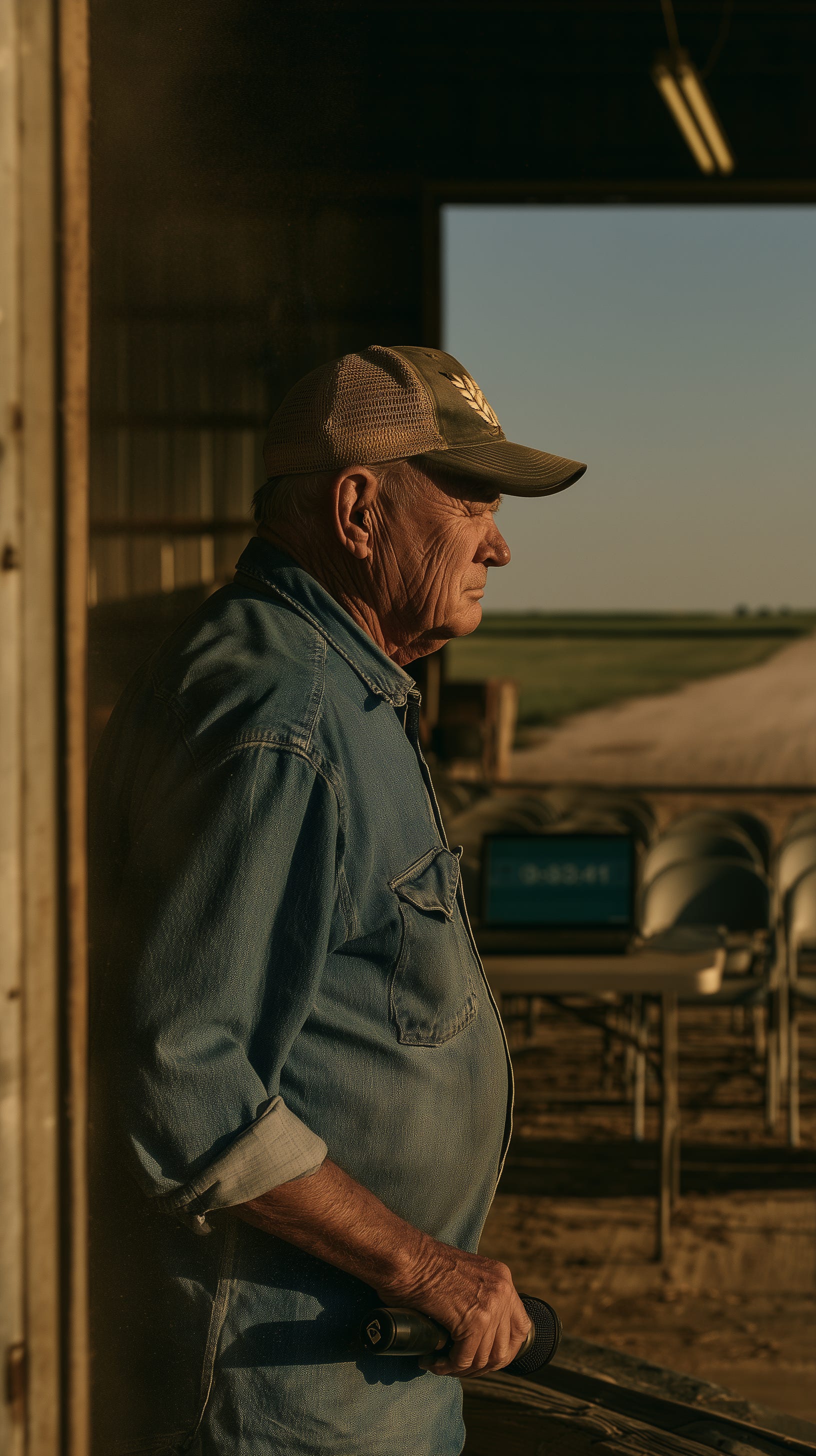
Hold that detail. The dearest acre of Iowa farmland on record was priced by a voice in a room full of neighbors. What happens to the prairie when there is no voice and no room?
The room is already closing. Every year the University of Nebraska-Lincoln asks a panel of appraisers, farm managers, and rural bankers how agricultural land in that state actually changed hands, and the 2025-26 report amounts to a count of the colonel’s losses. Hybrid auctions, live in the room and live on the screen at once, led the list at 31 percent of sales. Traditional listings followed at 29. The public auction, the open-outcry sale that has priced Plains land since the years after the Civil War, took 17 percent. Online-only auctions took 14 and sealed bids 8. Asked what had changed over five years, 39 percent of the panel said hybrid sales had increased and 27 percent said online-only sales had, against 8 percent who reported any decrease in the old public format. Jim Jansen, the Nebraska Extension agricultural economist who wrote the report, puts it in the level language of his trade: methods continue to evolve with technological advancements.
The men who cry the sales are aging out, and the men who certify the price are aging with them. The Appraisal Institute, reading the Appraisal Subcommittee’s National Registry, has charted a decline of nearly 3 percent a year in licensed and certified appraisers since 2006. By the Institute’s 2016-17 count, 62 percent of appraisers were 51 or older; 13 percent were 35 or younger. A 2026 survey by Working RE, an appraiser trade publication whose readership skews senior, found 57 percent of active appraisers over 60 and fewer than 2 percent between 25 and 39. Jim Park, a former executive director of the Appraisal Subcommittee, supplies the pipeline figure: first-time appraiser test takers are down 70 percent since 2009. The American Society of Farm Managers and Rural Appraisers, the profession’s own society, now gives journal pages and conference hours to generative AI in rural valuation. A profession that cannot replace its people learns to replace the function.
Auctioneers are harder to count, and the thinness of the count is its own evidence. Twenty-four states license them outright, according to the Knee Regulatory Research Center at West Virginia University; a 2022 Institute for Justice tally that folds in local and business licenses pushes the number to 28. Several licensing states have reported 5, 7, and even 10 percent declines in licensed auctioneers since 2009. The National Auction Association, founded in 1949 and headquartered in Overland Park, Kansas, claims thousands of members and publishes no firm figure. Sellers match criers gray for gray. The 2022 Census of Agriculture put the average American farm producer at 58.1 years old, and the ranks of producers 65 and older grew 12 percent in five years.
They still call an auctioneer Colonel, and the title predates the profession’s present troubles. The association’s own history traces it to the Civil War, when only officers of colonel’s rank could sell seized property and surplus at public sale. After the war the colonels kept selling, and civilian auctioneers followed the same trails and dressed the part until the name stuck. The chant that goes with the title is a learned skill, drilled like scales. At the Missouri Auction School, founded in 1905 and billed as the oldest and largest of its kind, students spend a week at a Route 66-themed Holiday Inn in Sunset Hills, outside St. Louis. When St. Louis Public Radio visited in 2016, mornings opened with a hundred voices working through Betty Botter bought some butter, then dollar drills. Paul Dewees, the school’s president, described the tool in terms of throughput. A working auctioneer may need to sell 60 to 100 items in an hour, he said, and the chant exists to draw out the bidder and press the urgency. His summary was three words long: it’s now or never.
On the prairie that urgency did a second job. A land sale priced the ground in public, aloud, in front of everyone with an interest in knowing. The farmer, the banker, the assessor, the neighbor who swore he would never sell: any of them could stand at the back and learn in twenty minutes what a quarter-section was worth, and the number was spoken by a man who could be found afterward and asked about it. That was a function of the room, and there was no folklore in it. The auctioneer worked for the seller, on commission, and the chant existed to pry one more bid out of a crowd he could see. Sentiment is a poor guide to what is being lost. The ledger is a better one.
The ledger, honestly kept, starts by crediting the platforms. Hybrid and online sales widen the bidder pool to anyone with a connection, spare the seller the cost of staging a crowd, and let an heir in Phoenix bid against the neighbors without buying a plane ticket. Farm Credit Services of America, which finances its share of these purchases, explains the timed online auction to borrowers in one plain sentence: it resembles bidding on eBay, a running countdown, and the sale closes at a set time. The record argues for the room only at the top of the market, since the $32,000 acre was cried live. And most farmland never meets an auctioneer in any format. The USDA’s Tenure, Ownership, and Transition of Agricultural Land survey projected that a tenth of all farmland, 93 million acres, would change hands between 2015 and 2019. Most of it would move by gift, trust, or will; roughly a quarter of the transferring acres would be sold to anyone outside the family. Even where land does sell, the buyer usually lives close. A county-level analysis by Camo.ag, an agriculture data firm, found that across Midwestern transactions from 2020 through 2023 the share of buyers from beyond 35 miles held steady, with the great majority of acres going to local hands. The prairie has not been sold out from under itself, and an honest account says so before it says anything else.
What is changing is the machinery, and then the distance of the money. AcreValue, founded in 2014, put algorithmic valuations on farmland parcels across the country and draws several hundred thousand users a month; Corteva’s Granular subsidiary sold it in 2021 to Ag-Analytics, in a deal that arrived with a strategic alliance with Farmer Mac. AcreTrader, founded in 2018 in Fayetteville, Arkansas, goes further. It places a farm in a limited liability company and sells shares to accredited investors at minimums around $10,000, accepting fewer than 5 percent of the parcels it reviews. In August 2025 Proterra Investment Partners, a Minneapolis alternative asset manager, acquired the platform itself. The ownership numbers are already moving. The USDA counts 283 million acres, 31 percent of all American farmland, in the hands of landlords who do not farm it. A Reuters investigation in 2023 found that the seven largest institutional investors in farmland had increased their properties 231 percent since 2008, with the value of those holdings up more than 800 percent, to about $16.2 billion.
Here the record has to be handled with care, because it will not carry the full weight of an elegy. No one has measured how much of that consolidation the vanishing auctioneer causes, and the data to do so do not exist. What can be proved is narrower and, on inspection, worse. The live auction was one of the last machines that forced a local price into the open and gave the neighbor first sight of it. A browser gives the neighbor the same seat as a pension fund, and the pension fund has better broadband and more patience. When the colonel retires and the county’s sales migrate to a countdown, the room stops telling the county what the county is worth. The number still gets made. It gets made elsewhere, by people whose names the county will not know.
The men who remain learned the trade when the trade was grief. The working land auctioneers of the Plains came up through the 1980s farm crisis, when they cried sales no one wanted to attend, and they lasted long enough to cry sales everyone wanted to win. Mike Brandly, an Ohio auctioneer who writes the profession’s most careful chronicle, grew up at farm auctions in Preble County in the 1960s and 1970s. His father would find the auctioneer and greet him the old way: Good morning, Colonel, where you giving out numbers? Brandly can still name the men who cried those sales, Horace Kramer, John Kramer, Harry Hudson, Jake Campbell, Dave Kessler, Jim Kottyan, a county’s worth of colonels, and the naming reads like a roll call because it is one. The pipeline behind them is the week in Sunset Hills, where the school said its students ran from teenagers to retirees, many of them bound for charity galas, far from the land. Peggy Ladd, a recent retiree in that 2016 class, described her first chant as trying to do my ABCs in Russian. She was learning a skill the land market will never ask her to use.
None of this requires mourning, and mourning would miss the point. The auctioneer was a tradesman with a rare skill, paid a percentage, and the skill priced a county’s ground in the open for a century and a half. His replacement prices it too, faster and at greater distance, and the price is often higher. The loss sits elsewhere, in the difference between a number spoken in a room and a number posted to a screen. On a sale bill for a December 2025 retirement auction outside Bridgeport, Nebraska, the live crowd is promised a start at 9:32 in the morning, the odd precision of a man who has said the words ten thousand times and knows how long a crowd takes to settle. The online catalog opens at half past noon, whenever the lots finish loading. Only one of those starting times depends on a particular man being alive to keep it.