

The new book is out, and I will not pretend this is anything other than what it is. It is an announcement, and an announcement is a claim on your attention and, at the far end of it, on your money. The law of this page is that a claim carries its proof or shrinks until it does. So here is the fact, and then the proof.
The Watermark, a Fractional Fiction novel, is published this week in three editions. A Kindle eBook on Amazon. A paperback, five and a half by eight and a half inches, cream paper, two hundred and thirty-six pages. And a web edition, the whole book as a single PDF, at bolesbooks.com. The audiobook is in preparation. That is the fact. Everything below is the proof, and the proof starts a long way from any marketplace.
The book is about a city that computes its poor as calories, and about the man who does the computing. Anselm Wenger is a clerk of the Relief Bureau, the best computer on the fourth floor of the Provident Building, and in the evenings the Quarter’s singing clerk. When the Trust that owns the water asks the Bureau for a scheme to reduce the surplus of mouths over means, Wenger writes one. He writes it as an indictment, in the Trust’s own grammar, with the Trust’s own adverbs, the Quarter’s children priced by the dressed-weight table. He believes the first reader will rise from a chair. The city reads it as a plan. What follows is the book’s year: the scheme printed, praised, corrected, adopted, and the reservoir over the Quarter climbing by chalk marks toward the spring accounting.
The method is half the book. Every Fractional Fiction novel binds three public-domain sources under one governing idea, and the sources are named in the apparatus, because the naming is the method. From Thea von Harbou’s Metropolis, the 1926 novel and the 1927 film, the book takes the city and refuses its handshake. Bertolt Brecht’s Baal, the 1922 first edition, supplies Wenger’s engine: the appetite that never repents. And Jonathan Swift’s A Modest Proposal, 1729, lends the written voice: the projector’s composure, the arithmetic carried past every human stop. Beneath the fiction sits a research record, all of it real and all of it cited: the calorie science, the charity societies and their casework, the settlement houses, the moral economy of the food riot, the year the money died in Germany.
The year the book keeps is not the calendar’s. It is the account’s own year, which runs from the books’ winter closing to the water’s spring accounting, regardless of how many calendars it outlives. Every institution in the city keeps an account, the Trust’s paper, the Bureau’s ledgers, the Settlement’s chalk, the engineers’ figures on the dam’s face, and the novel’s wager is that the reader can tell which one is honest before the year is out.
Now the part this room exists for.
I learned what relief costs a long way from that invented city. The first paid byline was in Lincoln, and I was ten. The stage took me early, and the grounding after it was medicine and law, two trades that price a person in their own units and keep ledgers about it. And the summers were North Loup, with my grandfather, and the nouns I carried home are still the load-bearing ones: the river, the valley, the county seat at Ord, the courthouse, the mill. A boy carries nouns home from a place like that the way the place carries water: without comment, and for the rest of his life.
Valley County has a relief record, and it predates any bureau. The county’s own history tells the 1874 year plainly. The grasshoppers came in the summer and destroyed every growing crop in the path of them. Settlers who had counted the yield for their winter left and never came back, and the ones who stayed practiced the strictest economy and still faced the winter short, and what carried them was contributed food and clothing, sent by friends and by the aid societies formed back East. Read that sentence of the county’s history against the century that followed it. Relief arrived then as charity, organized and voluntary. Within two generations it was a county charge, kept at the courthouse in Ord, where the county’s records begin in 1883. The drought years of the nineties emptied the newest homesteads off the valley’s marginal acres; the valley’s answer, in time, was an alternative crop, and North Loup’s Popcorn Days have run every August since 1901, which is the valley’s way of saying the record of the drought is a celebration now. In the thirties it all came back, the long Dust Bowl years, and relief went federal. The nouns changed, and the question stayed: who keeps the count of the poor, and who reads it back.
That is the question the book was written inside, and it is a prairie question as surely as it is a city one.
Before the proof, the opposing case, at full strength, because the piece fails the room otherwise. First: this is marketing wearing a byline, and a celebration of one’s own book is vanity press of another kind. Second: the book’s city is invented and its sources are European, a German film, a German play, an Anglo-Irish pamphlet, and calling it a prairie book is a stretch performed for a website’s theme. Third: the apparatus, the scholarship, the glossary, the corrections, are garnish on a novel, and a novel is not a record.
Take the first charge. It is true that this piece announces a book and asks for your attention, and the attention is asked on behalf of a thing sold. There is no answering that by denying it. The answer is the open ledger, and this page has kept one for years: the piece tells you what the thing is, what it is made of, what it cost to make, what it gets wrong and where that got fixed, and where it can be had. A claim with its accounts showing is commerce with the chalk on the wall, which is the Settlement’s method and this page’s.
The second charge has the most truth in it, so it gets the most answer. The city is invented, and the sources are European. But the book’s ground is the documented record of how the poor get priced, and that record runs straight through this county. The Bureau’s calorie tables are the Minnesota starvation research and the century’s social arithmetic. Its queue at the windows descends from the charity organization societies’ casework. The Settlement on Stocking Lane is the settlement house with the investigation stripped out, the Hull-House method, presence instead of files. The winter the paper dies is 1923 in Germany, and it is also every year the county’s farmers watched a price move between the field and the mill. And the flood that ends the book is any water that keeps its own account. North Loup had one in 2010, when the Bredthauer Dam up Mira Creek broke in the June rain and the village took eight inches down Main Street and evacuated for the duration. The book’s intake room keeps a brown line in the plaster at the height of a seated man’s shoulder, the mark of an older flood, washed at and painted over twice and back through both. The porters have a word for it: the line by which a thing is known afterward. Every town on a river has that line somewhere. Ours was on Main Street, twelve years back, in living memory.
The third charge dissolves on the apparatus itself. The book’s back matter carries the three sources with their publication data, the note on the research record, the glossary, the questions for discussion, and the bibliography, and the bibliography is real. A novel with an honest apparatus shows which record it stands on. That is all this page asks of anything, including itself.
And because this page corrects in the open, the corrections go here, in the middle of the celebration, where a reader can watch them work. The close review before printing caught two errors in the apparatus, and both were mine. One of them: the Baal first edition was credited to Munich’s Drei Masken Verlag, and the 1922 first edition is Potsdam’s Gustav Kiepenheuer Verlag; the apparatus now says so, and cites the scan of that edition. The other: the Ullrich history of the year the money died had the wrong American publisher; it is Liveright, and the entry now says so. Both fixes are in every edition. The page has corrected the record this way before, against broadcast and against memory, and a book about an honest account should keep one.
Now the evidence that the book earns the celebration, because celebration without evidence is the decayed form.
The book’s counter-institution is a house on Stocking Lane called the Settlement, and its practice is the count: persons kept as persons, in public, in chalk, unembarrassed. It feeds without files and reads the Bureau’s letters aloud twice, the letter and then the person out of it. The Bureau prices; the house reads back. Against the year’s whole method, which is absorption, the house’s whole doctrine is one sentence: the count stands. The count is a refusal before it is anything else: the refusal to let a person be reduced to the number the window wants first. The book’s boy gives his number before his name because the queue taught him that the number gets the card and the name gets questions. He is eleven. The file calls him Rabeder, Ferdinand; his mother called him Ferdl; the file is what the Trust feeds. A county that has kept relief in a ledger knows that boy. Every ledger has one.
The book’s fourteenth chapter is the crowd, and it is the piece of the novel I will put up against any hostile reading. The Quarter takes the Trust’s stores after the flood, and the crowd does not loot. It seizes the grain and sells it at the just price, computed from the year’s own records, and it pays the clerks with receipts entered, because the crowd’s whole argument is that the clerks were not the account. It burns the Voice’s plates and spares the presses, because the Quarter can tell the instrument from the hands. And it makes one error, a chandler’s stock two lanes off the yard, and when the count catches it, the crowd comes back and pays, in coin, at the just price, and the error goes into the chalk beside the receipts. This is not a novelist’s optimism. It is the documented behavior of the eighteenth-century food riot, the moral economy in the record: the crowd that pays is the crowd that argues, and it frightened the authorities more than the mob they expected. The figures the crowd prices by are a dead girl’s. She kept the yard’s count, unpaid, because her hand did not shake, and she found the error in the scheme’s tables, and nobody with power heard her in time. The Trust’s scheme was wrong by a fifth. Her arithmetic was exact to the penny.
There is one more thing the ledger does not show, and it is the thing a reader hears. This book is written for the ear in places. The Quarter carries its news by voice and its music the same way, and the songs inside the book work as songs: the gate-stair song, with the rain that never read your tables; the counting song, the lanes’ abacus, in which both lists rhyme; the water song, unfinished for most of the year because its second verse is the people under the water saying their goodnights, and its third verse is the flood, which the Quarter writes in company. The Trust counterfeits the songs by editing rather than inventing. It moves one word. The paper war of the year is fought over that one word, and the Quarter’s children settle it in the pump hall by singing the true one in the Trust’s arrangement. I have read that page aloud more than any other in the book, and it holds.
The celebration, then, is something narrower than the existence of a book. Books exist by the pallet. The celebration is that the account exists, and that it is correct, and that I know what correctness cost, because I watched the year’s work collect it. The house motto holds: yes is hard, no is easy, and the book’s ending is the year’s hard yes: the head reads the hands’ account, says it is correct, and does not say the Trust will pay it; the price replaces the handshake. A reconciliation that costs nothing is the frame’s word for absorption, and this house does not publish the frame’s words.
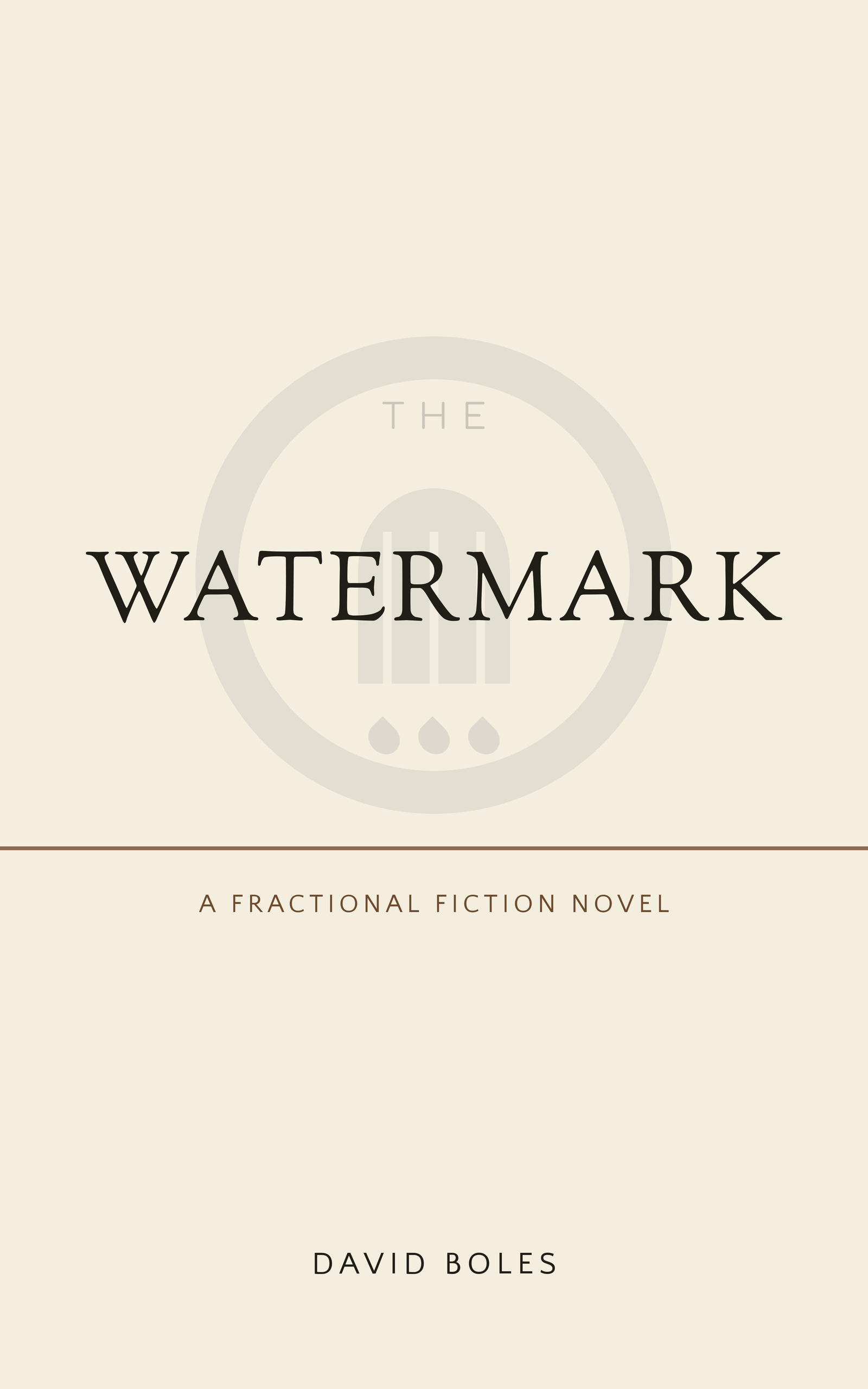
The account of the thing itself, briefly, because the ledger asks. Sixty-one thousand words, give or take, in fourteen chapters, with the full apparatus. The cover was built from the book’s own materials: the Trust’s seal, the gate and the three drops, ghosted into the cream sheet the way a watermark is held in paper, THE set into the top of the ring like the legend of a stamp, the title crossing the seal’s middle, and the brown line crossing all three panels at the same height. Finished alongside: the narrator’s guide for the audiobook, with the pronunciations, the history underneath, and a list of what a first reader might miss. The web edition is typeset on cream with the cover carried as its first page, for anyone who wants the book without the marketplace at all.
I said the proof starts a long way from any marketplace. It ends there too, briefly. The eBook and the paperback are on Amazon; the web edition is at bolesbooks.com. And the audiobook will be announced here when it is ready.
The porters’ word for the brown line is the line by which a thing is known afterward. A village reads its flood that way, eight inches down Main Street and gone by morning, and a county reads its droughts that way, popcorn every August, and a reader can read a book that way, if the book was built to be read that way. This one was. The count stands.