

There is a dairy barn standing in Nance County, Nebraska, and if you go inside it with a flashlight you can read the names of children on the beams.
They carved them there. Some scratched them into the wood, some wrote them, and they have outlasted the school, the government that ran it, and every adult who ever told them their own names were the wrong ones. The barn is what remains of the Genoa U.S. Indian Industrial School, which operated on this ground from 1884 to 1934, fifty years, on a campus that ran to hundreds of acres beside what is now the Loup River Power Canal.
The school had a cemetery. Nobody can find it.
That is the part I want to put in front of you before anything else, because it is the sort of fact this publication exists to sit with. Researchers have been looking for years. The Genoa Indian School Digital Reconciliation Project, formed in 2017 and co-directed by Margaret Jacobs of the University of Nebraska–Lincoln, has gone through federal records, letters, and newspaper clippings across the country. Judi gaiashkibos of the Nebraska Commission on Indian Affairs and the State Archeologist have brought ground-penetrating radar onto the old campus, and then crews with shovels and trowels, working by hand, sifting for anything at all.
The record says at least eighty-six students died at Genoa, most of them of disease, tuberculosis and typhoid mainly, with one death recorded from an accidental shooting and one from drowning. Nine are recorded as buried in the school cemetery. Thirty-seven were sent home to their nations. The final resting place of about forty is unknown. Excavation has turned up dirt.
An institution that took children from forty nations, kept them for half a century, and buried its dead on its own grounds, then mislaid the ground.
I want to be careful here, because there is a way of writing about this that turns children into an argument. The names in that barn are handwriting. A hand held the knife, and the hand belonged to a child who was being told that name was the wrong one.
But the argument exists, and it is bigger than Genoa, and it is the subject of a book I am publishing this month.
Genoa belonged to a system, and the system was national. The federal investigation opened in 2021, prompted by the unmarked graves found at a residential school across the Canadian border, documented an American network that ran from 1819 to 1969, more than four hundred federal schools across dozens of states, into which tens of thousands of Native children were taken. The Department of the Interior identified more than eighteen thousand of those children by name and said plainly that the real number was far larger. It confirmed the deaths of hundreds at the schools, a count later raised to nearly a thousand, and called its own figure incomplete. It located burial grounds at dozens of the sites.
None of this was new information in 1969, or in 2021. It was documented in 1928, when the survey team led by Lewis Meriam delivered its report on Indian administration and produced some of the most damning pages the federal government has ever written about itself. Meriam’s investigators found children fed on roughly eleven cents a day, with half their school hours diverted into the labor that kept the institutions running, in dormitories packed past any defensible capacity, with tuberculosis moving through them.
The system was told, in writing, by its own inspectors, and it ran for another forty years.
The template was built by a man who thought he was performing a rescue.
Richard Henry Pratt had fought in the Indian wars. In 1875 the army gave him custody of seventy-two Plains prisoners at Fort Marion in Florida, and he cut their hair, put them in uniforms, set them to lessons and wage work, and called the result a success. In 1879 he opened the Carlisle Indian Industrial School in an abandoned barracks in Pennsylvania, the first of its kind run by the federal government. Nearly eight thousand children passed through Carlisle across four decades, from a hundred and forty nations.
Pratt was, by the standards of his time, a reformer. He rejected the widespread belief that Native people were biologically inferior and destined to disappear. Against men who wanted the tribes exterminated, he offered schooling as the humane alternative. He put his purpose in six words that have never been improved on as a description of what the institution was for.
Kill the Indian, save the man.
He meant it as mercy. That is the whole difficulty. The harm at Carlisle and at Genoa was not a failure of the schools to do their job. It was the job, carried to completion, by people who believed they were saving the children in front of them. The cure was the erasure.
Government also liked the arithmetic. Fighting the tribes in the field cost the Treasury far more than schooling their children into submission. One administrator could describe the final campaign of the Indian wars as a campaign waged with the classroom instead of the cavalry, the child taken in place of the territory.
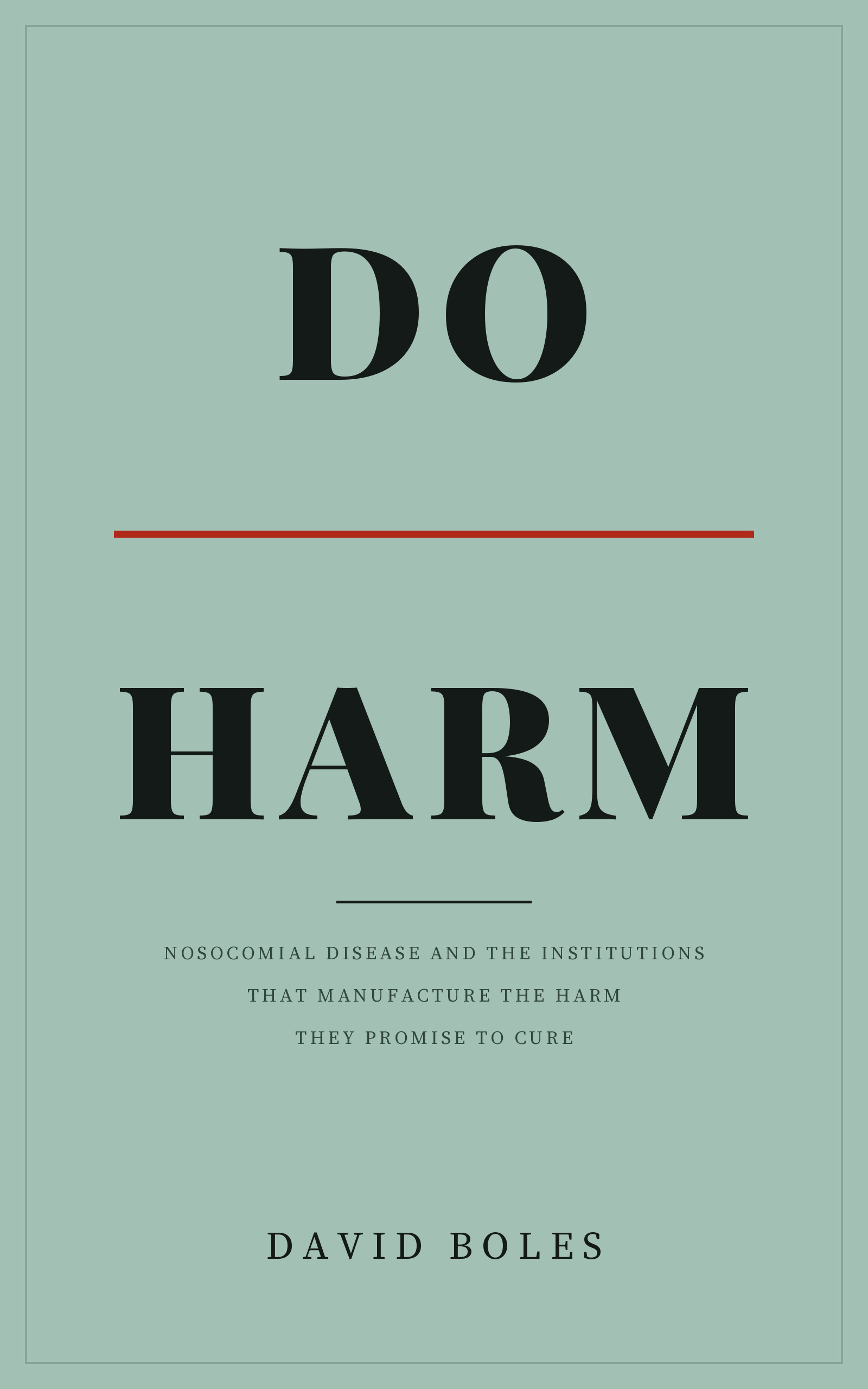
Do Harm is out this month from David Boles Books, and Genoa sits inside its argument even though the book never names the town.
The book begins somewhere else entirely, in a Vienna maternity ward in 1847, where a doctor named Ignaz Semmelweis worked out from a register of the dead that he and his colleagues were carrying childbed fever from the autopsy room to the delivery bed on their own hands. He put a basin of chlorinated lime at the door and the death rate collapsed. His colleagues destroyed him for it. He died in an asylum of the same class of infection he had spent his life trying to stop.
Medicine has a word for the illness a patient does not have on arrival and carries home on discharge. The word is nosocomial. It means hospital-acquired, and it is more than a century old, and it was built to let a room full of decent people discuss a horror without anybody’s voice changing. The book takes that word apart, then follows the shape it exposes out of the hospital and into the prison, the asylum, the school, the parish, the research protocol, and the congregation that promised deliverance and delivered the grave.
The structure repeats. Only the costume changes. A house is raised to end a harm. It produces that harm through its ordinary operation, while every person inside it does the job as taught. And the institution, once shown the evidence, defends itself, because the finding does not accuse it of failing. The finding accuses it of being what it is.
That is why the Meriam Report changed nothing for forty years. Not because it was weak. Because it was correct about the thing the system could not survive believing about itself.
This is my home ground. That is why the piece belongs here.
The plains are good at building institutions and better at losing the paperwork. We put up the schools and the asylums and the county homes and the reformatories, staffed them with people who mostly meant well, and then let the prairie do what the prairie does to anything nobody maintains. The grain elevator empties. A barn leans. The cemetery goes back into the section line, and a hundred years later a crew with trowels kneels in a Nebraska field and finds nothing but dirt where forty children ought to be.
The Interior Department has now written down what the schools cost. Nebraska has written down eighty-six names it can prove and knows there are more. The digging continues. The barn still stands, and the names are still in the beams, cut by hands that were told those names did not belong to them.
Whatever the institution promised, that is what it kept.
Do Harm: Nosocomial Disease and the Institutions That Manufacture the Harm They Promise to Cure is available now from David Boles Books in eBook and paperback. The full catalog is at BolesBooks.com.
From Nebraska to New York, the silos are hollow until hallowed.