

The first monster ever commissioned in recorded human history was paid for in grain.
We do not have the receipt for any specific commission, but we have the receipts for the rate structures that made the commission possible. The Oriental Institute in Chicago, the British Museum in London, and the Vorderasiatisches Museum in Berlin together hold thousands of surviving cuneiform tablets from the Old Babylonian period that document the temple-economy labor market. The tablets establish three architectural facts. Skilled artisans were paid in measured rations of barley, supplemented by silver weights for specialized commissions. Those silver weights came from the temple’s barley surplus, traded along the river-and-canal networks for the precious metals the alluvial plain itself could not produce. Beneath both, the temple’s ownership of irrigation infrastructure gave the priesthood structural control over agricultural production across thousands of small holdings.
Anyone who has read a Kansas county assessor’s report can recognize the architecture immediately.
This is the opening proposition of my new book, Commissioned Monsters: A Labor History of Fear, published today and available as a free web PDF download from BolesBooks.com. The book traces the history of monstrous figures across approximately four thousand years of human cultural production, beginning with a specific clay mask in the British Museum’s Mesopotamian galleries. The mask was made to terrify. Hooded sockets sink its eyes into darkness, serpentine coils wrap its brow, and a chipped tooth grins from the left side of its mouth. The mask is approximately three thousand eight hundred years old. Someone paid for it. Someone profited from the fear it generated. The transaction is documented at the architectural level even where the specific invoice has not survived.
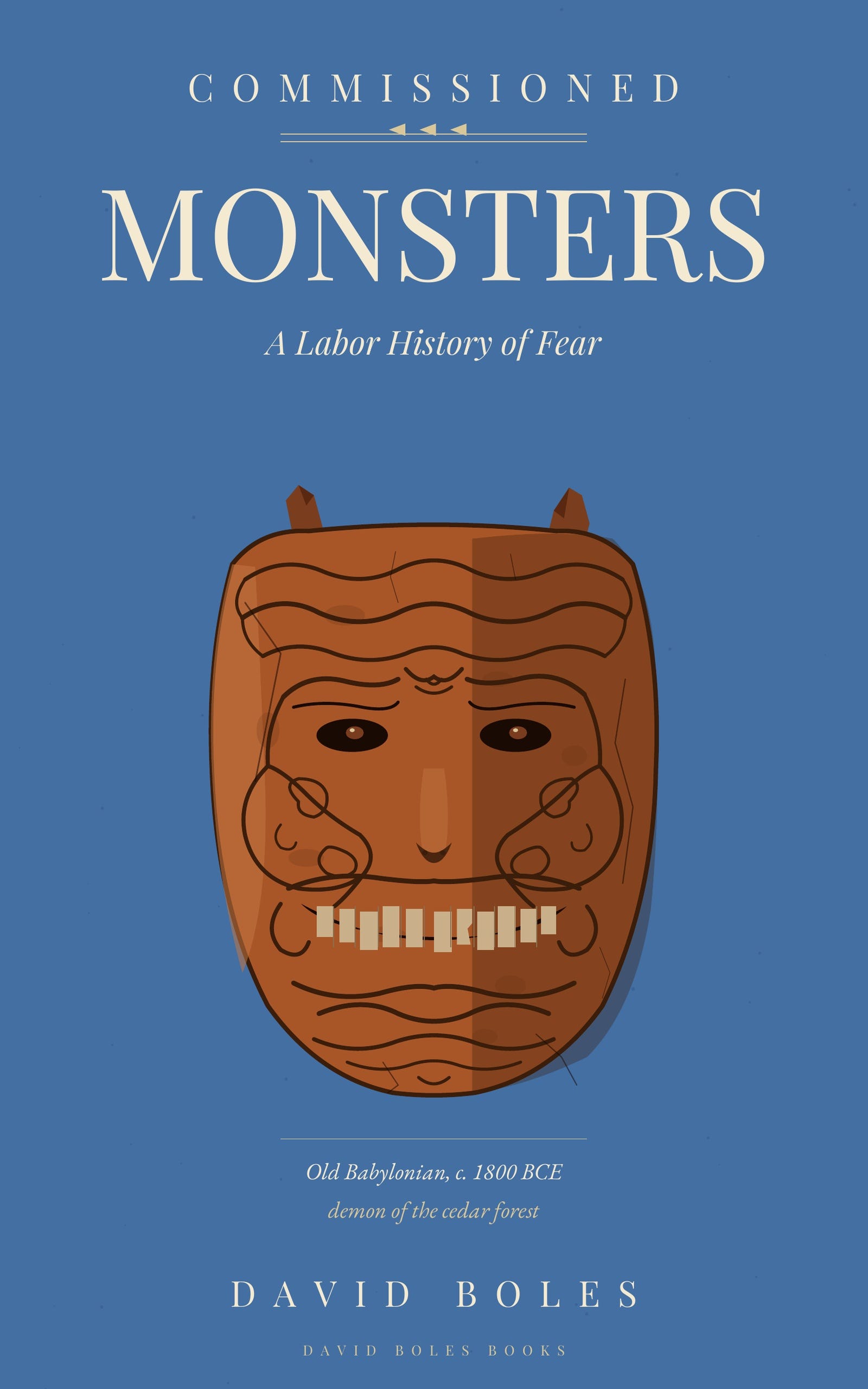
The argument of the book is straightforward in its premise and exhausting in its application: every monster you have ever encountered was made by somebody, paid for by somebody, and continues to generate profit for somebody. There is no collective unconscious doing this work. There is labor, there is an invoice, and there is a beneficiary. Most of the cultural commentary of the last hundred years has treated monstrous figures as expressions of some deep cultural psyche, which has the effect of letting the contractors who designed and sold those figures disappear into a fog of mystical attribution. The book refuses the fog and works through twenty case studies, naming the contractors where the documentary record permits naming them.
I want to do something here that the book does not do. The framework deserves application to a figure the book does not examine in depth, and the readers of PrairieVoice are uniquely positioned to test it. Who designed the commissioned figure called real America?
The phrase entered American political life through specific people at specific moments. Sarah Palin’s October 16, 2008 fundraiser remarks in Greensboro, North Carolina, gave the modern launch point: small towns described as “the real America” and as the “pro-America areas of this great nation.” The phrase had antecedents reaching back through Nixon’s silent-majority construction, through Wallace’s stand-up-for-America deployment, through earlier nineteenth-century heartland mythologies that constructed Jeffersonian agrarianism as the moral center of the republic against banking and industrial cities. Its 2008 redeployment, however, is the version operating in current political life, and its contractor architecture is recoverable from the documentary record.
The contractor was the McCain campaign’s communications operation in coordination with the speechwriting class clustered around it. That speech followed several months of campaign-internal framework testing in which similar formulations had been deployed and refined through rally-response measurement. The frame moved from the rally circuit into television amplification, then into fundraising direct-mail testing, then into the Tea Party network as it formed in 2009 and 2010. By the 2012 election cycle, the frame was operating below the surface of every Republican primary debate and most of the campaign rallies. By 2016, it had become the central organizing premise of the Trump primary insurgency, refined by Stephen Bannon and the operatives clustered around Breitbart News and similar media properties.
The beneficiaries were also specific. The frame generated fundraising returns at scale across every cycle in which it operated, and operatives in the political-consulting industry have spoken at conferences and in trade-press interviews about the small-dollar donor performance that rural-coded framing delivers. Talk radio empires built audience share around the frame. A specific cluster of media properties (Breitbart, the Daily Caller, OAN, Newsmax, and various successor operations) built their corporate valuations on it. Political consultants billing seven-figure cycles built careers on it.
The figure has produced approximately eighteen years of monetized political fear, with an architecture that is recognizable in its labor specifics. Someone designed it, someone paid for the design, and someone profited from the figure once it was circulating. The frame’s relationship to the actual rural population it claims to represent has been instrumental rather than representational. Rural Americans appear in the frame as moral category, with specific labor histories, specific debt profiles, specific exposure to commodity price swings, specific exposure to medical bankruptcy, and specific exposure to the labor-market consequences of agricultural consolidation pushed entirely out of the frame’s working content. The actual rural-American economic situation, which has been deteriorating across approximately the same eighteen-year span the frame has operated, is not what the frame is for. Its purpose is moving fundraising dollars and television ratings.
A separate object from this actual rural-American economic situation is the real America figure operating in political fundraising and media monetization. Rural Americans exist, and their political grievances are documented in every farm-foreclosure docket, every hospital-closure announcement, every rural-broadband disparity report, every Medicaid-non-expansion mortality study. The figure is a commissioned product whose relationship to actual rural Americans is approximately the relationship the Welfare Queen figure had to Linda Taylor: the historical referent is real, the commercial figure has been engineered to extract from the referent for the benefit of third parties.
This is the labor-history register at work.
The same procedure runs in reverse and produces parallel findings. The commissioned figure called the flyover-country resentment monster, deployed by certain national columnists and television hosts to characterize rural voters as politically and morally retrograde, is also a contractor product. It has its own designers, its own invoice trail, and its own beneficiaries clustered around national-magazine subscription bases, donor networks for specific advocacy organizations, and media-and-advocacy industries that monetize urban-versus-rural framing for their own donor base. The labor-history analysis does not require the analyst to share the politics of either commissioned figure. What the analysis identifies is the structure of how each figure has been designed, paid for, and profited from. That structure operates identically across the political spectrum.
What changes when the analysis is applied is the available political horizon. A rural voter who can identify the real America frame as a commissioned product purchased for someone else’s profit, and who can also identify the flyover-country frame as a commissioned product purchased for someone else’s profit, has acquired a discipline that neither frame can survive. The two commissioned figures can be set aside, and the actual rural population can become available again as a population with documented labor history, documented economic exposure, documented institutional needs, and documented political agency. None of those documented features will sell as well in a direct-mail letter as the commissioned figures do, and that reduced commercial value is built into the analysis from the beginning.
This is why I think the readers of PrairieVoice are positioned to receive this book with a kind of working advantage. Plains readers know what it looks like when distant capital builds a figure out of local material and sells the figure back at a markup. The grain elevator does it, the data center does it, the meatpacking plant does it: the Tyson operation in Lexington, the cattle yards across western Kansas, the wind-development leases negotiated by out-of-state energy holding companies, the ethanol refineries owned by Decatur and Chicago commodity firms, the agricultural retail consolidation that has reduced county-seat farm-supply businesses to satellite operations of three or four national distributors. Plains experience has lived inside the pattern for generations. What the book argues is that the same pattern produces monsters, has been producing monsters for four thousand years, and is still producing monsters now at higher throughput than at any previous point in the documented record.
The clay mask in the British Museum was paid for with the surplus of an irrigation economy whose participants had no name in the surviving record; the Welfare Queen figure was paid for with campaign budgets whose donors had names registered with the Federal Election Commission; the real America figure is being paid for with direct-mail returns whose donor demographic is approximately the demographic the figure claims to represent. That figure is selling rural Americans a fictional version of themselves at premium prices and pocketing the difference. This is what monster commissioning has always done. The architecture has stayed consistent across four thousand years. Only the throughput has changed.
The book is Commissioned Monsters: A Labor History of Fear. Paperback is available through standard distribution. Kindle is available through Amazon. A free web PDF can be downloaded from BolesBooks.com for any reader who prefers to read the book without paying. The free option matters because the argument of the book is precisely about who pays for what fear and who profits, and the option to read the book without paying ensures that the argument is available to readers regardless of the commercial position they occupy.
The grain that paid for the first mask is still being harvested. Those fields are no longer in southern Iraq, and the silver no longer moves through temple ledgers; the surplus is now denominated in dollars and moves through fundraising platforms and media holding-company balance sheets. Architecture has not changed. Labor has not changed. Only the names have changed. The book is an attempt to recover the names where the record permits the recovery.
I think you will find the recovery worth your time.