

In September 2025, a wooden grain elevator on First Street in Havre, Montana, came down under the claws of heavy machinery. The structure had been built and operated by the Great Northern Railway, later BNSF, as part of the Hi-Line corridor that stitched the northern plains into the national wheat trade for the better part of a century. Residents gathered to watch. Some called it history falling. Others called it an eyesore finally removed. Both were correct, and neither statement captured what was actually lost.
What fell in Havre was a node. The grain elevator was the physical address where an individual farm became legible to a commodity market, where a truckload of wheat acquired a grade, a weight, a price, and a destination. Remove the elevator, and the farm does not disappear. The wheat still grows. But the local point of sale, the place where a farmer could drive a loaded truck and convert a season’s labor into money before sundown, is erased. The network between grower and buyer loses a connection, and the surviving connections belong to someone else, someone larger, someone farther away.
This is happening everywhere.
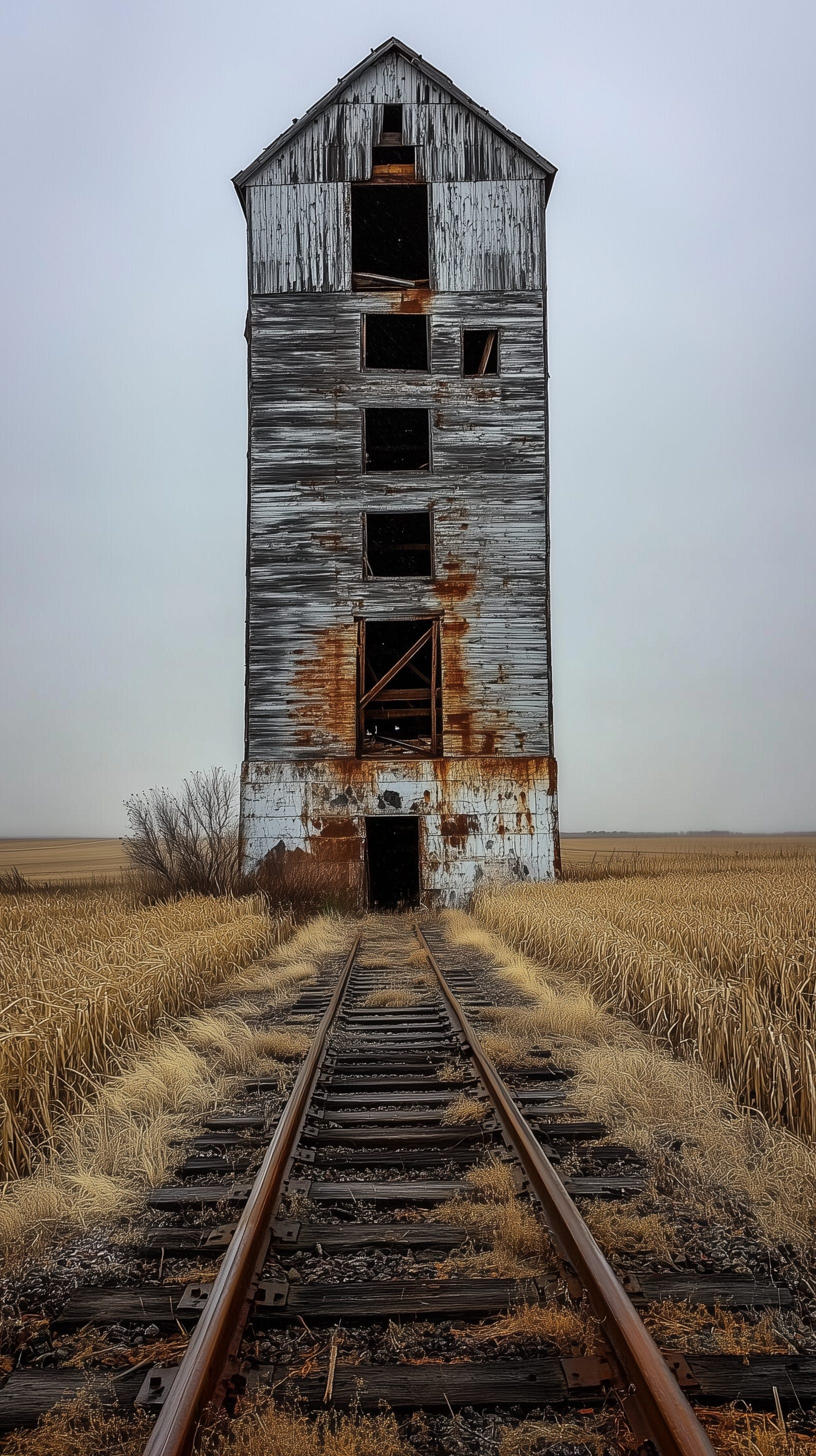
Crews in Vulcan, Alberta, tore down the town’s last remaining grain elevator in April 2025, the final survivor of a legendary formation locals called “Nine in a Line,” a row of towering wooden structures that had defined the skyline and the identity of the community for generations. A year before that, in March 2024, Key Cooperative had held a controlled training burn to demolish its last wooden grain elevator in Roland, Iowa, a structure built in 1956 from thirteen railcars of lumber, standing 106 feet tall with a capacity of 140,000 bushels in twenty-eight separate bins. Two planned explosions in November 2024 reduced the 185-foot head houses of the Farmers Grain Cooperative in Ogden, Utah, to rubble. That facility, built in 1941, had once served roughly 2,000 grain farmers across Utah and southern Idaho with forty-nine silos holding 500,000 bushels. By August 2025, the original grain elevator in downtown Kewanee, Illinois, had been demolished, another small-town skyline altered overnight.
Each of these demolitions is reported locally as a bittersweet milestone, covered with the same pair of competing quotes: the old-timer who mourns what the structure represented, and the pragmatist who notes it had been unused for years. These are honest reactions, but they describe only the visible event, the falling of a tall thing. The structural event is invisible. It is the consolidation of market access into fewer and fewer hands.
The arithmetic of this consolidation is severe. In the Canadian province of Alberta, 1,642 country elevators operated in 1961. By 2010, that number had collapsed to 79. The total storage capacity across those 79 surviving facilities was less than half what the original 1,642 had held. The pattern in the American grain belt follows the same trajectory. Thousands of small wooden elevators that once dotted every rail siding from the Dakotas to the Gulf have been replaced by a smaller number of massive concrete shuttle-loading terminals, each capable of filling a 100-car train in eight hours, each car holding 3,500 bushels. These facilities are engineered for throughput, not for community. A farmer does not linger. The selling point, literally advertised by the companies that operate them, is the speed at which a grower can unload and leave.
The companies that own these surviving terminals are the ones that consumed the old network. In 1998, Cargill acquired the grain merchandising division of Continental Grain, absorbing roughly seventy inland elevators and seven export terminals. At the time, Cargill handled approximately 20 percent of American grain exports and Continental handled another 15 percent. The Clinton administration approved the deal after Cargill agreed to sell a handful of facilities, a gesture toward competition that altered nothing about the underlying concentration of buyer power. In 2019, Cargill and Archer Daniels Midland executed a swap of river-based elevators along the Ohio and Illinois rivers, trading facilities in Mount Vernon, Evansville, Beardstown, Naples, and Keithsburg. The swap reduced the number of competing buyers for farmers’ crops in each affected area. In 2024, Cargill divested eight grain assets across five states to CHS, the agricultural cooperative, shedding facilities in Pipestone and Maynard, Minnesota; Morris and Seneca, Illinois; Holdrege, Nebraska; Cheyenne Wells and Byers, Colorado; and Parker, South Dakota.
Follow the names in those transactions. They are the same four or five entities rotating assets among themselves: Cargill, ADM, Bunge, CHS, and a shrinking cast of regional cooperatives. Austin Frerick, in his 2024 book Barons: Money, Power, and the Corruption of America’s Food Industry, observes that this consolidation has produced a sustained collapse in the number of potential buyers competing for farmers’ crops. Each facility that changes hands between these firms, or that is demolished and not replaced, tightens the market. The farmer has fewer places to sell, fewer competing bids to weigh, and less leverage over the price of the grain that constitutes a year of work and risk.
The physical consequences of this consolidation are legible in specific places. In Ballard, Illinois, a ghost town along Route 66 between Lexington and Chenoa, the grain elevator was the last standing structure that indicated a community had ever existed there. When it was demolished, eighty feet of evidence came down in less than an hour, and a railroad sign became the sole remaining proof that Ballard had been a place where people lived and did business. In Sharples, Alberta, an isolated rail stop eighty-one kilometers east of Carstairs, the 1923 Parrish and Heimbecker elevator that once gave the location its economic reason for being was, as of late 2025, moving toward demolition. At Dorothy, a near-ghost town in the Drumheller Badlands with just four residents, locals fought to restore their 1928 Alberta Pacific Grain Company elevator at a cost of $160,000, recognizing that its loss would eliminate the last physical artifact connecting the community to the agricultural economy that built it.
Dorothy’s decision to restore rather than demolish is the exception that clarifies the rule. Preservation costs money, ongoing money, structural money, and the communities that can least afford it are the ones where the elevators are most endangered. The towns that lost their elevators decades ago have already felt the secondary effects: the feed store that depended on elevator traffic closes, the diner that served harvest crews shrinks to weekend hours, the implement dealer relocates to the county seat. The elevator was never just a storage building. It was the anchor tenant of a commercial ecosystem scaled to the surrounding farms. Its removal initiates a chain of closures that local residents experience as decline but that the consolidating firms experience as efficiency.
The word “efficiency” deserves scrutiny. From the perspective of Cargill or ADM, replacing thirty small elevators with one shuttle-loading terminal is a rational allocation of capital. The terminal processes grain faster, loads trains cheaper, and reduces per-bushel handling costs. These savings are real. But they are savings captured by the firm, not by the farmer. A grower now drives farther, waits in a longer line at the single surviving facility, and sells into a market with fewer competing buyers. Savings accrue upstream. Costs accrue at the ground level, where a family operation that once had three elevator options within twenty miles now has one option forty miles away. The additional fuel, the additional time, the reduced competition in bidding: these are the hidden taxes of consolidation, and no one sends the farmer a receipt.
What makes the grain elevator demolition distinctive as a form of loss is its completeness. When a factory closes, the building often remains, repurposed or abandoned but physically present, a shell that memorializes what it once contained. When a grain elevator is demolished, the structure vanishes. Concrete is hauled to a landfill. Wood, if it has value, is reclaimed by salvage firms. Steel is sorted for scrap. Within weeks, the site is a vacant lot, often rezoned for residential or light industrial use. In Ogden, the twenty-acre site of the Farmers Grain Cooperative is slated for redevelopment, possibly as a transloading or warehousing facility. In Moscow, Idaho, an old Columbia Grain site was rezoned for high-density residential housing. The land is absorbed back into the general economy of real estate, and the specific function it served, the intermediation between a farmer’s harvest and a global market, disappears without a trace.
This is the obituary. It is not for the buildings. Buildings were always expendable, wooden structures prone to fire, wind, rot, and the terrifying physics of grain dust explosions. What died was the network those buildings constituted: a distributed system of market access that allowed individual farms to participate in commodity markets on terms that, while never equal, were at least plural. The old system had corruption, exploitation, and the documented abuses that inspired the Granger movement, the Populists, and a century of cooperative organizing. But it had nodes, options, and the physical infrastructure that made competition at least geometrically possible.
The new system has terminals. Larger, faster, and fewer. Owned by firms whose annual revenues exceed the gross domestic product of some of the states where they operate. And each time a wooden elevator comes down in Havre or Roland or Vulcan or Kewanee, the distance between the farmer and the market grows by another increment that will never be recovered, because no one is building small elevators anymore. Economics do not support it. Railroads will not serve it. Firms that control the trade have no incentive to distribute market access when concentrating it is cheaper.
The skyline flattens. The network thins. And the farmer drives farther to sell what the land gave up.