

There was a time when a library on the plains was the most radical building in town. More radical than the church, which demanded faith before entry. More radical than the schoolhouse, which sorted children by age and ability. The library asked nothing of you. It did not care if you were the banker’s son or the sharecropper’s daughter. It did not ask your denomination. It did not check your shoes for mud, though you wiped them anyway, because the act of entering a library was, for many plains families, the closest thing to a civic sacrament they knew.
In towns where the general store doubled as the post office and the feed lot served as the de facto courthouse for settling disputes over property lines, the library occupied a strange and sacred position. It was the one building in town that existed purely for the interior life. Everything else on Main Street was transactional. You bought flour. You filed a deed. You got a tooth pulled. But the library offered something that had no price and no immediate utility, and that was precisely what made it dangerous and necessary. A farmer who read Montaigne between harvests was a farmer who might start asking questions about the way things were run. A girl who found Willa Cather on a bottom shelf in Hays, Kansas, in 1923 might begin to imagine that her life did not have to end at the fence post where her father’s land stopped.
Andrew Carnegie understood this, or at least he understood something adjacent to it. Between 1883 and 1929, Carnegie funded the construction of over 1,600 libraries across the United States, and a disproportionate number of them landed in small towns across the Great Plains. The deal was straightforward and, by the standards of philanthropy, almost insultingly honest: Carnegie would pay for the building if the town would pay for the books and the staff. This meant that the community had to invest in its own literacy. It was not a gift. It was a dare. And town after town took it, because the alternative was to admit that you did not believe your own people were worth educating. In Nebraska, Kansas, Iowa, the Dakotas, and across the Oklahoma Territory, Carnegie libraries went up in towns that sometimes had fewer than a thousand residents. The buildings were often the finest architecture for fifty miles in any direction, built from limestone or brick, with columns and tall windows, because Carnegie believed, and he was right, that the building itself was part of the argument. A beautiful library told a farming community that the life of the mind was not a luxury reserved for cities. It was a birthright.
What happened inside those buildings mattered more than the architecture, though. The plains library was, by default, the only climate-controlled public space in most small towns. In summer, it was the coolest room available. In winter, it was warm and dry. This alone made it an essential gathering point, but the gathering was shaped by what surrounded you when you arrived. You were surrounded by books. Even idle conversation in a library happened in the presence of accumulated human thought, and that proximity changed the texture of the talk. Mothers brought children not merely for story hour but because it was the one place in town where a woman could sit in a chair and not be expected to serve someone. Old men read newspapers from other cities and came away knowing that the world did not stop at the county line. Teenagers discovered, between the stacks, that their most private feelings had been felt before by someone who had the skill to write them down. The library made loneliness literate, and in doing so, made it survivable.
The Works Progress Administration extended this logic during the Depression, sending book women on horseback through the Appalachian hollows and staffing reading rooms in plains towns that had lost everything except their stubbornness. The reasoning was not sentimental. The federal government understood that a population without access to information is a population vulnerable to demagoguery, and the 1930s had furnished enough evidence of that particular equation to make the point stick. A library was a counter-argument to the radio demagogue, because a library contained multiple voices, and a reader who had practiced the discipline of sitting with contradictory ideas was a reader less likely to be swept up by a single loud one.
This is what makes the slow gutting of the American small-town library so much more than a budget story.
It began quietly, as most structural failures do. In the 1990s, the internet arrived in rural America not as a revolution but as a trickle, and libraries were among the first public institutions asked to carry the new technology to people who could not yet afford it at home. This was, on its face, a reasonable extension of the library’s original mission. If the library existed to provide free access to information, and information was migrating to digital formats, then the library should provide digital access. The logic was clean. The consequences were not.
What happened, in practice, was a slow and almost imperceptible act of substitution. Shelf space was cleared to make room for computer terminals. Reference sections, those dense, unglamorous collections of almanacs, encyclopedias, atlases, trade directories, and specialized indexes that represented the accumulated infrastructure of self-directed research, were the first to go. The reasoning was that all of that information was “available online,” which was true in the same way that all the ingredients for bread are available in a wheat field. The information existed, but the architecture for finding it, evaluating it, and placing it in context was being quietly demolished.
Then the periodicals went. Then the large-print collections. Then the local history sections, boxed up and moved to a back room, then to a storage unit, then to nowhere anyone could precisely identify. New books still arrived, but fewer of them, and the collection philosophy shifted from depth to circulation numbers. A library that once maintained a serious collection of agricultural science, regional history, and literary fiction because those subjects mattered to its community began instead to stock primarily what would move off the shelf fastest, which meant bestsellers, self-help, and whatever had recently been featured on a television book club. The library, in other words, started thinking like a retailer rather than a repository.
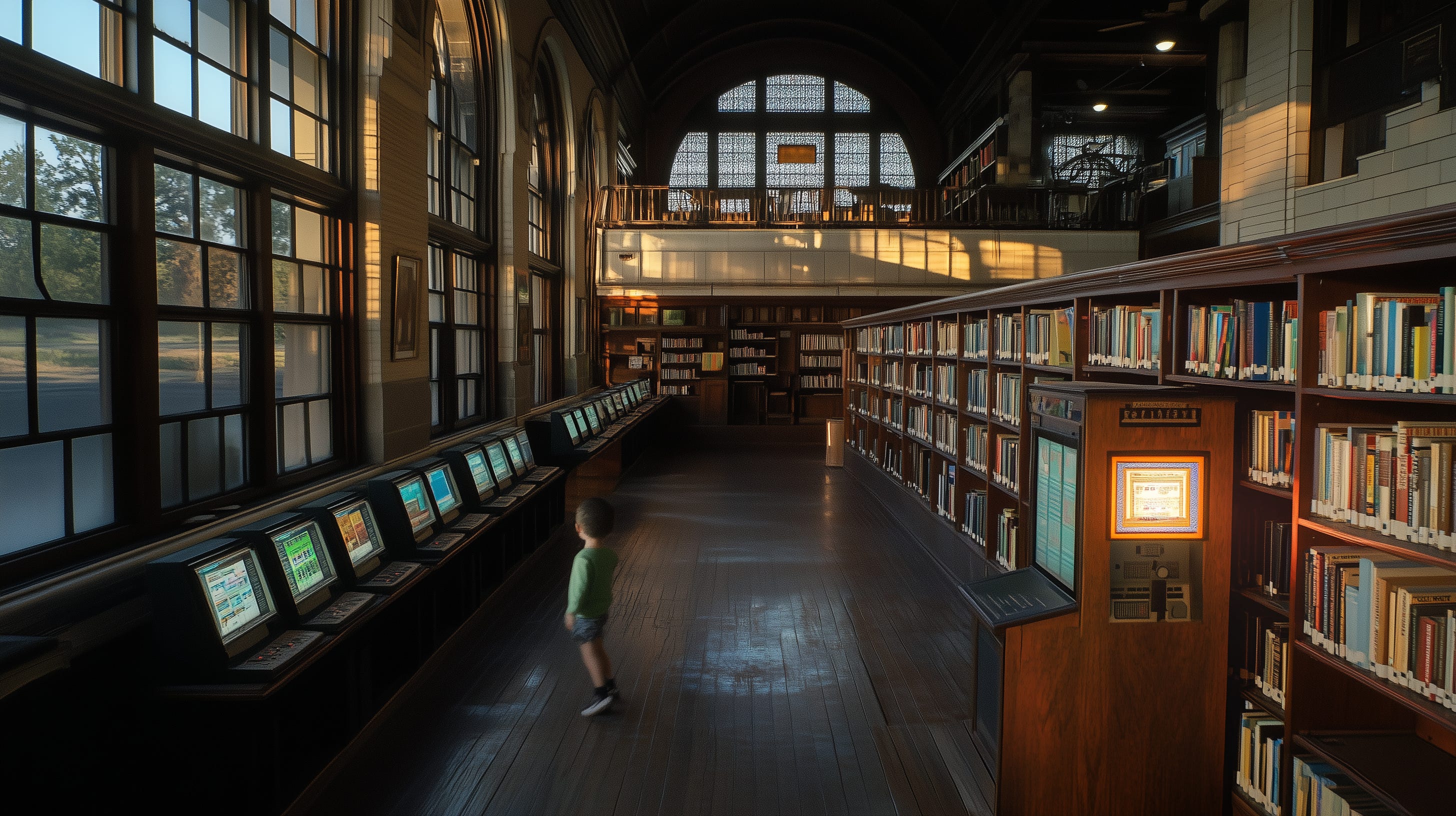
By the 2010s, many small plains libraries had become something that would have been unrecognizable to the people who built them. The stacks were thinned to a polite gesture. The center of the room was given over to rows of computer terminals where patrons checked email, filed unemployment claims, and watched videos. The computers were necessary, and no honest person could argue that providing internet access to people who had no other option was a bad thing. But the necessity of the computers did not explain the disappearance of the books, because the books did not have to leave for the computers to arrive. That was a choice, made incrementally by library boards, city councils, and state funding formulas that increasingly measured a library’s value by its foot traffic and digital transactions rather than the depth of its collection.
The language changed, too, and the language always tells you where the power went. Libraries became “media centers” or “information hubs” or “community learning spaces,” and each new name moved further from the word “book” and closer to the word “access,” as though access to the raw ocean of the internet were the same thing as access to a curated, organized, and carefully maintained collection of human knowledge. It is not the same thing. A library without a serious book collection is a room with a Wi-Fi signal. It may be useful. It may even be necessary. But it is not a library in any sense that the word has carried for the last five centuries, and pretending otherwise is a lie told to justify the defunding of something that was working.
The loss is not merely cultural, though it is that. The loss is cognitive and civic. A book, by its nature, is a finished argument. It has been written, edited, reviewed, and published. It can be wrong, but it cannot be quietly altered after the fact. It sits on a shelf and says the same thing today that it said yesterday, which makes it a fundamentally different kind of object than a web page, which can be changed, deleted, or buried in search rankings without notice. A community that has access only to the internet has access to an enormous quantity of information with no guarantee of its stability, accuracy, or permanence. A community that has access to a well-maintained book collection has something the internet cannot provide: a fixed, physical record of what has been thought and said, available for comparison and contestation across time.
The old plains library understood this without having to articulate it. The books on the shelf were not just books. They were evidence that the world was larger than the horizon, that the past was accessible, and that the future was not yet written. When a child in a small Kansas town pulled a volume of Greek mythology off the shelf in 1951, she was not consuming content. She was making contact with a tradition that had survived for three thousand years precisely because someone, at every point along the way, had believed it was worth preserving in a fixed, physical form. That chain of preservation is now breaking, not because anyone decided to break it, but because no one with the authority to prevent it understood what was being lost.
The empty shelves are not a sign of progress. They are a sign that we have confused access with substance, and that we have allowed the most democratic institution ever built on the American plains to be hollowed out from the inside while we were busy arguing about everything else. The library was the one place that belonged to everyone and demanded nothing in return except the willingness to be quiet and to pay attention. That deal is off the table now in too many towns, and the people who will pay the price for its absence are the same people who always pay when a public good is allowed to quietly disappear: the ones who had nowhere else to go.