

In 1896, the mines beneath Butte, Montana, produced twenty-six percent of the world’s copper supply. By 1982, the last mine had shut down, and the city’s population had fallen from a peak near 100,000 to fewer than 34,000. The Berkeley Pit, a mile-long open-pit mine carved from a neighborhood called Meaderville, had swallowed homes, churches, a baseball field, and an Italian social hall. When the pumps stopped running, the pit began filling with water contaminated by arsenic, cadmium, copper, and zinc. In 1995, a flock of 342 migrating snow geese landed on the pit’s red-brown surface. All of them died overnight. The Butte Chamber of Commerce still sells bumper stickers that read “Butte: A Mile High and a Mile Deep.” The depth now belongs to poison.
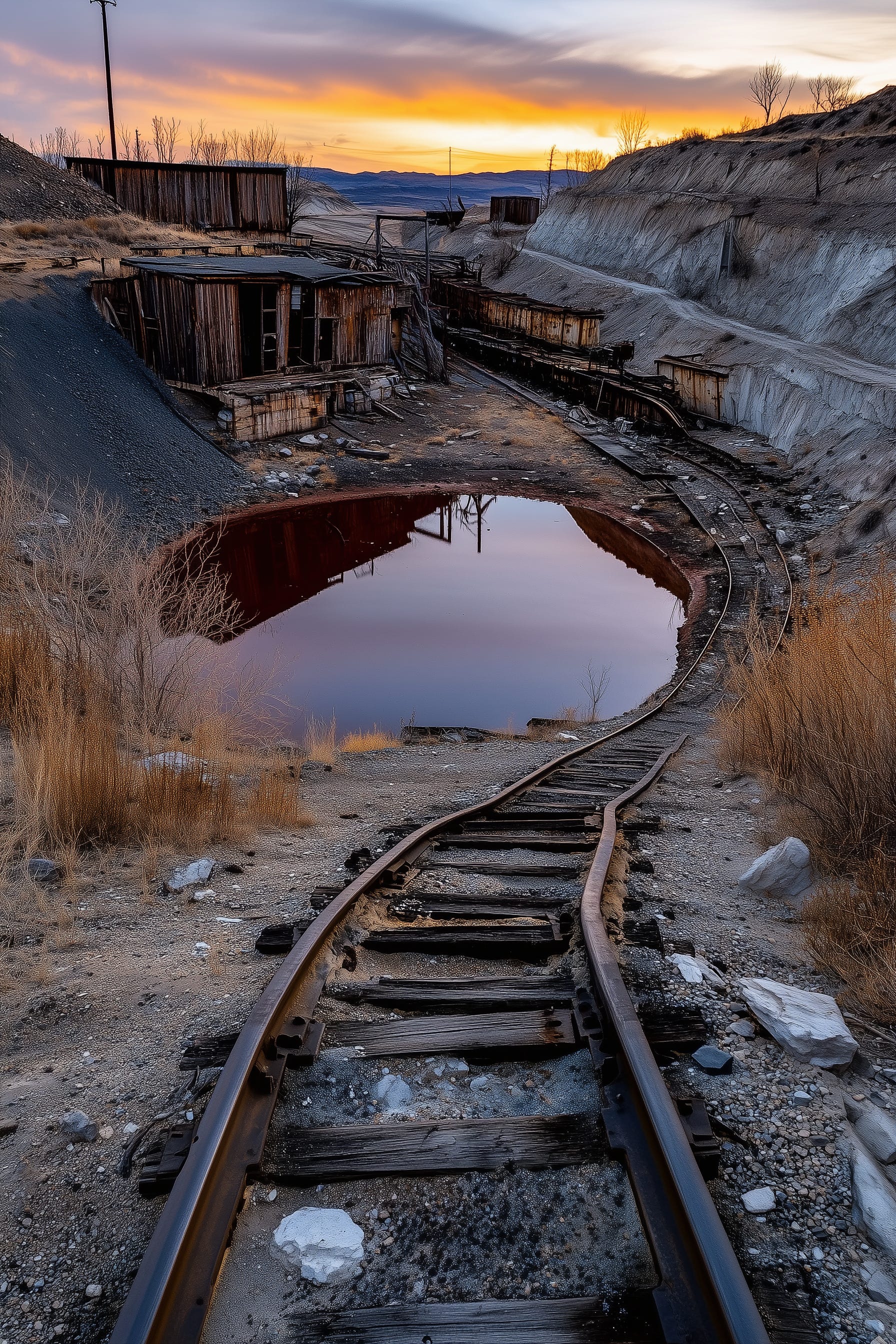
Thirty-four percent of the children in Picher, Oklahoma, tested positive for lead poisoning in 1994. Their parents had let them ride bicycles up and down the chat piles, the gray mountains of crushed limestone and dolomite left behind after decades of lead and zinc extraction. Some families used chat to fill backyard sandboxes. When the children swam in local ponds, their hair turned orange and stayed that way. No one connected the respiratory infections, the abnormally high infant mortality, the standardized test scores that lagged behind every other district in the state. The ore had been worth twenty billion dollars between 1917 and 1947. Fifty percent of the lead and zinc consumed by the American military in the First World War came from the Picher mining field. The town’s reward for supplying the bullets was to be buried in the casings.
In Gillette, Wyoming, March 31, 2016, is still called Black Thursday. More than five hundred coal miners received layoff notices that morning, the first tremor in a sequence of bankruptcies and consolidations that would strip the town of 2,500 coal-related jobs in eighteen months. Gillette sits at the center of the Powder River Basin, a geological formation stretching across northeastern Wyoming and into Montana that has supplied more than forty percent of all coal mined in the United States. At production’s peak in 2008, more than a hundred mile-and-a-half-long trains left the basin every day, carrying low-sulfur subbituminous coal to power plants in thirty-eight states. By 2024, Wyoming’s coal output had fallen to roughly 87 million short tons, a decline of more than eighty percent from that peak. The welcome signs have not been changed. The haul trucks on the “Stay Strong, Gillette” posters still have thirteen-foot wheels.
Aberdeen, Washington, calls itself the Lumber Capital of the World. The sign greets eight million cars a year on Highway 101, most of them passing through to the Pacific coast without stopping. The mothballed Weyerhaeuser mill across the river tells a different story. In December 2005, Weyerhaeuser closed its 81-year-old large-log sawmill. Eighty-three employees lost their jobs, some of them third-generation mill workers who learned about the closure from local radio before management told them. In January 2009, Weyerhaeuser closed its two remaining plants and a log export yard, ending the company’s presence in a town it had operated in since 1924. Aberdeen’s poverty rate now hovers near twenty-four percent. Its population has declined from its early-twentieth-century heights to roughly 17,000. The “Lumber Capital” sign remains because no one has proposed a replacement that anyone can agree on.
◊
These four places share a single economic biography. A resource is discovered. Capital arrives to extract it. Workers follow capital, and a town crystallizes around the work. Schools, churches, saloons, and baseball fields appear. The community develops an identity inseparable from the material beneath its feet or growing on its hills. Then the resource dwindles, or the market shifts, or the environmental cost becomes impossible to ignore, and the capital departs. The workers cannot follow it because they own houses they can no longer sell, or because the skills they spent decades mastering have no transferable value, or because leaving would mean admitting that the place they built their lives around was, from the beginning, a transaction with an expiration date.
The pattern is old enough to have produced its own literature. Bret Harte’s mining camps, Upton Sinclair’s meatpacking yards, John Steinbeck’s migrant laborers chasing seasonal harvests through California. Each generation produces a version of the same narrative, and each generation fails to absorb its central lesson: that a town built on a single extractive commodity is a town with a timer running in its basement.
◊
Butte’s timer started in the 1860s, when prospectors found gold in the creeks around Silver Bow. The gold played out within a decade. By 1874, the population had dropped to somewhere between 61 and 241 people. Then assayers discovered that the rock formations contained silver, and after silver came copper, and copper arrived at the precise historical moment when Thomas Edison’s electrical grid was converting American cities from gaslight. Butte’s copper wired the continent. At the industry’s height, three men controlled the operation: William A. Clark, Marcus Daly, and F. Augustus Heinze, the so-called Copper Kings whose feuds over mineral rights shaped Montana’s politics so thoroughly that Clark’s bribery scandal in the 1899 U.S. Senate race contributed to the passage of the Seventeenth Amendment, establishing direct popular election of senators.
The Anaconda Copper Mining Company, consolidated from the Copper Kings’ holdings, ran Butte and much of Montana for most of the twentieth century. Underground mining gave way to open-pit operations in the 1950s when declining ore grades made the tunnels uneconomical. The Berkeley Pit, excavated beginning in 1955, consumed the Meaderville neighborhood and parts of McQueen and East Butte. Families received offers for their homes and were relocated, though “relocated” is a generous word for a process that scattered a tight-knit Italian and Eastern European community across a city that no longer recognized its own geography.
The underground mines had employed ten thousand workers at their peak. The open pits required far fewer. When the Atlantic Richfield Company (ARCO) shut down the Berkeley Pit in 1982, Butte became what it had been only once before in its history: a mining town with no mine. Montana Resources reopened the adjacent Continental Pit in 1986, employing roughly four hundred people. That is the scale of Butte’s current mining operation. Four hundred workers in a town that once required ten thousand.
The Berkeley Pit earned Superfund designation in 1983. It contains more than forty billion gallons of acidic water. The snow geese incident in 1995 was followed by a second avian die-off in 2016, when several thousand geese landed on the pit during a November snowstorm. Montana Resources deployed lasers, drones, and air horns to keep them off the water. Several thousand had already landed. The company reported that fewer than a thousand birds died, though environmental groups disputed the count. The pit’s water level must be perpetually managed to prevent it from reaching the alluvial aquifer beneath the city. If that aquifer is contaminated, Butte’s drinking water becomes undrinkable. The pumping and treatment must continue in perpetuity. “In perpetuity” is a phrase that appears often in environmental remediation documents. It means that Butte’s mining era has ended, but its mining costs have not.
◊
Picher, Oklahoma, was incorporated in 1918 on Quapaw tribal land, named for O.S. Picher, owner of the Picher Lead Company. The ore strike that created the town occurred in 1913 on Harry Crawfish’s allotment, making Crawfish one of the few figures in American extractive history whose name carries such accidental precision. By 1926, the town had 14,252 residents. More than fourteen thousand men worked in the mines, with another four thousand employed in roughly fifteen hundred mining-service businesses. An interurban trolley system connected Picher to towns across the Tri-State Mining District, reaching as far as Carthage, Missouri.
When mining ceased in 1967, the pumps that kept groundwater from flooding the shafts ceased with it. Seventy-six thousand eight hundred acre-feet of contaminated water accumulated underground, and by 1973, it began seeping to the surface. Tar Creek, which runs through the district, turned red from dissolved iron, zinc, and manganese. Left behind were 178 million tons of toxic mine waste arranged in mounds that reached three hundred feet high, scattered in and around a town whose children played on them because no one had yet connected the gray hills to the blood-lead levels.
Picher earned designation as part of the Tar Creek Superfund site in 1983. Testing by the Indian Health Service in the early 1990s and found that thirty-five percent had dangerous blood-lead concentrations. A 2004 soil analysis of schoolyards and daycares confirmed elevated lead and other heavy metals in the places where children spent their days. Lung disease rates in the tri-state mining area ran twenty to thirty times above the national average. Pneumoconiosis, the chronic lung disease associated with mineral dust inhalation, occurred at two thousand percent above expected frequency.
The town could attract no replacement industry because a majority of the land belonged to restricted Quapaw heirs, creating title complications, and because fourteen hundred mine shafts honeycombed the ground beneath every building. In 2006, the federal government began buying homes. In May 2008, an EF4 tornado killed six people and destroyed much of what remained. The EPA declared the town uninhabitable and completed its buyout in 2009. Oklahoma officially dissolved Picher’s municipal charter on September 1, 2009. A 2010 census counted twenty residents. Gary Linderman, a pharmacist who had said he would stay until the final resident left, died in 2015. Arsonists destroyed the Picher Mining Field Museum, housed in the former Tri-State Zinc and Lead Ore Producers Association building, was destroyed by arson in April 2015. A church that had been converted from a one-room schoolhouse burned in 2017. Picher’s remaining structures are decaying at a rate that suggests the town will disappear from the surface within a generation, though the contamination beneath it will persist for centuries.
Every December, former residents return for a Christmas parade through the empty streets. They wear sweatshirts that read “Chat Rats,” reclaiming a term that outsiders once used to mock the children who played on the toxic piles. The parade is an act of defiance against the idea that a dissolved town can be a forgotten one. It is also a wake.
◊
Gillette, Wyoming, did not exist before coal. The town was incorporated in 1891 as a railroad stop, but its modern identity belongs entirely to the strip mines that opened in the Powder River Basin beginning in the 1970s. The Clean Air Act of 1970 and its 1977 amendments created the market: power plants needed low-sulfur coal to meet new emissions standards, and the Powder River Basin’s subbituminous seams, buried under thin overburden in beds fifty to a hundred feet thick, were the cheapest source available. From 1969 to 1974, Wyoming’s coal production quadrupled. By 2008, the basin was producing 496 million short tons per year. Gillette’s population surged to roughly 32,000, and Campbell County became one of the wealthiest per-capita jurisdictions in the American West.
The company town of Wright, located thirty miles south of Gillette, was built specifically to house workers constructing the Black Thunder mine. Wright is a planned community in the same sense that Picher was a planned community: it exists because an extractive company needed a dormitory. If the mine closes, Wright has no secondary economic purpose. A state senator representing the district estimated in 2020 that Gillette would likely shrink from 32,000 to 26,000 people and suggested that Wright’s prospects were worse.
The decline has structural causes that no amount of political rhetoric can reverse. Natural gas became cheaper than coal for electricity generation when gas prices dropped below three dollars per million BTU. Wind power eroded coal’s market share across the Great Plains. Coal-fired power plants are retiring faster than new demand can replace them. The U.S. has not opened a new coal-fired plant since 2020. In 2024, the Bureau of Land Management declared federal lands in the Powder River Basin unavailable for future coal leasing. Wyoming’s statewide coal production is projected to fall to 165 million tons by 2028, at an average price of $13.75 per ton, barely a third of the basin’s peak output.
Gillette’s economic development officials talk about solar panels on reclaimed mine lands, hydrogen fuel production, and carbon capture facilities. The talk has been ongoing for a decade. The soil beneath reclaimed strip mines is unstable enough that solar arrays may shift and topple after a few years. Grid capacity for renewable electricity in northeastern Wyoming is limited. Fifty years of boom-and-bust cycles have produced a workforce specialized in operating haul trucks and draglines, skills that do not transfer to the installation of photovoltaic cells. “Stay Strong, Gillette” posters remain in every coffee shop. Coal trains still pass through the highway overpasses, though they pass less frequently now, and some of the cars are empty.
◊
Aberdeen, Washington, entered the twentieth century as one of the grittiest towns on the Pacific coast, a place nicknamed “The Hellhole of the Pacific” and “The Port of Missing Men” for its murder rate, its saloons, and its brothels. The grit was financed by timber. Grays Harbor County’s mills exported a billion board feet of lumber in 1924, the year Weyerhaeuser opened its first Aberdeen mill. In the 1920s, eighty percent of the region’s lumber left by rail and ship for the rest of the country and the world. The county hosted thirty-seven sawmills at its peak. By the time the Great Depression ended the boom, nine remained.
The industry recovered after the Second World War and continued into the 1970s, when the accessible old-growth Douglas fir, Western red cedar, and hemlock stands had been cut. Decades of clearcutting with minimal reseeding meant that second-growth timber could not support the same scale of operations. The northern spotted owl’s listing as a threatened species in 1990, and the subsequent Northwest Forest Plan of 1994, reduced timber harvests on federal lands by eighty percent. The industry argued that environmental restrictions killed the jobs. Environmental economists countered that logging employment had been declining since the 1940s, driven by mechanization and the finite supply of old-growth trees. Both arguments contain partial truth, and the distinction matters little to a third-generation sawmill worker learning from a radio broadcast that the mill is closing.
Weyerhaeuser’s departure from Aberdeen unfolded across four years. Weyerhaeuser’s large-log mill closed in December 2005. Its Cosmopolis pulp mill followed in 2006. By January 2009, the last two plants and the log export yard had closed as well, ending the company’s presence in a town it had operated in since 1924. Aberdeen now lists among its major employers a state prison that opened in 2000. Tourism promoters note that Aberdeen is the hometown of Kurt Cobain, hoping that Gen X nostalgia for grunge music might generate pilgrimages. Eight million cars pass through each year on their way to the ocean. Most do not stop. The poverty rate of twenty-four percent is more than double the national average. The median household income of approximately $50,000 places Aberdeen among the poorest communities in western Washington.
Across the Pacific Northwest, former timber towns have tried variations on the same recovery strategy: tourism, mountain biking, Bavarian-themed storefronts, casinos. Oakridge, Oregon, rebranded as a mountain biking destination and still carries one of the state’s highest poverty rates. Coos Bay, Oregon, built a casino, and unemployment remains near nine percent. Leavenworth, Washington, transformed itself into a faux-Bavarian village that draws tourists but has priced out many longtime residents. The formula appears to be: replace extraction with recreation and accept that the new economy will pay less, employ fewer, and serve outsiders rather than locals.
◊
The four towns share a final, structural similarity that resource-exhaustion narratives tend to overlook. In each case, the extracted material left the community almost entirely. Butte’s copper was smelted and shipped to wire factories in the East. Picher’s lead and zinc became bullets and galvanized steel in factories the miners never saw. Gillette’s coal traveled by rail to power plants in states whose residents could not locate Campbell County on a map. Aberdeen’s lumber built houses in Los Angeles, Chicago, and San Francisco. The wealth generated by extraction accrued to shareholders, holding companies, and metropolitan consumers. The community that bore the physical cost of extraction received wages, payroll taxes, and an identity, and when the resource departed, the wages stopped, the tax base collapsed, and the identity became a memorial to something that was taken rather than something that was built.
This is the arithmetic of extractive economies, and it has not changed in four hundred years of American settlement. Consider the precedents. Virginia Company investors extracted tobacco from Tidewater and sent profits to London. California’s Gold Rush enriched San Francisco banks and Eastern investors while the Sierra foothills filled with abandoned sluices. Extraction has always worked this way because extraction is, by definition, removal. The resource leaves. The hole remains.
Butte has its toxic pit. Picher has its chat piles and its dissolved charter. Gillette has its shrinking train schedule and its solar-panel proposals. Aberdeen has its “Lumber Capital” sign and its state prison. Each town’s story is legible as a cautionary tale, a historical case study, or a tragedy, depending on the reader’s distance from the hole in the ground. For the people who stayed, who could not leave or chose not to, who watched the capital depart and the trucks stop running and the schools consolidate and the young people scatter, the story is none of those literary categories. It is Tuesday. It is the mortgage. It is the pharmacy that closed when the pharmacist died.
◊