

Brownie Wilson pulls his white Silverado off a dirt road outside Moscow, Kansas, mud covering everything except the Kansas Geological Survey logo stuck on the door with electrical tape. He walks through dry cornstalks to a decommissioned irrigation well, unspools a steel tape measure, and feeds it into the hole until gravity takes over. This is how we measure the dying: one well at a time, one foot at a time, watching the numbers fall.
Beneath Wilson’s boots lies the Ogallala Aquifer, one of the largest freshwater accumulations on Earth, stretching 174,000 square miles across eight states from South Dakota to Texas. Geologist N.H. Darton named it in 1898 after the Nebraska town where he first mapped its extent. For thousands of years, rainfall seeped through sand and gravel deposited by ancient rivers flowing from the Rocky Mountains, collecting in underground reservoirs that held roughly three billion acre-feet of water. The Ogallala made the High Plains possible. It transformed the dust bowl into the breadbasket. It turned cattle country into corn country. And now it is running out.
The numbers are precise and catastrophic. Since the mid-twentieth century, when large-scale irrigation began with center pivot systems adapted from automotive engines, water levels in Kansas have dropped an average of 28.2 feet below their pre-pumping levels. In the Texas Panhandle, the decline reaches 44 feet. Some wells near Lubbock have fallen more than 250 feet. A 2025 University of Texas projection indicates that up to 70 percent of the Texas Panhandle will become unusable within twenty years if current pumping rates continue. In parts of western Kansas, state officials say there is not enough groundwater to last another quarter century.
Kansas Governor Laura Kelly has acknowledged the arithmetic. Some communities, she says, are just a generation away from running out of water. If they do nothing, they will suffer the consequences. The qualifier matters. If they do nothing. The problem is that doing something requires choosing between the present and the future, between this year’s crop and next generation’s survival, and nobody has figured out how to make that calculus work.
The Economics of Extraction
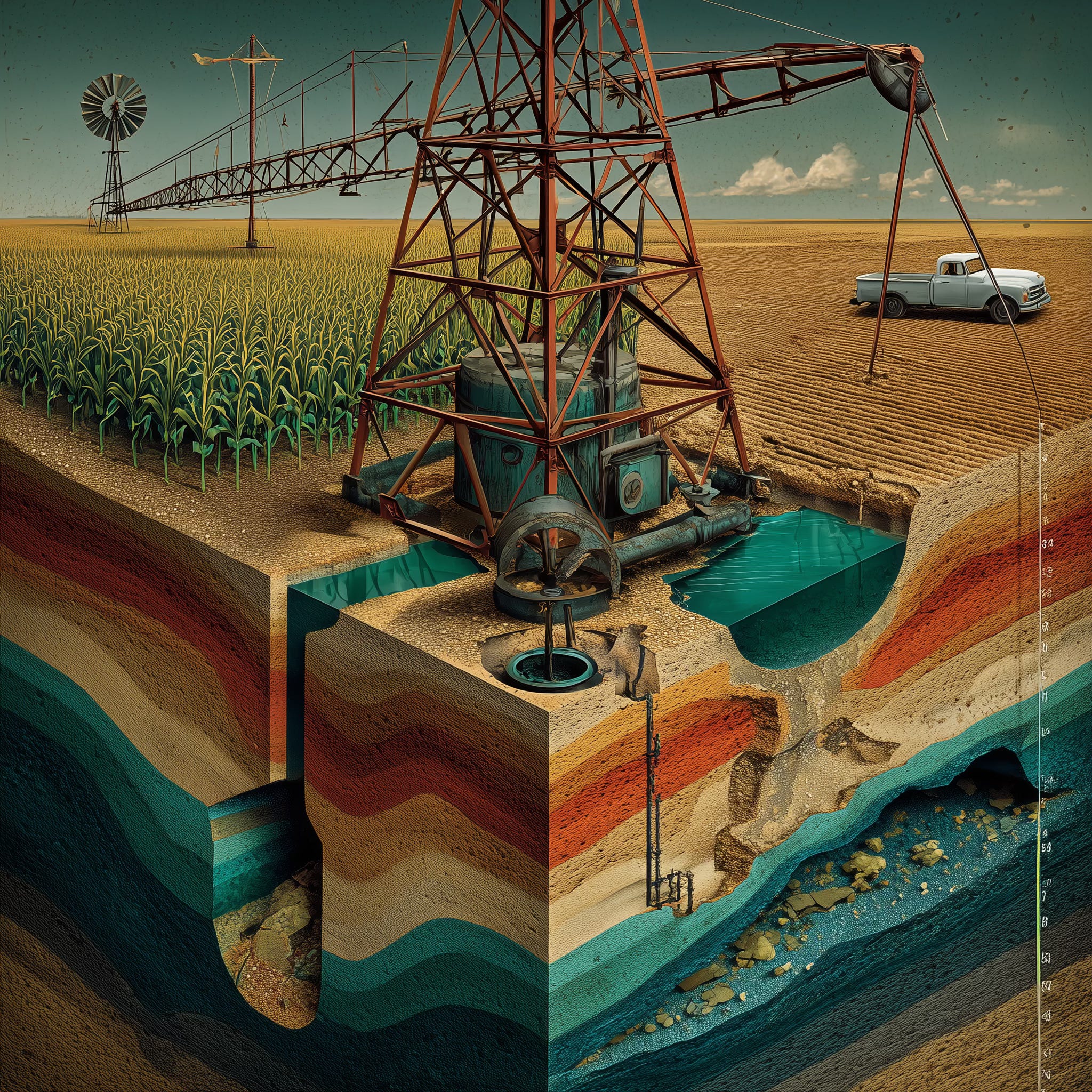
The Ogallala supports 20 percent of the nation’s wheat, corn, cotton, and cattle production. It yields 30 percent of all groundwater used for irrigation in the United States. Agricultural products from the region total tens of billions of dollars annually. The aquifer is not merely a water source; it is the foundation of an entire regional economy, a hidden subsidy beneath every field of irrigated corn, every feedlot, every ethanol plant.
The recharge rate tells the story of unsustainability. Only about one inch of precipitation actually reaches the aquifer each year. Rainfall in the Texas High Plains is minimal, evaporation is high, and infiltration rates are slow. Once depleted, the Ogallala will take more than 6,000 years to replenish naturally through rainfall. The water farmers pump today fell as rain when Mesopotamian scribes were inventing writing. There will be no more of it in any timeline that matters to human civilization.
Between 2001 and 2011, losses to the aquifer equaled a third of its cumulative depletion during the entire twentieth century. The pace is accelerating. Southwest Kansas fell by over a foot and a half between January 2024 and January 2025, the largest decline in recent years. The Ogallala is being depleted at an annual volume equivalent to eighteen Colorado Rivers. We are drinking the ocean dry.
The Politics of Denial
Mike Shannon learned about the Ogallala the hard way. In the mid-1980s, as a new city official in Guymon, Oklahoma, he watched one of his hometown’s wells begin to fail. He assumed he could simply drill another hole and find more water. He spent several thousand dollars on a test well that came up bone dry. Today Shannon serves as interim city manager for Guymon, the Oklahoma Panhandle’s largest city, still thinking about groundwater, still explaining to constituents that there is no great ocean beneath their feet, just a sand and gravel formation laid down millions of years ago, and it is emptying.
Texas follows a legal doctrine called “right of capture” regarding groundwater. If you can pump it from your land, it is yours. Oklahoma operates on an honor system, permitting irrigators to use two acre-feet of water per acre of land per year, but nobody monitors whether farmers actually stay within those limits. Kansas uses a similar self-reporting system. State officials know that growing corn in the panhandle region requires four or five acre-feet of water per year, but they still allow farmers to report using two. The forms get filed. The pumps keep running.
Mark Griggs, formerly a water lawyer for Kansas, has criticized decades of state policy predicated on voluntary, cooperative, locally based solutions. These are the catchwords, Griggs observes. None of them have achieved much. By 2024, voluntary conservation districts in Texas saw less than 15 percent of eligible farmers participating in incentive programs. The federal government offers subsidies that encourage irrigation and expanded acreage. Farmers drain the aquifer because policy encourages them to do it, not because they want to destroy their own future.
The Last Generation
In Kansas, “Day Zero” has already arrived for about 30 percent of the aquifer, with the entire system expected to be 70 percent depleted within fifty years. Vast stretches of Texas farmland over the aquifer can no longer support irrigation. Up to a fifth of irrigated farmland along a hundred-mile stretch in west-central Kansas has already gone dry. Farmers notice their corn getting shorter year after year, watching the soil turn to brick as water quality degrades alongside water quantity.
The communities built around agriculture face what reporters have called a twisted threat: the very industry that made them might just eradicate them. Towns are digging deeper wells, purchasing expensive water rights from farmers, building pipelines, recycling their water supplies in new ways to save every drop possible. Lincoln, Nebraska’s capital, projects it will need a second water source to supplement the Ogallala by 2048. These are not distant problems. They are happening now, in places that have farmed the same land for three and four generations.
Some farmers are returning to dryland agriculture, accepting lower yields to become independent of aquifer limitations. Some are adopting precision irrigation, tilling less to retain soil moisture, monitoring crop water needs remotely to avoid wasting what they pump. Oklahoma modified its water rules in 2023, tying new irrigation permits to sustainable yield estimates. Kansas and Colorado gave local water management districts authority to limit withdrawals during drought years. These are gestures toward the future. Whether they are sufficient is a question that will be answered by the wells themselves.
The Measure of Things
Brownie Wilson finishes his measurement, notes the depth, reels in his tape. The Kansas Geological Survey has been tracking these wells for decades, assembling the evidence of depletion one data point at a time. The measurements are reported to Congress every two years, as required by law since 1986, when legislators first recognized the economic importance of the High Plains aquifer to the states that depend on it. The reports document what everyone already knows. The water is going. The question is what comes after.
Without the aquifer, farmers in West Texas could not grow much unless it is cactus or mesquite. The transformation from breadbasket to something resembling desert is becoming more real every year. Climate change is reducing recharge while increasing demand: hotter summers mean crops require more water, even as more intense heat causes rainfall to evaporate before reaching the ground. A 2019 study found that the rate of groundwater depletion in the Ogallala could increase by as much as 50 percent by 2050. The crisis feeds on itself.
The hidden system beneath all the other hidden systems we have explored in these pages is water. The prison guards, the storm chasers, the data centers humming with servers, the feedlots and the ethanol plants and the small towns holding on to their futures with both hands, all of them depend on an aquifer that is emptying faster than anyone wants to admit. The prairie was never what it appeared to be from the surface. Beneath the grass, beneath the fields, beneath the circle of irrigated green visible from space, there is an ancient reservoir of time running out. We are farming the rain of six thousand years, and when it is gone, it is gone.