

Lincoln copied Chicago’s ugly law nearly letter for letter in 1889, dollar fine and poor farm and all. A new book follows the ordinance onto the prairie, and follows the people who outlasted it.
◊
She has no recorded name.
On May 19, 1881, the Chicago Tribune reported that Alderman James Peevey, who sat on the Council’s West Side Streets and Alleys subcommittee, the body responsible for sidewalk improvement, had prepared a new ordinance whose object, the paper said, “is to abolish all street obstructions.” The obstruction the coverage went on to describe was a woman. She had worked in a woolen mill until a carding machine caught her and injured her, and she was supporting herself and her two children the only way left, on the pavement, in public view. The newspaper kept her anonymous while making her famous. The city then wrote her into law without ever writing her name.
Chicago’s ordinance, passed that month, declared that any person “diseased, maimed, mutilated, or in any way deformed, so as to be an unsightly or disgusting object, or an improper person to be allowed in or on the streets” was forbidden to expose himself to public view anywhere in the city. Its design shows through. The law did not punish begging, which the city already regulated, and it did not punish idleness, which the era prosecuted under other names. It punished appearance. A body the sidewalk committee did not want to see became, by ordinance, a body with no lawful place to stand.
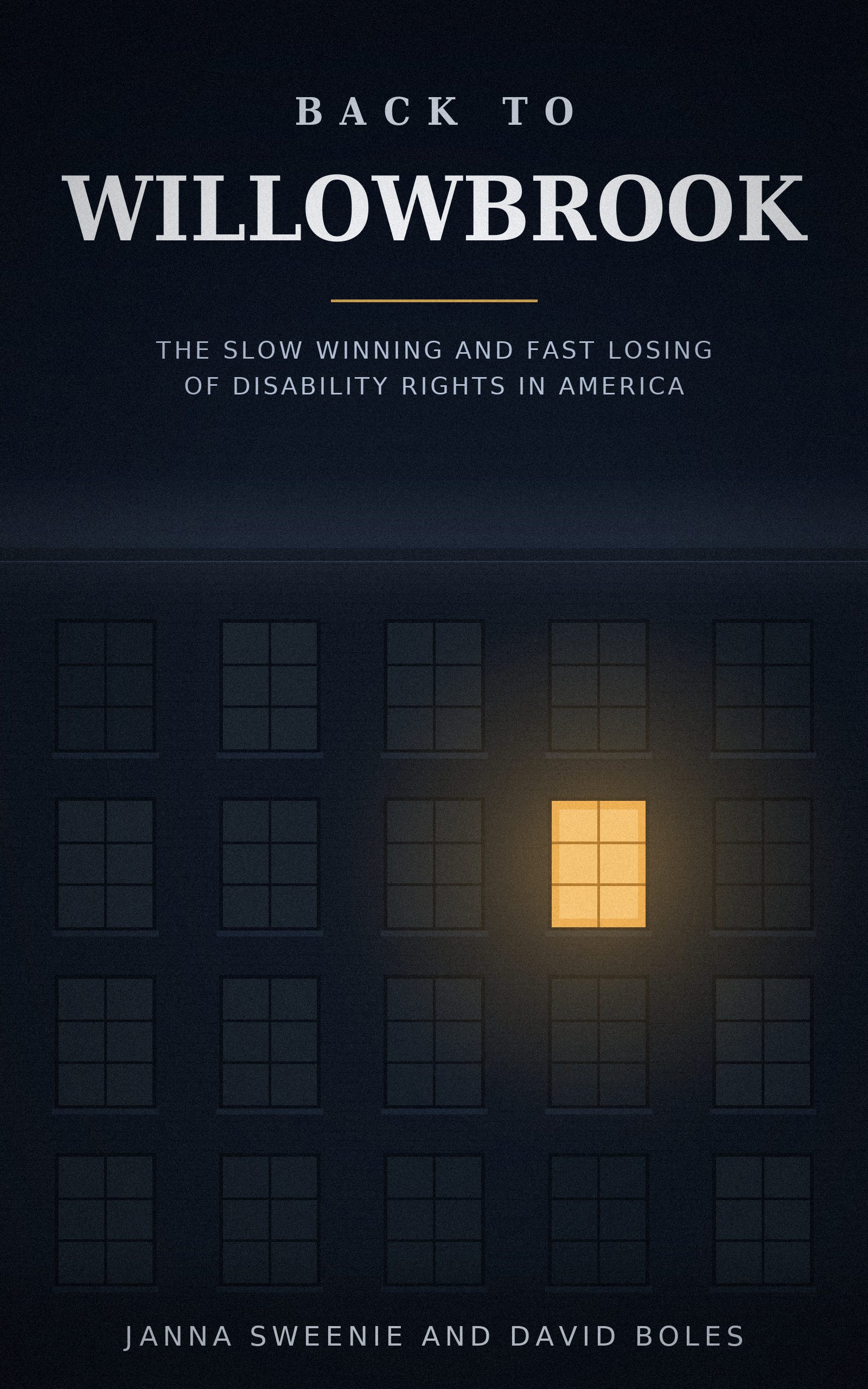
This month my wife and co-author Janna Sweenie and I published a book called Back to Willowbrook: The Slow Winning and Fast Losing of Disability Rights in America, and the woman from the woolen mill stands at the front of it, because the record owes her the place the newspaper denied her. The book runs from her sidewalk to the envelopes leaving state Medicaid agencies this summer. Prairie Voice readers will want to know what happened in the middle, because a good part of the middle happened here.
◊
The polite memory calls the ugly laws a big-city sin, a Chicago cruelty, an eastern industrial reflex. The ordinances themselves say otherwise. Portland, Oregon adopted a version of its own a few months before Chicago’s, in the same year of 1881, and kept it in its pocket for ninety-one years. Then the Chicago text rode the railroads west into the reforming Midwest, and the reforming Midwest copied it down.
Denver adopted the provision in 1886 and indexed it in the municipal code under the heading of how deformed persons are to be cared for. A clerk in Denver looked at a law forbidding injured people to be seen and shelved it under care.
Lincoln, Nebraska followed in 1889, and Lincoln did the thing this article is named for: it enacted the Chicago wording nearly letter for letter, down to the dollar fine, the suspension clause, and the commitment to the county poor farm for those who could pay nothing. Omaha adopted the family text a year later, in 1890. In 1894, Columbus, Ohio passed Ordinance No. 8191, a housekeeping bundle of new misdemeanors whose Section 15, titled Unsightly beggars, fined public exposure by the diseased, maimed, mutilated, or deformed at up to twenty dollars, or ten days in jail, or both. The ugly law arrived in Columbus as one line item among the era’s petty offenses, which is how its authors ranked the people it named.
Who were those people? The book answers with the veterans, because the timing convicts the era on its own terms. These ordinances arrived while the Union’s maimed soldiers still filled the streets they had saved, and the book gives them a sentence I will simply hand over whole: “The men who lost limbs saving the Union or grading its railbeds discovered that gratitude had a sightline, and that theirs ended at the curb, the parade route and the ordinance covering one pavement on different days.”
I grew up in Lincoln. I sold my first article to a Lincoln newspaper at ten years old and read that city’s print for years afterward, and no page I ever turned mentioned that my hometown had once set the price of being seen at one dollar, with the poor farm waiting behind the fine. The silence was the ordinance’s second life. A law like that does its loudest work after repeal, in the shape of the streets it emptied and the histories it never entered.
◊
The counter-record is Nebraskan too, and the book gives it a full chapter of room.
In the late 1970s, with Lincoln’s 1889 ordinance still sitting in living memory, a motorized wheelchair rolled onto the campus of the University of Nebraska at Lincoln carrying William Rush, called Bill. He was Omaha-born, a graduate of that city’s J. P. Lord School for physically disabled children, born with cerebral palsy after a delivery that starved his brain of oxygen. He could neither walk nor speak nor sit in his wheelchair without straps, and he had scored his way into the university on the SAT. By his own later account in print, the affirmative-action office greeted him with the assurance that he would be the first and the last of his kind to attend.
Rush communicated with a headstick, a rod fixed to a headband, striking one letter at a time on a board, then on a Selectric typewriter, then on an early voice synthesizer his friend Mark Dahmke helped build, funded in part by the state’s own rehabilitation division, “the government’s remedial hand and its custodial one belonging to the same body,” as the book puts it. The same state that had copied Chicago’s ordinance letter for letter in 1889 paid, ninety years on, for part of the machine that let a man it once could have fined for appearing say whatever he wanted, in public, one letter at a time. Nobody handed him the second Nebraska. He spelled it into existence.
◊
Across the Missouri River from Omaha sits Council Bluffs, Iowa, and in Council Bluffs, in the fall when she was five years old, my co-author’s life was decided by a roll call.
Janna tells it herself in the book, in the first person, and her telling is the reason I could never have written this book alone. At DeForest Elementary, a mainstream Hearing school, a teacher called the roll on the first day of class, and one name got no answer. The name was Janna’s. She did not hear it. She had never heard it, or anything else, in her life. Her teacher, Mavis Thies, said, “There’s something wrong with Janna,” and had her hearing tested, and the test found what five years of family life had missed: a Deaf daughter in a Hearing house, Deaf since the delivery room, undiscovered through five years of dinners and birthdays and a brother and sister ten and eight years older.
What Mavis Thies did next is the kind of fact Prairie Voice exists to print. She failed Janna in kindergarten. She failed her deliberately, to force her parents to recognize their daughter’s Deafness and enroll her at the Iowa School for the Deaf, right there in Council Bluffs, where language would finally arrive in a form her eyes could reach. The lesson still runs her classroom. On the first day of her courses at New York University, the speaking stops for the semester, because, as she writes, the language her students have come to learn “lives in the hands and the face and the shaped space between two people.” Janna is fond of saying that her kindergarten teacher saved her life, while the Iowa School for the Deaf saved her mind, and she says it because the sentence needs both halves. Mavis Thies was killed in a car crash three months before we finished the book. She read no page of it. Her lesson is in its opening pages anyway: sometimes beautiful things are born from failure.
Set the two prairie stories side by side and the pattern of the whole book appears. An institution fails a person, and a person inside the institution refuses the failure. Ninety years after the cruelty entered the code, a state office paid for the machine that talked back. The book calls the long version of this the slow winning: the ugly laws repealed, Willowbrook exposed and emptied, Section 504 signed unchanged after a twenty-five-day occupation, Gallaudet’s students seating a Deaf president, the Americans with Disabilities Act signed in 1990. From the woman on the Chicago pavement to the ADA took a hundred and nine years.
The book takes its title from the place where the looking-away collapsed. Willowbrook State School, on Staten Island, held thousands of children and adults the state had removed from view, and a senator who walked its wards in 1965 told the country what he had seen there. The country changed the channel. In January 1972 an ordinary brass key to Building 6, held out by people inside who had run out of quieter instruments, let a young reporter carry a camera through the door, and the film ended the institution’s long privacy. A lawsuit and a consent judgment followed, and then the slow emptying. The old grounds are a college campus now, with a memorial path called the Willowbrook Mile running through them, and the book walks that path in its final pages.
◊
The fast losing is taking considerably less time, and it is the reason the book had to be finished this year instead of remembered later.
A 2026 memorandum now instructs federal agencies to read the ADA in a way the federal courts have rejected. Work requirements meter Medicaid at eighty reported hours a month, and between June 30 and August 31 of this year, envelopes left state Medicaid agencies for the mailboxes of millions, each one explaining what its reader must now prove to keep coverage. Federal law dictates what each envelope must say, and the book walks through the requirements one by one before landing on the sentence that holds the whole machine: “An address on file is a wager that the person still lives there.” The wager is the policy. The template was Arkansas, which ran the experiment first and removed 18,164 people from coverage while employment stood still. Those results were published before the national law passed. Congress legislated with the evidence face up on the table. The court case challenging the new order is called Texas v. Kennedy, and our book follows it to press time, July 11, 2026, and says plainly which matters remained open when the presses ran.
The prairie knows the shape of this. In the nineteenth century, the county poor farm answered for the person the ordinance fined: out of sight, at public expense, under public control. Today the answer is the waiting list, and the book documents waiting lists growing where wards once stood. The dollar fine has been repealed everywhere. The idea that a disabled neighbor is a cost to be managed rather than a citizen to be counted was never repealed anywhere. It was only outvoted for a while, and votes can be retaken.
Back to Willowbrook is the record of both movements, the winning and the losing, with the documents quoted at length and the people named wherever the record allows names. Janna’s testimony runs through it in the first person, from the Council Bluffs roll call to her classroom at New York University, where she has taught American Sign Language since 1991, to this year, when her students are solicited to work without pay and her friends are penalized for requesting what the law promises. My half is the archive: the ordinances, the transcripts, the court files, and a comment thread from 2016 where a reader named Dawn wrote in about her life and I wrote back that the ADA was in danger and the disabled were being pushed backward. This book exists because that reply turned out to be reporting.
The woman from the woolen mill never got her name into the Tribune. The paper printed the alderman’s name, the committee’s name, the ordinance’s object, and left her as the obstruction. Our book cannot recover what was never recorded, so it does the one thing a record can still do: it holds her place at the front, ahead of the aldermen and the statutes, where the story of American disability rights actually begins, with a working mother on a public sidewalk whom the city decided it would rather fine than see.
◊
Back to Willowbrook: The Slow Winning and Fast Losing of Disability Rights in America, by Janna Sweenie and David Boles, is available now in paperback and Kindle on Amazon, and as a free PDF download at BolesBooks.com. David Boles founded David Boles Books Writing & Publishing in Lincoln, Nebraska, in 1975.