

Between 2010 and 2020, sixty-nine of Nebraska’s ninety-three counties lost population. In Kansas, the number was eighty out of one hundred and five. Nationally, roughly 1,660 of the country’s 3,140 counties shrank over the same decade, a figure the Census Bureau called unprecedented. The buildings remain. The grain elevators still stand along the rail lines. The courthouses keep regular hours because the county still exists as a legal entity even when the people who once filled its rows at the Fourth of July parade could now fit into a single high school gymnasium. The infrastructure is present. The body is not.
I grew up in this. Not in the theoretical version that gets discussed in policy papers about rural decline, but in the physical reality of streets that had fewer cars on them each year, of schools that consolidated and then consolidated again, of churches that merged because neither congregation could fill half the pews on its own. The process has a specific quality that is difficult to convey to anyone who has not lived through it. It is not sudden. It is not dramatic. It is the gradual experience of watching a community retain its name, its zip code, its position on the map, and its memory of what it once was, while losing the physical means by which any of that identity made contact with the world.
The community becomes a head without a body. It remembers. It thinks. It has opinions. It has a history and a personality and a collection of stories about itself that are told at the cafe that still opens at six in the morning because Darlene has always opened at six and will continue to open at six until she cannot. But the body, the economic and demographic and institutional body that once allowed the community to act on its identity, to build things and sustain things and reproduce itself across generations, that body has been leaving for decades, and the leaving has been so gradual that the moment it departed cannot be identified on any calendar.
I wrote a novel about this. Except the novel is about cats.
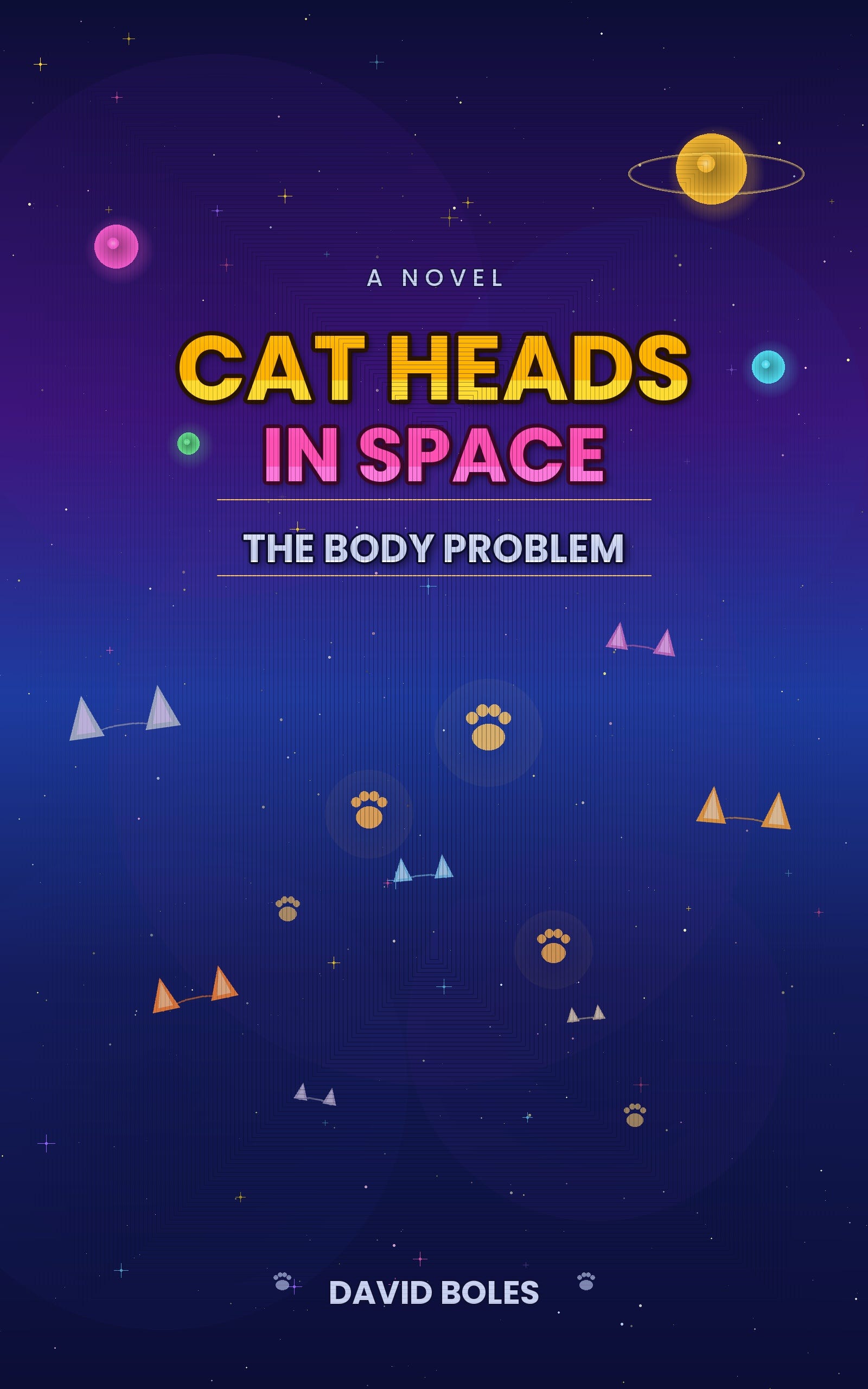
Cat Heads in Space: The Body Problem began as twenty-eight episodes of a serialized audio drama on the Human Meme podcast at HumanMeme.com. The premise is exactly what it sounds like: four cat heads, separated from their bodies by a procedure they do not remember choosing, float through the universe in Life Helmets that provide oxygen and treats while they search for the bodies they have lost. Captain Whiskerfluff delivers monologues about cosmic indifference that nobody requested. Lieutenant Mittens tells jokes as a form of respiratory function. Cookie Kitty cooks via intercom instructions to a kitchen system that understands approximately sixty percent of what she says. And Skeedootle is a puppy, adopted into the crew because no one could justify leaving a creature alone in the dark.
It is a comedy. It is ridiculous. It is also, I discovered over the course of writing it and then rewriting it as a novel, one of the truest things I have made about what it means to lose the structure that held you together.
Prairie Voice has spent its existence examining hidden systems. The rendering plants that process what the slaughterhouses leave behind. The data centers that consume wind power in converted cornfields. The meatpacking towns that function as inland ports of entry for global refugee populations. The prison economies that monetize rural emptiness. Every article in this publication has been, in one way or another, about the invisible infrastructure that sustains communities, and about what happens when that infrastructure is removed, rerouted, or replaced with something that looks functional but serves a different master.
The Cat Heads encounter versions of these systems throughout the novel. Bureaucrat 7-Q is an asteroid that is also a processing center, requiring forms that require bodies to complete, creating a circularity that would be familiar to anyone who has tried to access county services in a jurisdiction that has outsourced its administrative functions to a regional hub sixty miles away. The Treat Ration Protocol replaces the adaptive morale algorithm with standardized distribution: one treat per crew member, every ninety minutes, flavor locked to standard. No variation. No emotional calibration. No feedback loop. Equal distribution. Total neutrality. If you have watched a locally owned business replaced by a Dollar General, you have seen this protocol in action. The product is available. The product is affordable. The product does not know your name or remember that you prefer the other brand.
Dr. Vera Clawsworth arrives with mechanical bodies that do everything a body should do except feel. They walk. They respond to input. They perform the functions. But sensation, the actual experience of contact between a living creature and the physical world, is absent. The data is present. The meaning is not. I did not set out to write a scene about telemedicine replacing the county doctor, or about automated customer service replacing the person at the hardware store who knew which washer you needed without being told. But the parallel is there because the parallel is structural. When you replace a system that was responsive with a system that is merely functional, you have performed a version of the separation the Cat Heads experienced. The service continues. The relationship does not.
There is a chapter titled “The Litter Crisis” that functions as a brief interlude of absolute chaos, and it is the chapter I suspect Prairie Voice readers will recognize most immediately. The crew’s ship has a litter system that was designed for four bodies and is being operated by four heads, which means the system’s capacity is based on a set of assumptions that no longer apply. The infrastructure was built for a population that no longer exists in the form the infrastructure anticipated. The system does not fail. The system does what it was designed to do. The problem is that the conditions under which it was designed no longer obtain, and nobody has updated the design because the entity responsible for updates does not recognize that the situation has changed. County road maintenance budgets calibrated to 1990 traffic patterns. School building capacities designed for enrollment projections from the 1970s. Hospital service areas drawn when the nearest facility was twenty miles away instead of seventy. The litter crisis is funny because it involves cats. It is recognizable because it involves infrastructure.
The novel’s deepest revelation, which I will not fully spoil here, involves the discovery that the separation was voluntary. The crew chose this. They signed the forms. They walked into the procedure with their bodies still attached and walked out, or rather floated out, without them. The implications restructure everything the reader has understood about the quest, transforming it from a rescue mission into a reckoning with a decision that cannot be undone.
I have thought about this in the context of the prairie’s own separations. The young people who left were not abducted. The businesses that closed were not raided. The decision to consolidate the school district, to close the hospital, to let the rail line go dormant, these were choices made by people and institutions operating within constraints that felt absolute at the time. The departure was voluntary in the same way that the Cat Heads’ separation was voluntary: it was chosen, yes, but the choosing occurred under conditions that made the choice feel inevitable, and the people who made the choice are not the same people who now live with its consequences. The ones who signed the forms and the ones who search for what was lost are the same creatures in name only. The novel calls this the Doctrine of Irrevocable Change. The prairie calls it Tuesday.
Cat Heads in Space: The Body Problem is available from David Boles Books at BolesBooks.com. The twenty-eight original podcast episodes are archived at HumanMeme.com. The novel is not a Prairie Voice article. It does not contain census data or county names or the specific texture of gravel on a section road at dusk. It contains cat heads and a puppy and a soup that goes counterclockwise for seventeen chapters and then clockwise in the eighteenth because wholeness changes everything, including the direction of stirring.
But if you have lived in a community that remembers what it was and cannot quite reach the body of what it used to be, you will recognize these creatures. They are not metaphors. They are too ridiculous to be metaphors. They are four heads in helmets, eating fish-flavored treats, arguing about whether their ship has a name, and refusing to stop searching for the thing that will make them whole.
The prairie does the same thing every morning. Darlene opens the cafe at six. The grain elevator stands against the sky. The courthouse keeps its hours.
The quest continues.