

Tract 1305 sits on the Sisseton-Wahpeton Lake Traverse Reservation in South Dakota. It measures forty acres. It produces $1,080 in income a year and carries an appraised value of $8,000, and when the Supreme Court examined it in Hodel v. Irving in 1987, the tract had 439 owners. A third of them received less than five cents a year in rent. The largest shareholder collected $82.85. At the bottom of the list, one heir was owed one cent every 177 years, and the Bureau of Indian Affairs spent $17,560 a year, sixteen times the land’s annual yield, keeping the ledger of who was owed what. The Court called it one of the most fractionated parcels of land in the world, and the arithmetic behind that title required a common denominator of 3,394,923,840,000 to express who owned which sliver of the forty acres.
Nobody alive designed that outcome. The allotment acts of the 1880s carved communal reservations into individual parcels, and then the ordinary machinery of death took over. Each owner died, and the undivided interest passed to heirs, and the heirs died, and the interests split again, generation after generation, until hundreds of people held mathematical ghosts of a field none of them could farm. Fractionation is what happens when the instructions of the dead accumulate faster than the living can consolidate them, and Prairie Voice readers will recognize the family of problems it belongs to: the heirs’ property that strands Black farmland across the South, the family trust that forbids selling the home quarter, the fence line held in place by a grandfather’s word long after the reason for the fence has been forgotten. Rural America has lived under government by the deceased longer and more intimately than any other part of the country. Out here the dead hand is a neighbor.
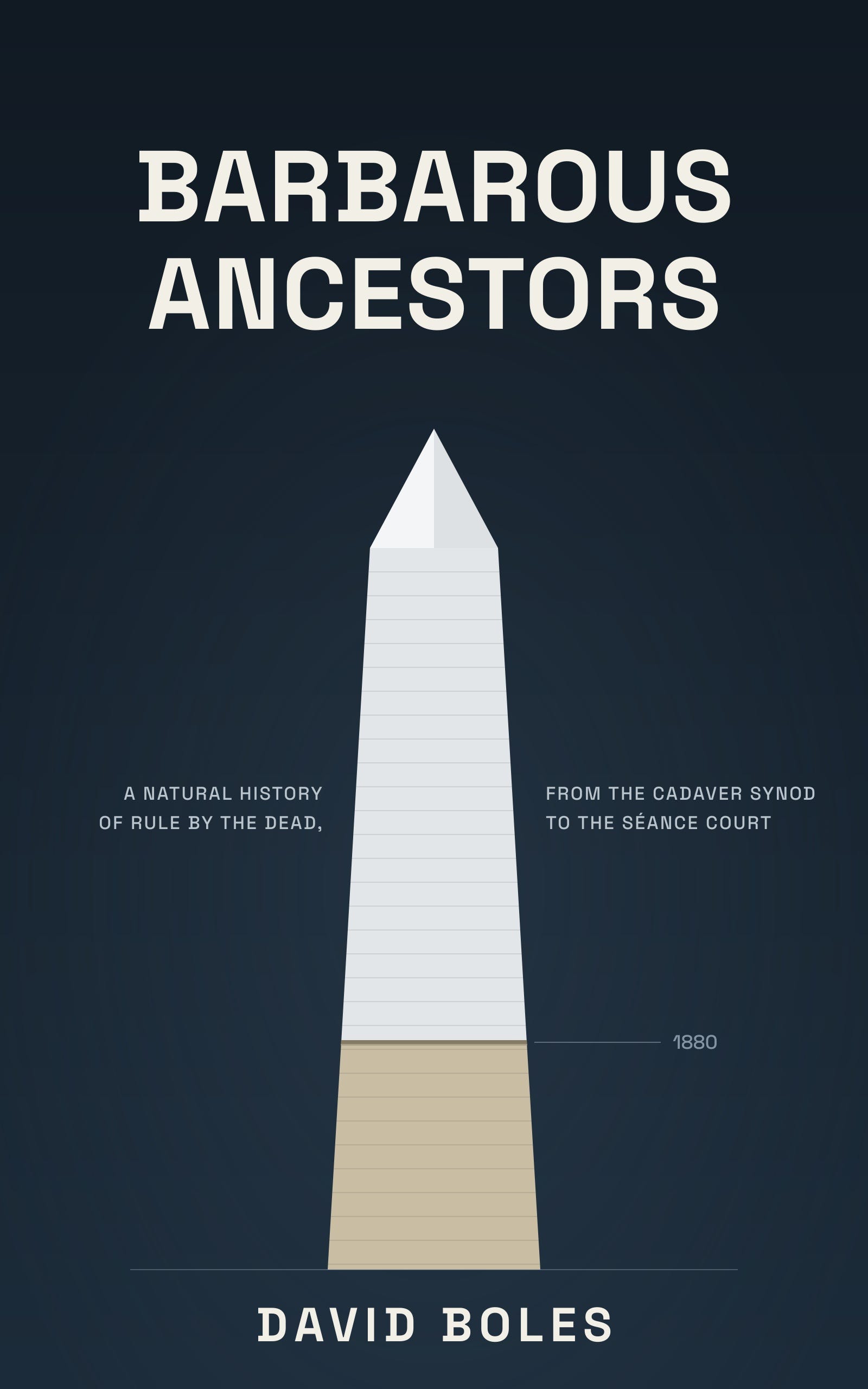
That is the reason my new book belongs in this publication’s pages. Barbarous Ancestors: A Natural History of Rule by the Dead, from the Cadaver Synod to the Séance Court is published this week from David Boles Books, ninety thousand words arguing that the arrangement strangling Tract 1305 also runs the highest courtroom in the country. Constitutional originalism holds that the founding document means what its ratifying generation understood it to mean, and nothing since, which makes the modern Supreme Court a probate proceeding on a national scale: the living petitioning the estate of the dead for permission to govern themselves. The justices had no trouble diagnosing accumulated dead instruction when it sat on prairie ground; the book asks why the diagnosis stops at the courthouse door.
The founders saw this coming, and the book lets them testify. Jefferson wrote from Paris in 1789 that the earth belongs in usufruct to the living, and usufruct is a farmer’s word, the old tenure term for working ground you hold in trust, taking the harvest without the right to bind the hands that come after you. He repeated the warning to a Virginia lawyer named Kercheval in 1816. Madison spent his last years revising his own convention notes by candlelight, which means the sacred record the originalists consult is a manuscript edited by its survivor. One of the book’s dramatized interludes summons Jefferson to a deposition he never agreed to attend and lets him answer the doctrine erected in his name.
The book is a natural history because the disease recurs, and the case studies range far beyond the law. In December 1799 the best physicians in the republic drew five pints of blood from George Washington at Mount Vernon, close to forty percent of what his body held, on the authority of texts reaching back to Galen, and the most valuable man alive died on his own farm of obedience to a dead one. In late March 1848, in a farmhouse in Hydesville, New York, a hamlet near Rochester, two farm girls named Kate and Margaret Fox began answering mysterious raps, and rural America founded the industry of talking to the dead that the book’s title courtroom still practices in robes. The mediums of that century relayed a recovered will of the departed that reliably matched what the paying customer came to hear, and the book documents how the modern bench performs the same retrieval with law-office history. A sentence from Chapter Nineteen carries the diagnosis: “The disease is rule by the dead, the subordination of present evidence to the recovered authority of the past.”
Readers who farm inherited ground will want to know whether the book respects what it criticizes, and it does. Chesterton’s fence gets its full weight in these pages: the book agrees you should learn why a thing stands before you clear it away, and it honors the conserving instinct that keeps a shelterbelt or a covenant alive for good reason. Its quarrel is with reverence that has stopped asking the question, with the treatment of any inherited instruction as beyond the reach of present evidence. A working fence is maintained because it works. A ghost’s fence is maintained because the ghost is presumed to be watching.
The book ends on a piece of rural material. The Washington Monument rose in two campaigns, and when the Army engineers returned in 1880 to finish what an earlier generation had abandoned at about a hundred and fifty feet, the Maryland quarry bed that supplied the first campaign could no longer give a block worth having, so the new stone came down from Massachusetts. Fresh courses refused to match the old ones, and the engineers built anyway, up to the aluminum cap in 1884, leaving a horizontal seam that late light still picks out above the Mall. Two American grounds meet at that line, one generation’s work joined honestly to another’s, and the fourth interlude of the book puts two workmen on the scaffold above it and closes with the sentence the whole argument was written to earn: “The living hand picks up the trowel, and it builds, and it lets the seam tell the truth.”
Tract 1305 waits for that kind of masonry. So does the document in the courtroom. Barbarous Ancestors is available now at BolesBooks.com and wherever books are sold, in a Kindle edition, a 488-page paperback that carries the monument’s seam across its wraparound cover, and a free PDF download on the site for any reader who wants the full argument in hand.