

The Ogallala Aquifer holds approximately 2.91 billion acre-feet of water beneath 174,000 square miles of eight states, from South Dakota to the Texas panhandle. That volume would fill Lake Erie three times over. It underlies 27 percent of all irrigated land in the United States and supplies 30 percent of the groundwater used for agriculture nationwide. It was deposited roughly ten million years ago by streams flowing east from the Rocky Mountains during the Pliocene epoch, and it has been quietly sustaining the prairie since long before anyone called the prairie a prairie.
You cannot see it. You cannot hear it. You cannot smell it or touch it unless you drill a well. The Ogallala sits between 100 and 400 feet below the surface, depending on latitude, filling the spaces between grains of sand, silt, clay, and gravel. It recharges at a rate of less than one inch of rainfall per year. Since 1950, irrigation has extracted roughly 286 million acre-feet from it, about nine percent of the total volume, and the rate of withdrawal exceeds the rate of recharge by a factor that varies from ten to one in Texas to something closer to equilibrium in parts of Nebraska. In the southern High Plains, where the saturated thickness was never great to begin with, the water table has dropped more than 200 feet in some counties. Farmers in western Kansas are already drilling dry holes. The USGS estimates that once depleted, the aquifer would require 6,000 years to refill through natural processes.
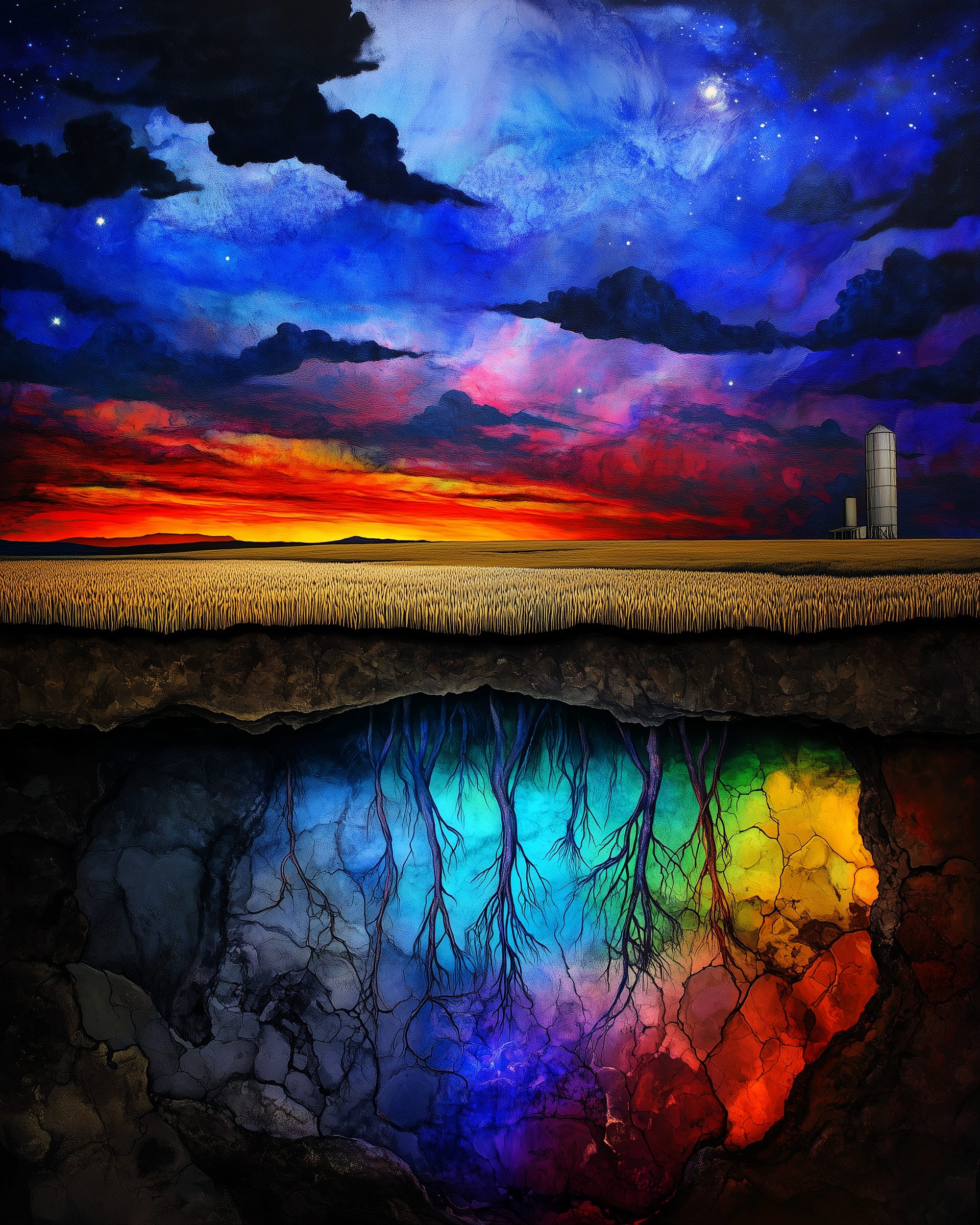
This is the largest and most consequential body of water most Americans have never thought about. It produces a fifth of the nation’s agricultural output. It turns the semi-arid shortgrass prairie, a region that receives between twelve and twenty inches of rain per year, into the global breadbasket. It is the reason center-pivot irrigation circles visible from satellite orbit dot the landscape from Lubbock to Valentine. And it is invisible. It does its work entirely underground, entirely out of sight, sustaining an economy that assumes the water will always be there because the instruments of attention were never built to measure what sits beneath the topsoil.
The prairie has always operated this way.
Four hundred Minuteman III intercontinental ballistic missiles currently sit in hardened launch silos scattered across approximately 40,000 square miles of Wyoming, Colorado, Nebraska, Montana, and North Dakota. Each silo is buried more than 100 feet underground, sealed by a 110-ton blast door, surrounded by a chain-link fence and motion detectors. From the surface, a silo looks like a concrete slab in a pasture. Ian Frazier described the missile silo as one of the quintessential Great Plains objects: to the eye, almost nothing; to the imagination, the end of the world. During the Cold War’s peak, 1,000 missiles occupied these silos, each carrying warheads capable of reaching Moscow in thirty minutes over the North Pole. The Air Force chose the Great Plains for the same reason they chose it: vast space, sparse population, and the reasonable assumption that nobody would look twice at a fenced acre of concrete surrounded by wheat.
This publication has spent the past year documenting the hidden economies that operate beneath the prairie’s visible surface. The rendering plants in Lexington, Nebraska, processing millions of pounds of dead livestock into ingredients that appear in pet food and cosmetics. The data centers outside Council Bluffs, Iowa, and Papillion, Nebraska, where server farms draw power from the same wind that once pushed covered wagons and now turns turbines generating electricity to cool processors storing photographs and financial records for populations that have never seen a combine. The custom harvest crews following the 2,000-mile corridor of ripening grain from Texas to Saskatchewan, an annual migration that employs thousands of people in an industry that most Americans do not know exists. The meatpacking plants in Garden City, Kansas, and Storm Lake, Iowa, that have transformed prairie towns into some of the most ethnically diverse communities per capita in the country without anyone in Washington or New York particularly noticing.
The pattern is consistent. The most consequential systems on the prairie are the ones you cannot see from the road.
I have been thinking about this pattern for a long time, and it is the reason I wrote a novel called The Dark Matter People. Not a Prairie Voice article. A novel. Because the connection I wanted to make required characters and time and the slow accumulation of consequence that only fiction provides.
The novel’s premise comes from astrophysics. In 1970, the astronomer Vera Rubin pointed a spectrograph at the Andromeda galaxy and discovered that the stars at its outer edge were orbiting too fast for the amount of visible matter in the galaxy to hold them in place. The discrepancy was not subtle. The stars were moving as though embedded in a halo of mass that no telescope could detect. She observed more galaxies and found the same result in every one of them. Every galaxy in the observable universe is held together by matter that does not emit, absorb, or scatter light. It interacts with ordinary matter through gravity alone. It constitutes approximately 85 percent of all matter in the cosmos. It is called dark matter, and despite decades of particle physics experiments, nobody has directly detected it. We know it is there the way you know the Ogallala is there: by what it does to the things we can see.
The novel follows a gravitational lensing researcher named Lena Vasquez who finds a periodic oscillation in the dark matter density profile of a candidate dark galaxy. The instruments are real. The Euclid space telescope is real. Weak gravitational lensing is a real technique for mapping the distribution of mass, including mass that emits no light. The discovery is fictional, but the question it raises is not: what happens to a person, professionally and psychologically, when her instruments detect structure in something every institution has told her is structureless?
I grew up on the Nebraska prairie, and the question was familiar before I had the physics to describe it.
The old-timers knew about the Ogallala before the USGS named it. They dug wells and hit water and understood that the water came from somewhere other than the sky. They built root cellars and noticed that some years the earth stayed cool and damp at six feet down and other years it did not, and they drew conclusions. They watched the native grasses survive droughts that killed the imported crops, and they understood, without the vocabulary of hydrology, that the visible landscape was being sustained by something they could not see. They called it different things. Good land. Deep land. Country that holds. What they meant was that the surface was not the whole story, and that the real economy of the place, the system that determined whether you survived or starved, operated underground.
The same instinct applied to social infrastructure. The handshake loan, which this publication has written about, was a financial instrument based on the recognition that the borrower’s visible assets were not the whole picture. The banker who shook hands with a rancher and advanced him $10,000 on nothing but reputation was making a dark matter calculation. He was measuring the invisible halo of social capital, community obligation, family history, and demonstrated competence that surrounded the borrower the way dark matter surrounds a galaxy. The collateral was not the ranch. The collateral was the rancher, and the rancher’s value was not reducible to what you could see from the road.
That instrument is gone now, replaced by credit scores and algorithmic risk assessment, which measure only the visible. The predictive models are effective within their domain. They correctly identify the five or ten percent of financial reality that cooperates with their instruments. But they cannot measure the 85 percent that does not: the neighbor who will bring a tractor when yours breaks down, the church that will feed your family when the crop fails, the county agent who will defer the payment because he sat next to your father at Friday night football for thirty years. These are gravitational effects. They hold communities together the way dark matter holds galaxies together, and they are invisible to every instrument that the financial system has built to measure creditworthiness.
The prairie knew this. The prairie has always known this. The question was never whether the invisible systems existed. The question was whether the instruments would ever catch up. In astrophysics, they did. Vera Rubin’s spectrograph was followed by gravitational lensing surveys, the cosmic microwave background, and the large-scale structure maps that confirmed what she saw in 1970. Every line of evidence converges on the same conclusion: the visible universe is the exception, not the rule.
On the prairie, the instruments have not caught up. The Ogallala is being depleted at an annual rate equivalent to eighteen Colorado Rivers, and the policy response has emphasized planned and orderly depletion rather than sustainable yield. The missile silos are simultaneously the most dangerous and the least discussed infrastructure in the region. The rendering plants, the data centers, the harvest circuits, the refugee communities, the underground economies that sustain small towns through winters that the balance sheet says should have killed them decades ago: all of these continue to operate in the dark, visible only to the people who live close enough to feel their gravitational pull.
The Dark Matter People is a novel about an astrophysicist, not a farmer. It is set in Chicago and Geneva and a fictional radio observatory in Wyoming, not in Garden City or Lexington or the wheat fields south of Valentine. But it is a prairie novel in the way that matters. It is a novel about a woman who discovers that the thing she has been trained to ignore is the thing that holds everything together, and about the institutional cost of saying so out loud.
The science in the novel is real. The discoveries are not. The question is open.
It is the same question the prairie has been asking since before anyone drilled the first well: What are you willing to see when the instruments tell you there is nothing there?
The Dark Matter People is available now from David Boles Books. The eBook is on Amazon, the paperback can be ordered, and a free PDF is available for download at BolesBooks.com.
David Boles is the publisher of Prairie Voice and the author of The Dark Matter People, published by David Boles Books Writing & Publishing, New York City.