

The county courthouse in my part of Nebraska is a square brick building on a square of grass, and the county attorney keeps his office in it. On most weeks his work is the ordinary work of a county’s law: the bad checks, the bar fights, the juvenile petition, the advice to the county board, the voters he meets at the café. Then a death arrives the way weather arrives, unscheduled. A trooper or a sheriff’s deputy brings the folder. The funeral home starts the paper. And the county attorney, who is by statute the county coroner, opens the folder and decides what the death was.

He decides it with what he has: a crash report, a doctor on the telephone, a family he knows or knows of, and a manner box on a form. The box has six values now. Natural, suicide, accident, homicide, pending investigation, and could not be determined. No laboratory comes with the job. No staff pathologist. And no one above him whose work is to review the manner he selects. What he writes, stands.
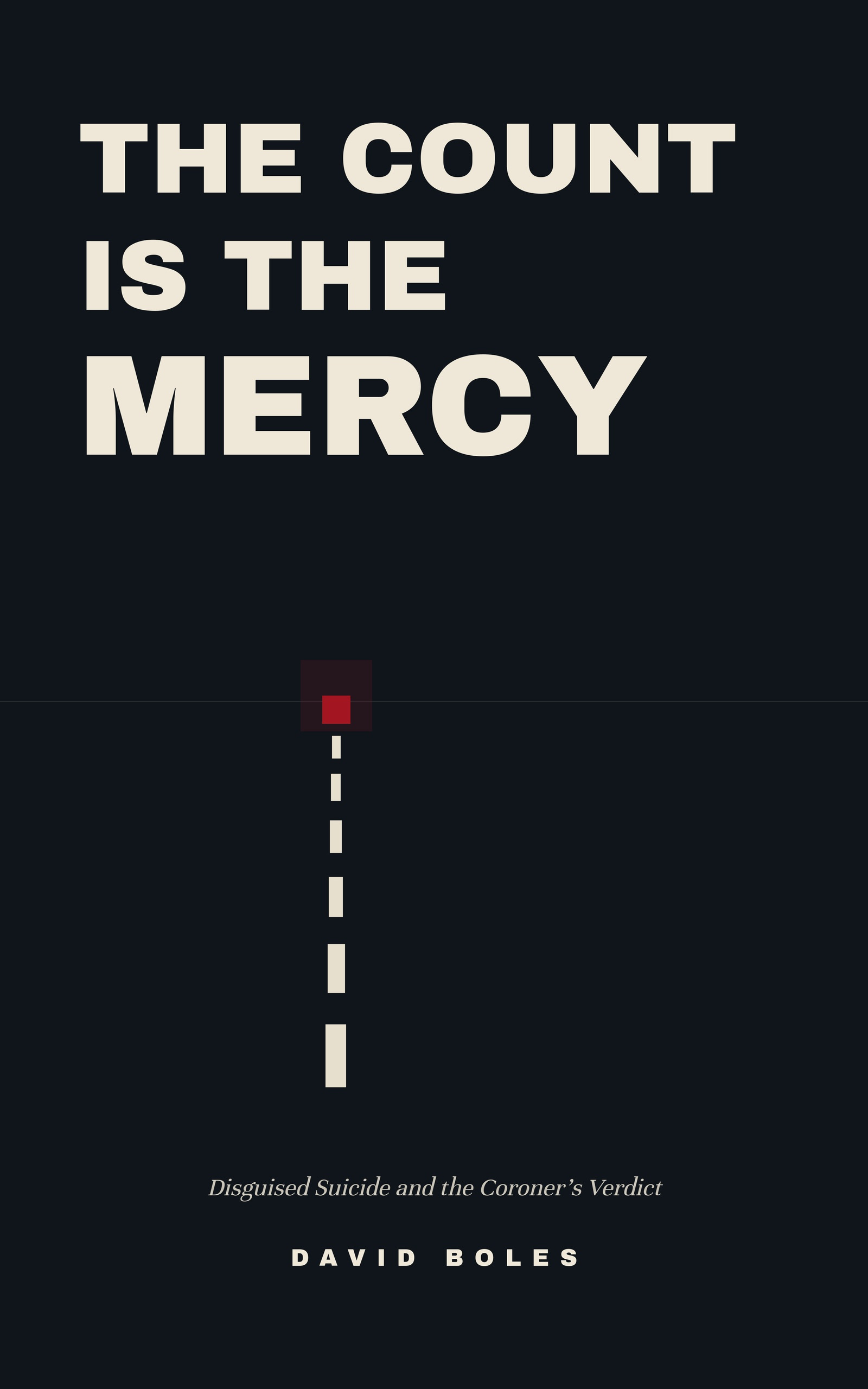
That arrangement has been the law in Nebraska since 1915, in all ninety-three counties, and it is the subject of the book I have spent the last year finishing and the last week holding in print. The Count Is the Mercy: Disguised Suicide and the Coroner’s Verdict is out now, and this article is about the ground it came from, because the ground is the argument.
The stretch of Interstate 80 that the book’s trooper worked runs from Grand Island west to the Wyoming line. Eight counties front it, and their county seats are the towns where the paperwork of death was done. The 1980 census counted six of those seats at 3,120 for Kimball, 5,638 for Ogallala, 7,040 for Lexington, 21,158 for Kearney, and 24,509 for North Platte. The biggest of them was Grand Island, at 33,180. The seventh seat is Sidney, in Cheyenne County, at 6,010, where the interstate’s own spur splits away for Colorado. The eighth is Chappell, in Deuel County, where the whole county held 2,462 people. A courthouse on a square, a weekly paper, a county attorney who knew the family of the dead man, or knew people who did. In a county of two or ten or twenty thousand, there is no other way to live, and no other way for a death to be decided.
The trooper worked those roads for twenty years, from about 1960 to about 1980: the flashlight, the measurements, the notification at the door. In the fall of 1983, interviewing him for a play I was writing as a sophomore in Lincoln, I heard him say it as an aside, in a lowered voice. When you read about a one-car crash that kills the driver on a Nebraska highway in the middle of the night, you are usually reading about a suicide. The claim waited forty-three years to be written down. His name did not survive the years either. He is unnamed in the book because his name is forgotten, and the book says so as a fact and never as a courtesy.
What changed by the time the claim finally surfaced into print, in September of 2026, is that the country had quietly built ways to ask his question. The interview of the living was invented in Los Angeles while he walked the ditches. Finland has sent a team of several professions to every fatal road crash since 1968. Sweden built a five-grade scale between certain suicide and certain accident. In 2012 it classified the same year’s road deaths twice: twenty-two suicides without the asking, thirty-six with it. The honest undetermined grade fell from twenty to eight while 273 certain accidents held still. A systematic review in 2024 lined up sixty-four years of the question’s studies from eleven countries. Nebraska joined the federal violent-death reporting system in 2016. And in January 2025 the Flatwater Free Press walked the arrangement the claim ran through and found it standing. The county attorney is still coroner in all ninety-three counties. About 87 percent of the state’s unattended deaths are never autopsied. And one county attorney said he did not think he had ever checked the box marked unknown.
The book’s test of the claim came back the way the book promised it would, in two directions at once. The trooper was right in kind: the deaths exist, the filing pattern exists, the machinery that produced both existed, and he saw them from the ditch while no one in print in his state was saying them. And he was wrong in size, where any size can be tested: his usually was a memory’s count of the scenes the bottle could not explain, and the record cannot return it. The verdict on the page is the county’s own word for the honest box. Undetermined. The box cannot fix the count, and it keeps the count from claiming what it does not know.
There is a braided river under all of this. The Platte, seen from a truss bridge, splits around a sandbar and rejoins and splits again. From the bridge deck the whole river looks like a page of crossed-out sentences, each channel true for a mile and abandoned by the next. The trooper’s belief ran in one channel, the courthouse’s certainties in another, the county weekly’s three-word sentences in a third. The channels never met. The state was the whole braid. Reticence was the region’s manners and its morals at once: you did not ask, and you did not tell. The roads were long, the houses far apart, and a man’s reasons were his own property. The county paper printed the word accident, and the town understood or did not, according to its willingness.
A book that tries to hold all of that without inventing any of it takes a year of Saturdays and a drawer of public records, and then it takes one more thing: the willingness to correct yourself in the open. The article the book expands got two names wrong, a year wrong, a country wrong, and a floor wrong. The book corrects every one of them on its own pages, because a book that indicts a ledger’s errors has to keep its own ledger clean. The corrections print where they stand. That is what finishing a book honestly looks like from here.
The book ends every chapter with the same sentence, and it is the most important sentence in the book: for support in the United States, call or text 988, the Suicide and Crisis Lifeline. The line rides at the end of every chapter because a book about the cost of hidden despair cannot then hide its own help. If this piece does one thing for the book it celebrates, let it be this: the count matters because the dead were worth counting honestly, and help is real, and numbered, and answered.

The book is out. The Count Is the Mercy: Disguised Suicide and the Coroner’s Verdict, by David Boles, is available now as a Kindle eBook and a 335-page paperback at Amazon, with the full account of how it was made at bolesbooks.com. The trooper’s name is forgotten. The question is not, and now the count of it is on the record, where anyone who wants to can check it, county by county, code by code, page by page.