

Olsen Custom Farms, the largest custom harvesting contractor in the United States with a fleet of 80 combines, begins each season the same way thousands of other crews have for generations. They start cutting wheat in Texas in late May and finish in Canada by October, following a 2,000-mile corridor of ripening grain that defines the actual productive prairie.
This annual migration, documented since at least 1976 when the BBC filmed Dale Starks for their documentary “Yellow Trail from Texas,” continues today with crews registered through the U.S. Custom Harvesters, Inc. (USCHI), the association founded in 1983 to represent this essential but largely invisible workforce.
The economics dictate everything. A new John Deere S790 combine costs between $599,900 and $739,900 according to 2024 dealer listings, with flagship models like the John Deere X9 1100 reaching $950,000.
Case IH’s Axial-Flow 260 series and CLAAS LEXION models fall into similar price ranges. These machines harvest at rates approaching 7,200 bushels per hour according to manufacturer specifications, guided by GPS systems and yield monitors that didn’t exist when many of these family operations began. Custom harvesters charge between $35 and $45 per acre according to industry reports, a rate that must cover fuel, maintenance, labor, transportation, and the massive capital investment in equipment.
Monthly rental rates for a single combine run $20,000 to $30,000, making custom harvesting economically essential for farmers who can’t justify owning machinery that operates only a few weeks per year.
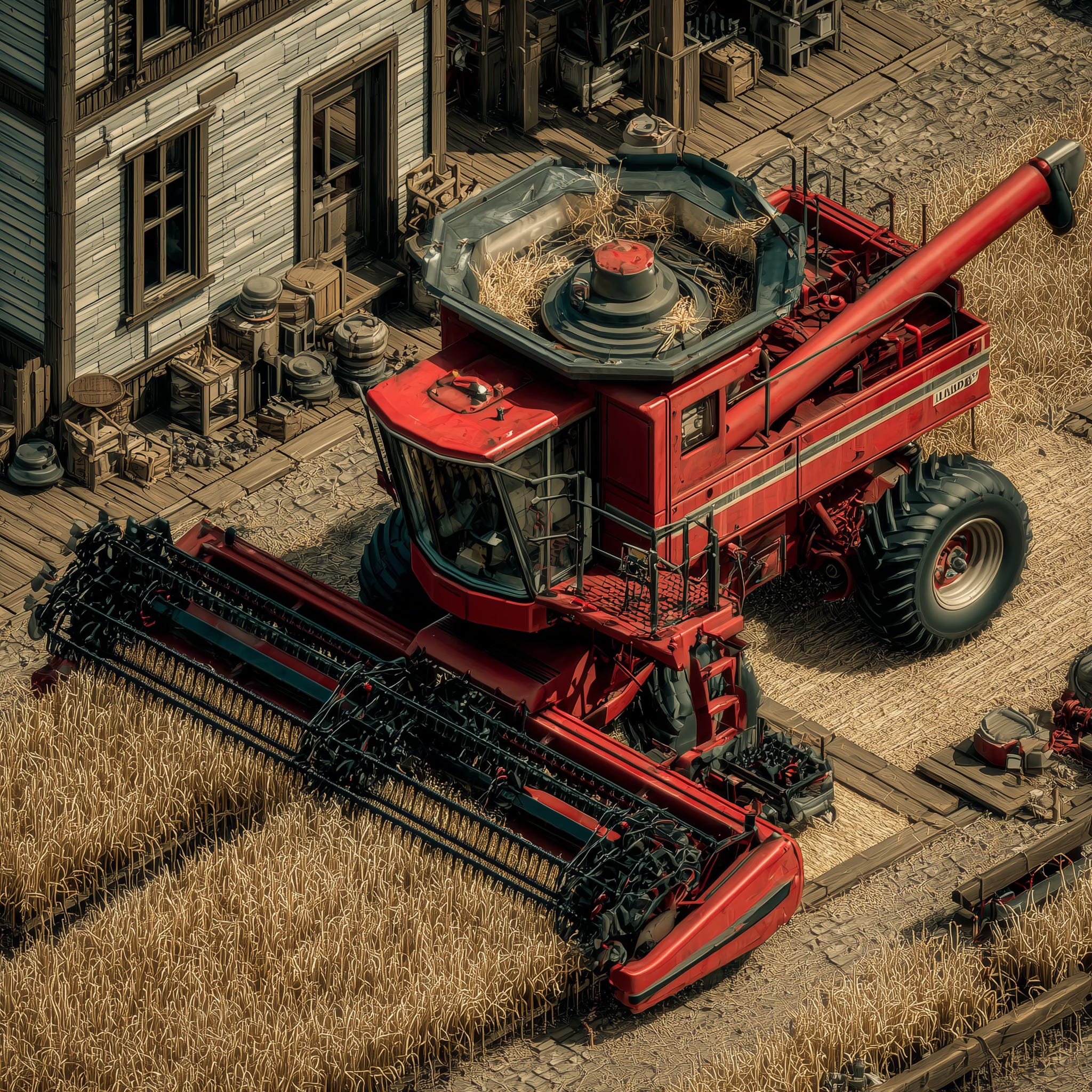
The schedule follows wheat physiology, not political boundaries. According to state wheat commissions and USDA harvest reports, Texas harvest typically begins around Memorial Day and completes by early July.
Oklahoma starts the last weekend in May, finishing by the first week of July. Kansas, producing more wheat than any other state with 335 million bushels in 2025, begins harvest in early to mid-June and finishes by mid-July. Nebraska starts late June, Colorado in early July, and by August the combines have reached South Dakota. The progression continues through North Dakota in late July and August, finally reaching Saskatchewan and Manitoba in September and October.
Mike Veith, a custom harvester based in Amarillo interviewed by John Deere’s corporate communications, explains the essential service: “We supply that turn-key.
One farmer with a large tractor and seeder can cover a lot of acres by himself. But when it comes to harvest, he has only a short time to get it all harvested. So that’s where the custom harvester really shines.”
The mathematics of modern farming support his claim. Large farming operations spanning thousands of acres cannot maintain millions in machinery for a harvest window measured in days, making custom harvesters indispensable to American agriculture.
The workforce faces critical challenges documented in federal regulatory filings and industry reports. During the COVID-19 pandemic, as reported by Farm Progress magazine, crews couldn’t secure H-2A visa workers, forcing operations to run at half capacity. Mandi Sieren, operations manager with USCHI, testified that CDL licensing requirements create additional barriers when DMV offices close or reduce services.
The Federal Motor Carrier Safety Administration has issued special exemptions for custom harvesters under age 21, recognizing the unique interstate nature of their work. These regulatory accommodations acknowledge what the industry knows: without these crews, the wheat doesn’t move from field to elevator.
Jim and DeAnn Deibert, who own JKD Harvesting based in Colby, Kansas, advertise their operation as “the 2,000 Mile Harvest,” explicitly marketing the journey from Texas through Oklahoma, Kansas, South Dakota, and North Dakota as an adventure.
Tracy Zeorian of Zeorian Harvesting & Trucking, who blogs about her family’s harvesting experiences at NebraskaWheatie.com, describes raising four daughters on the road, with the older ones wishing they could still join the harvest run.
These aren’t romantic narratives but practical descriptions of how the business functions: families living in RVs for six months, maintaining relationships with the same farmers year after year, passing knowledge between generations not through manuals but through proximity.
Frederick Harvesting LLC advertises their route explicitly: Kansas, Oklahoma, Texas, Colorado, Montana, and the Black Hills of the Dakotas.
This isn’t random wandering but precision logistics. As documented by Conrad Weaver in his film “The Great American Wheat Harvest,” these crews maintain intricate networks of relationships. They know which Hutterite colonies in Saskatchewan still shake hands on six-figure deals, which Mennonite communities in Kansas pay cash and provide three meals a day, which corporate operations in Nebraska treat them as contractors rather than partners.
The knowledge transfer happens through repetition rather than education. When CLAAS introduced their LEXION 8900 at Saskatchewan’s Ag in Motion farm show, delivering 779 horsepower from a 16.2L engine, the technology represented advancement.
But the fundamental skill remains reading moisture content, which must stay between 13.5 and 14 percent for optimal harvest according to industry standards. Too wet and grain requires expensive drying.
Too dry and kernels shatter, leaving profit in the field. These calculations haven’t changed since Dale Starks ran his crews in the 1970s, though the machines have tripled in capacity.
Labor shortages compound every season. Jeremy Heim, a board member of Wisconsin Custom Operators, told Madison’s Country Q106 radio in September 2024: “People are in need of custom harvesters as the farms grow and labor gets tight. It’s just a good option for a lot of operations to move to custom work and have us come in and do maybe half of it or maybe all of it.”
Raph Jolliffe, president of USCHI from Stratton, Colorado, confirmed to Radio Oklahoma that finding qualified labor represents their biggest challenge, intensified when COVID-19 prevented seasonal workers from arriving.
The market data reveals the scope. According to a 2024 industry analysis, the global combine harvester market reached $11.1 billion, projected to grow to $15.8 billion by 2033. Yet individual custom harvesters face uncertainty that no market projection captures.
Mark Anderson of USCHI has lobbied Congress to include custom harvesters in federal crop insurance programs, noting that when hail destroys a field before harvest, farmers receive compensation but custom harvesters lose the job while still carrying equipment payments and crew costs.
The actual route these crews follow, moving steadily northward from the Texas Panhandle through the heart of wheat country into the Canadian prairies, maps something beyond agriculture. Each town represents not just geography but relationships maintained across decades.
The Great American Wheat Harvest continues not through tradition but through necessity.
Someone must move the grain from Texas to Canada, reading weather patterns and moisture meters, managing million-dollar machines and minimum-wage workers, transforming standing wheat into the flour that becomes bread on every American table.
When USCHI holds its annual convention each January in Hot Springs, Arkansas, gathering at a trade show spanning 150,000 square feet, these contractors aren’t celebrating heritage.
They’re coordinating the infrastructure that allows American agriculture to function at scale. The 2026 convention already has dates: January 29-31.
By then, another harvest will have moved north with the summer, another generation will have learned the route by riding in combine cabs connected by radio, another year of wheat will have moved from field to market through the labor of crews most Americans never see.