

Le Corbusier told Europe’s architects to study our grain elevators. A new book explains why the people who raised them were denied the word art, and what it costs a county to keep denying it.
In 1923, the most famous architect in Europe published a manifesto called Vers une architecture, and among its plates he printed photographs of North American grain elevators. Le Corbusier held those concrete towers up to his own profession as a rebuke. The engineers, he told the architects of Europe, were the ones building the honest forms of the age, and the schools of the old continent should sit down and study them.
The towers he printed belong to the same species that stands at the end of Main Street in a thousand plains towns. Slip-form crews raised them in continuous pours, the wooden forms climbing a few feet at a time while the concrete set below, farmers’ cooperatives paying the bills and painting the town’s name on the finished bins. In most counties out here, the elevator is still the tallest thing standing. People call them cathedrals of the plains, and the joke has a true floor under it: they organize the horizon the way a spire once organized a parish, and you steer by them.
Nobody who poured those cylinders was called an artist. They were called labor, and the ledger treated them accordingly. Europe’s leading architect could print their work in a manifesto, and the men themselves still stood outside the word.
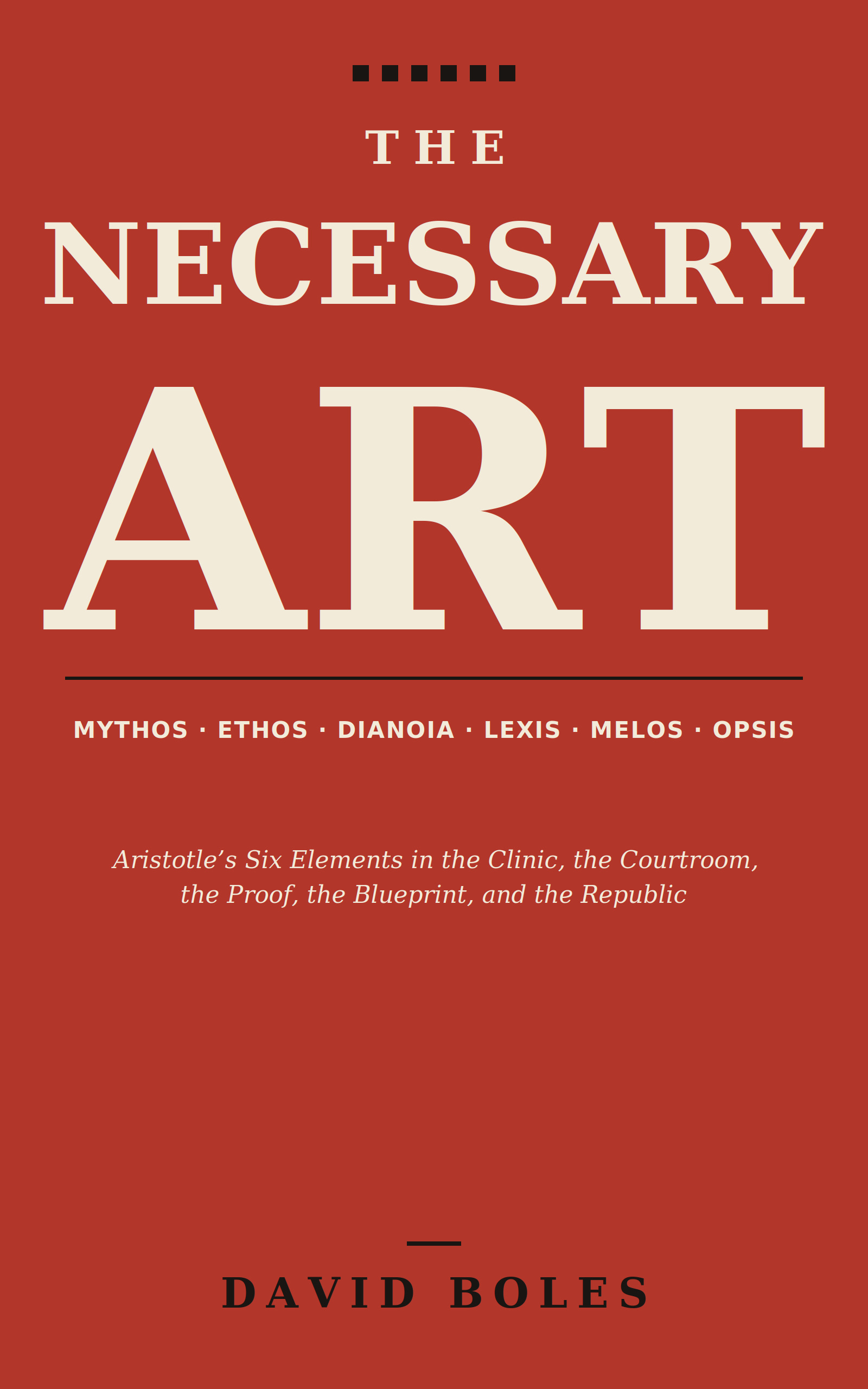
I have just published a book about that exclusion, where it came from, and why it is younger and shakier than it looks. The book is called The Necessary Art: Aristotle’s Six Elements in the Clinic, the Courtroom, the Proof, the Blueprint, and the Republic, and its argument begins with a piece of history most of us were never taught. For the long majority of Western time, the word art meant a principled, teachable discipline of making and doing, judged by its work. The Latin ars and the Greek techne named a family that held the painter beside the physician, the pilot, the general, and the geometer. Aristotle’s Poetics pulled six working parts out of tragedy, plot, character, thought, diction, song, and spectacle, and those six became load-points where any made thing carries weight, and where it can be built sound or built rotten. Then, in 1746, a French abbé named Charles Batteux fenced the fine arts inside a single principle, the Encyclopédie drew the map, and Kant gave the wall its constitution. Inside went the realm of genius. Outside went everyone who works. The wall is younger than the professions it divided.
Prairie Voice has spent years tracking what happens to the working disciplines of rural America when the country decides they are infrastructure instead of achievement: the handshake credit that consolidation replaced, the local knowledge that leaves when the co-op sells, the hollowing that follows every merger announced as efficiency. This book arrives as evidence for that whole file. Because here is what the county seat has known all along, without being allowed the vocabulary: within four blocks of a plains courthouse square, you can stand inside all five rooms the book walks.
Start at the clinic, where the doctor who has carried three generations of one family keeps the case history, and the case history is a plot: incidents arranged in time, welded by cause, aimed at a recognition scene called diagnosis. Walk to the courthouse, where the district court stages its argument under oath, and the rules of evidence decide which stories a jury may hear because a strong enough story will beat a fact in open court. The school two streets over hands down Euclid the way it has for a century, and a proof is drama on the barest stage there is, a recognition scene built from nothing except necessity. At the end of Main stands the blueprint made real, the elevator itself, a building that is scored action, every truck and auger and railcar moving to the composition. And on Monday night, in a room in the courthouse basement, the county commission performs the fifth room, the republic, working under a script written by men who had read their tragedy and were trying to compose a government that would refuse to write its own reversal.
Five rooms, one square. The county seat is the book in miniature, and it always was. What the eighteenth century took from these rooms was the title, and the title turns out to be a load-bearing word. Call the doctor’s discipline an art and you have a standard for judging it: sound or rotten at six named points. Call it a service line and closing it becomes arithmetic. Researchers at the University of North Carolina have tracked more than one hundred fifty rural hospitals that closed or ended inpatient care since 2010, and every one of those closures was announced in the vocabulary of throughput and margin, never in the vocabulary of a discipline being dismantled. The words we allow a profession decide what we are permitted to grieve when it goes.
The book’s first hundred pages clear the record of the forgeries that got taught in Aristotle’s name, the three unities assembled by an Italian commentator in 1570, the tragic flaw born from a mistranslation, the pyramid diagram published in Breslau in 1863 as advice for German playwrights, the great word katharsis shrunk to a purge. Its middle walks the five rooms at full length, from the anatomy theater at Padua where medicine staged its greatest recognition scene in front of a packed theater, to the two Nurembergs, the 1934 rally built as pure spectacle and the 1945 courtroom that answered it with a welded argument. Its final movement takes down the wall stone by stone and hands the word back to its holders, with a standing order addressed to every maker in every room: build worlds people can learn true things inside, weld them so they hold, and sign.
That last instruction is the one the plains obeyed before anyone wrote it down. This is the state that raised Willa Cather out of Red Cloud and sent William Jennings Bryan east from Lincoln with a speech that moved a convention like an anthem, and it is also the state where the anonymous crews poured the towers Europe put in a manifesto. I sold my first piece of writing in Lincoln at ten years old, and I have spent the decades since watching this region make things that hold while being told it makes nothing worth signing.
The Necessary Art is available now, a 342-page paperback, a Kindle edition, and a free reading edition for download at bolesbooks.com.
Out here, the elevator already carries a signature. It says the name of the town.