

There is a hole in the ground in the Black Hills of South Dakota, about ten inches across, and the air moving through it will take a hat off a man’s head.
It has been doing that for as long as anyone has stood beside it. In 1881 two brothers named Jesse and Tom Bingham were drawn to the spot by a whistling noise and found wind coming out of the rock, and that is the moment the written record begins. The Binghams get the credit in most accounts, the way settlers usually get the credit, because the paper starts when they arrive.
The paper is not the same thing as the knowledge.
Centuries before any barometer reached the Black Hills, the Oglála Lakȟóta had already noticed that the air at that opening reverses, that the reversal follows a pattern, and that the pattern was worth naming precisely enough to carry. Sina Bear Eagle records several Lakȟóta names for the site, among them Oníya Ošóka, heavy breath, and Maká Oníye, breathing earth. Leonard Little Finger published a different form, Washun Niye, which he described as a site from which Mother Earth breathes, and he heard the story of it in Lakota in 1947, at eight years old, from his grandfather Saste, who had been taken there to pray in 1883 at the age of seven.
Set aside for a moment what those names mean to the people who carry them, which is not my business to adjudicate. Consider only the observational content. Air moves in and out of that opening. The direction reverses. The reversal is regular enough to be described.
That is the first accurate account of a barometric cave in North America, and it is a Lakota one.
◊
The mechanism took the rest of the world a while to work out, and the man who did the most careful early work on it was a rock climber who lived four miles outside Custer.
Herbert Conn and his wife Jan came to the Black Hills on a climbing trip in 1959, went into Jewel Cave once at a geologist’s invitation, and stayed twenty years. Between them they mapped better than sixty miles of it. They lived on twenty acres in a stone house with no electricity and no running water for more than half a century, and Herb paid for the exploring by going up Mount Rushmore each year on a rope to fill the cracks in the four faces. In 1966 he published a study of the barometric wind in Wind Cave and Jewel Cave in the Bulletin of the National Speleological Society.
His method was almost embarrassingly plain. Measure how much air moves through the entrance for a given change in barometric pressure. If a small pressure change pushes a great deal of air, there must be a great deal of space behind the opening for that air to fill.
Run the arithmetic and the number is enormous. Wind Cave has about a hundred and seventy miles of surveyed passage as of this July, which makes it third longest in the United States and somewhere around sixth in the world, and a century and a half of exploration has not found the end of it. Conn’s calculation implies that the mapped passage is a small fraction of the air-filled space connected to that entrance.
What his method cannot say is how much of the remainder a person could walk into. The same volume might be one enormous chamber or a mesh of cracks too narrow to enter, and a repeat of the measurement in 2001 with better instruments came out several times smaller than his. The wind reports volume rather than corridors.
Still, consider the shape of the thing. A man in South Dakota with an anemometer and a barometer inferred the existence of space that no human being had entered, and that many will never enter, from nothing but the behaviour of moving air at a ten-inch hole. That is prairie work. It is unglamorous, it is done with cheap instruments by somebody who lives there, and it produces a result that a satellite cannot.
◊
I have written a book about breathing, and Wind Cave has a chapter in it.
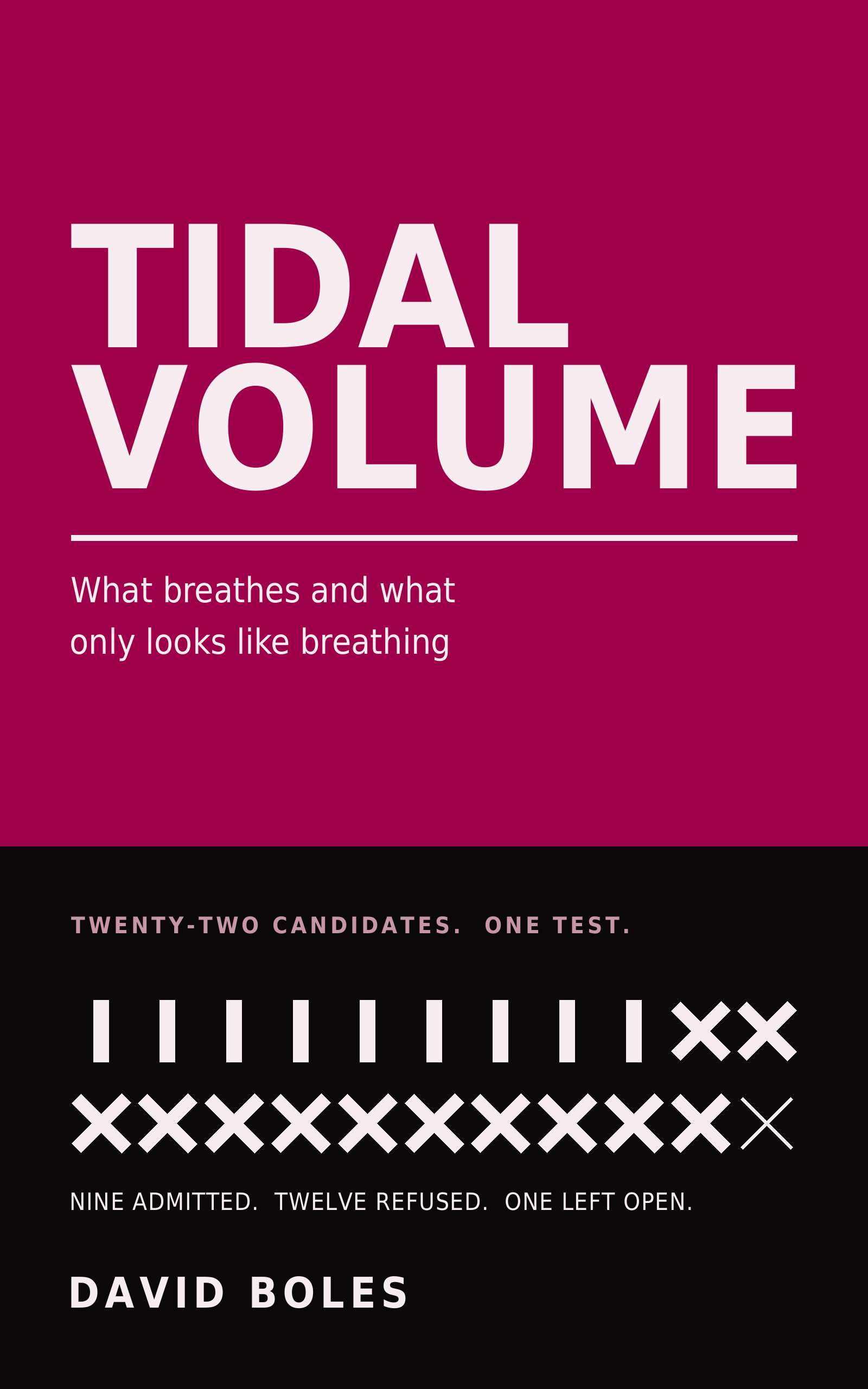
The book is called Tidal Volume, and its method is to state a rule in the first chapter and then apply that rule, in the open, to twenty-two candidates. A thing breathes if it runs a cycle in two phases where one phase is paid for and the other returns free out of a store, and only if running that cycle spends something the thing cannot get back. Nine candidates passed. Twelve failed. One was left unresolved.
Wind Cave failed.
I did not want it to. Of everything in the book, that cave is the case I most wanted to admit. It had the tradition behind it, it had Conn’s measurements, it had a hundred and seventy miles of argument in its favour, and it breathes in every ordinary sense of the word. But the second clause asks what running the cycle costs the thing itself, and the answer at Wind Cave is nothing. Turn off the weather and the cave is unchanged. Boxwork intact, passages uncollapsed, the limestone exactly where it was. The air is doing all the spending. The cave is the room the spending happens in.
So the verdict went against me, and I printed it, and I said in the chapter that I would have preferred the other answer.
That is worth saying out loud in a publication that takes the prairie seriously, because the temptation to flatter a place is at least as dangerous as the habit of dismissing it. Refusing the mechanism leaves the observation untouched. The Lakȟóta account of that opening was correct about what happens there, and it was correct first, and neither of those facts depends on whether my rule lets the cave through.
◊
The wind is still moving through that ten-inch hole. It reversed sometime in the last few days and it will reverse again, on a schedule set by weather systems crossing the Great Plains, and it will go on doing that long after every argument about what to call it has been filed.
Tidal Volume: What Breathes and What Only Looks Like Breathing is available now as a Kindle edition and a paperback, and there is a free PDF of the whole book at BolesBooks.com. Chapter Five is the Wind Cave chapter, and the verdict is at the end of it.