

Prairie Voice has published its first book. Plus, we have removed our paywalls here on Substack. If you cannot read our entire archive, let me know.
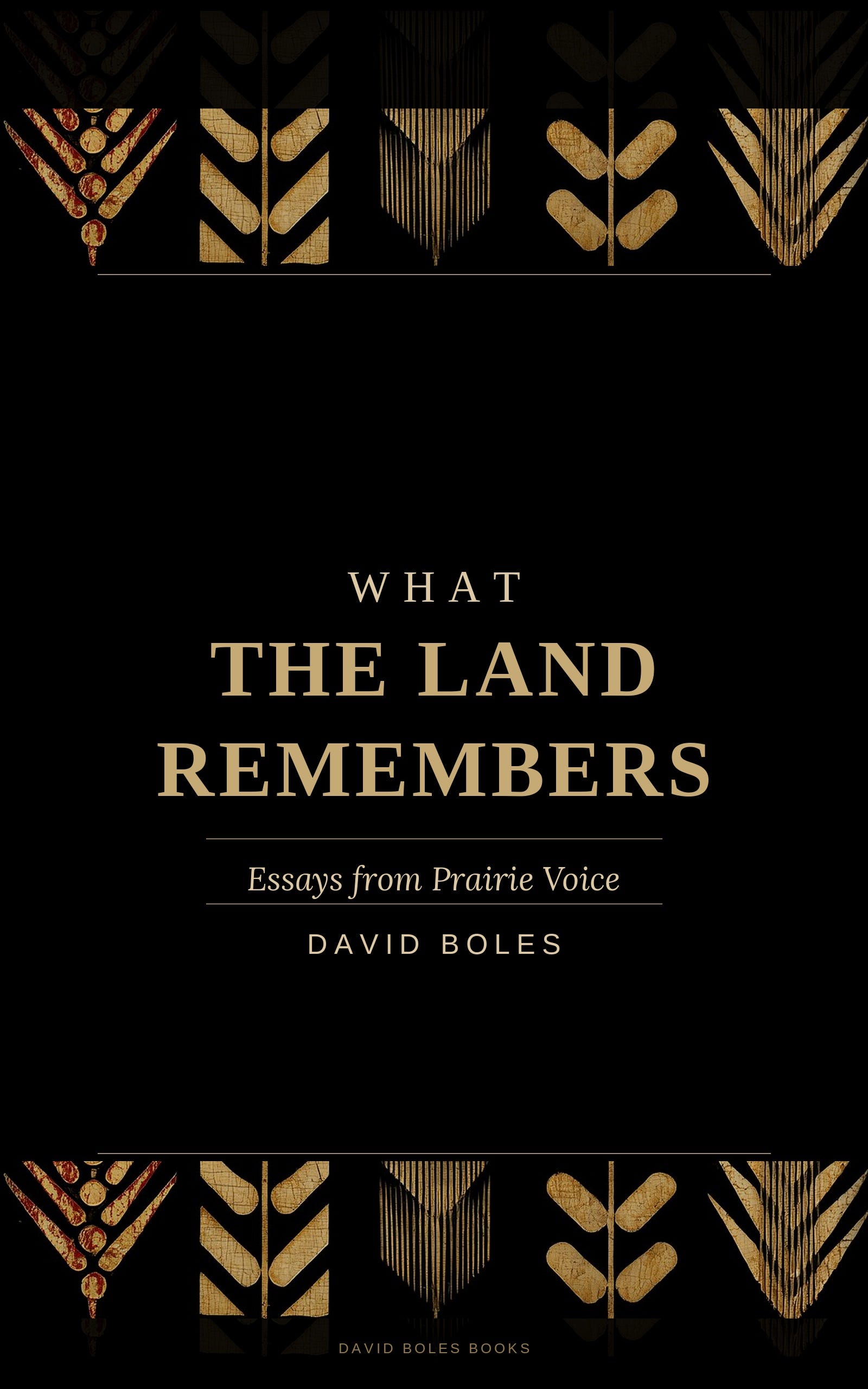
What the Land Remembers: Essays from Prairie Voice collects twenty-two essays and one piece of fiction from this publication into a single volume, organized across six thematic sections with scholarly apparatus including notes on sources, notes on composite characters, and a further reading list. The book is available as a Kindle eBook, a paperback, and a free PDF download from BolesBooks.com. It runs 215 pages in the paperback edition and approximately 50,000 words.
The publication of a book from a periodical is not unusual. What may be unusual is the argument that emerged from the accumulation. I did not plan it. The essays were written one at a time, each following its own question into its own territory. “The Rural Veterinarian’s Death Watch” followed Doc Brennan through forty years of 3 a.m. calving calls on gravel roads in western Nebraska. “Refugee Prairie” followed Somali and Guatemalan meatpacking workers into Garden City, Kansas, a town of 28,000 that enrolls students from dozens of countries in its public schools. “The Combine Harvest Circuit” followed custom cutting crews from Texas to Canada along a 2,000-mile corridor of ripening grain. “The Draining Prairie” followed the Ogallala Aquifer downward, inch by inch per year, toward a threshold below which the pumps stop working.
Each essay was self-contained. Each was published here, on this site, as a standalone piece of literary journalism. But at some point, the pieces stopped being individual observations and became chapters in an argument I had not designed. The argument is this: between roughly 1960 and 2020, America systematically dismantled the institutions that once produced citizens capable of self-governance, and replaced them with nothing that performs the same function.
The phrase I developed to describe what was lost is “technologies of formation.” These were not leisure activities or quaint traditions. They were the mechanisms by which communities reproduced themselves. The potluck supper. The handwritten letter. Sunday observance. The county fair. The one-room schoolhouse. The front-porch conversation. Each of these institutions trained its participants in specific civic capacities: patience, generosity, deliberation, the acceptance of mutual obligation, the understanding that you depend on people whose cooking you might not prefer. When these institutions were replaced by faster, more efficient alternatives, the civic capacities they produced disappeared within a generation.
The prairie is the best diagnostic instrument for this disappearance because the prairie is where the technologies of formation were most exposed. In dense cities, civic life can sustain itself through proximity. On the prairie, where the nearest neighbor might be a mile away and the nearest town twenty, every act of community is deliberate. When deliberate acts cease, the absence is immediate and total. You can count the closed schools. You can drive the abandoned roads. You can stand in the silence where a town used to be.
This publication has been standing in those silences since its founding. The articles that became the book explored the same territory from different angles. “The Grammar of Character” examined McGuffey’s Readers, the most systematic attempt in American history to build citizens through shared moral vocabulary, 122 million copies sold between 1836 and 1960. “The Table as Institution” examined the family meal as civic infrastructure. “The Sabbath Mind” examined what happens when a culture removes mandatory rest from the rhythm of its weeks. “Correspondence as Sacrament” examined the handwritten letter as a training exercise in patience and deliberation. “The Artisan’s Revenge” examined craft labor as a counter-economy that resists optimization. “The Right to Be Boring” examined privacy as an endangered civic right in a surveillance culture that treats opacity as suspicious.
Those six essays form Part One, “The Grammar of Formation.” Each subsequent section follows the same logic: identify an invisible system, trace its origins, document its decline, and measure the consequences.
Part Two, “The Institutions,” examines the Dedham town meeting (four hours of deliberation over seventeen dollars in road repair), mutual aid networks, deaf education on the open plains, and the transformation of the University of Nebraska from a land-grant institution serving local agriculture into a billion-dollar athletic enterprise. Part Three, “The Hidden Systems,” examines veterinary practice, refugee labor, inherited silence, migrating harvest crews, and the Ogallala Aquifer. A fictional interlude, “Blood Corn,” interrupts the argument to remind the reader that the prairie has always been a place where debts are collected in currencies we did not know we owed. Part Four, “The Digital Prairie,” examines abandoned internet forums, livestream homesteaders broadcasting to empty rooms, the impossibility of remaining unmapped in Wheeler County, and the emergence of electronic music culture in vacated rural spaces. Part Five, “The Standing Ovation,” examines community theatre as the institution that most precisely reveals how American culture sedates itself. Part Six, “What Endures,” asks what remains when everything else has been removed, and finds its answer in winter wheat growing beneath frozen ground and a prairie chicken calling at the same frequency as the wind turbine that will replace it.
The compression of these essays into a book required editorial decisions. Subscription prompts were removed. Promotional references to other publications were stripped. A few pieces were lightly revised for clarity and continuity. The arguments are unchanged. The voice is unchanged. Two outside reviewers examined the manuscript for factual consistency, cross-reference accuracy, and production readiness. Their corrections were implemented across three editorial passes. The Note on Sources documents the research behind each essay. The Note on Composite Characters identifies which essays employ composite characters drawn from multiple sources rather than portraits of specific individuals.
I want to say something about what this book is not. It is not a nostalgic project. Nostalgia is the sentimental form of the same forgetting the book opposes. The communities described in these essays enforced conformity, punished deviation, maintained hierarchies of race and gender and class that caused real damage to real people. The silence examined in “The Silence Inheritance” was not only a survival mechanism but a weapon, used to bury truths that powerful people wanted buried. The book does not argue that the past was better. It argues that the past built institutional infrastructure that the present has not replaced, and that the consequences of this failure are measurable.
The most hopeful claim the book makes is that this is not a crisis of human nature but a crisis of institutional design. The people have not become worse. The institutions that produced their civic capacity have been removed. Institutional design is something we can change. Whether we will is the question these essays cannot answer. They can only insist that it be asked.
Prairie Voice began as a place to write about what the land reveals when you stand still long enough to see it. This book is the first sustained expression of that principle in bound form. The publication continues. The essays continue. The prairie continues, though it gets quieter every year.
What the Land Remembers: Essays from Prairie Voice is available now as a Kindle eBook and paperback on Amazon, and as a free PDF download from BolesBooks.com.