

There is a story my grandmother never told me, and her generational silence was itself a kind of inheritance. She died when I was young; but her spirit was always around me growing up. She came from people who knew better than to ask too many questions about origins, about the villages left behind, about the relatives who stopped writing letters. Some truths are too expensive to carry across borders. You leave them behind with the old country clothes and the languages your children will not speak.
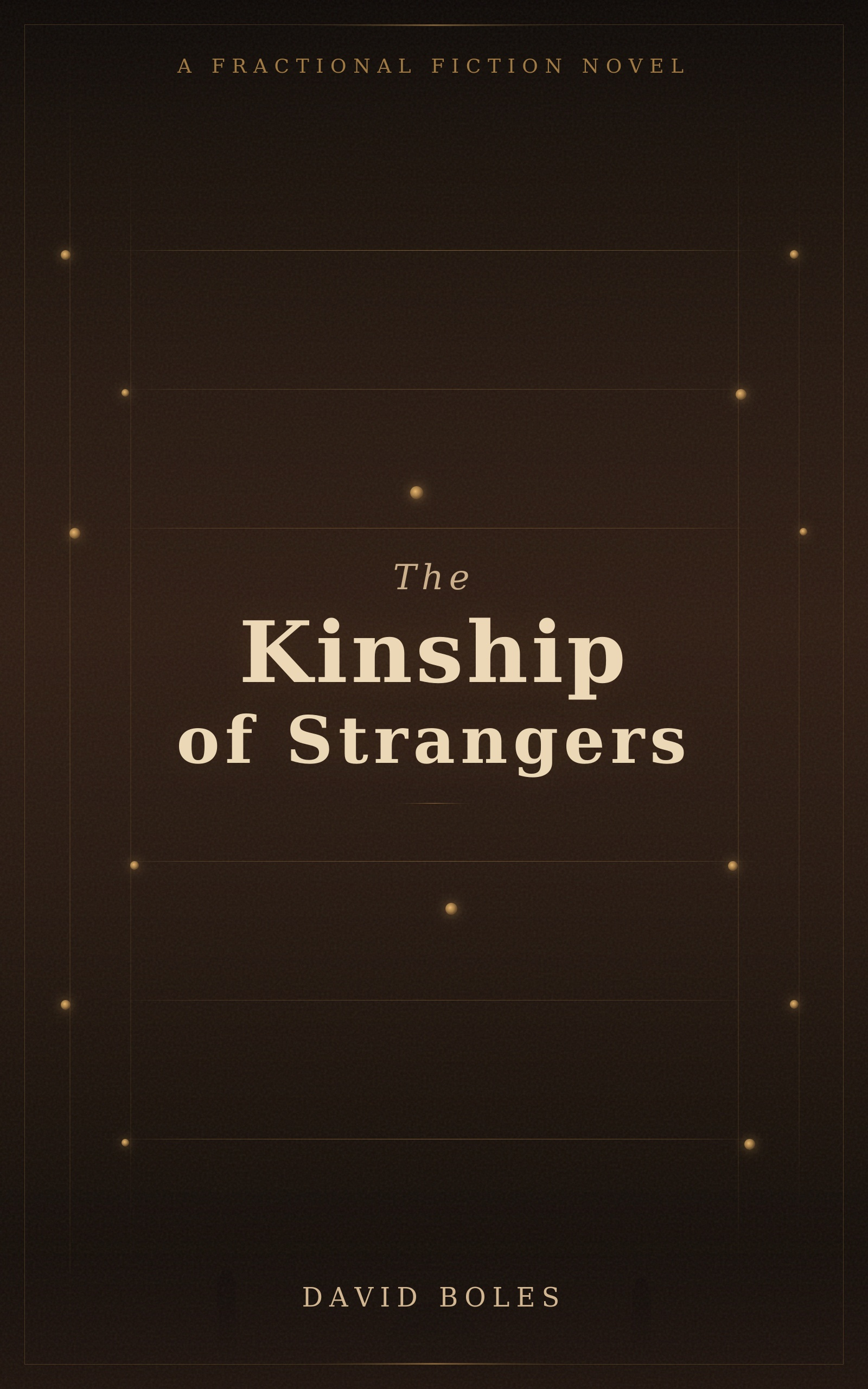
I thought about my grandmother’s silence while writing “The Kinship of Strangers,” the third novel in my Fractional Fiction series. The book follows ten characters who receive genetic ancestry results that contradict everything they were raised to believe about who their people are. A rabbi discovers his Y-chromosome connects him more closely to Palestinians than to his own congregation. A Palestinian archaeologist excavates Bronze Age bones that complicate every modern claim to the land. A Jewish convert realizes her belonging will always carry an asterisk that DNA cannot remove.
These are not my grandmother’s stories. But they rhyme with her silence in ways I am still learning to hear.
On the prairie where I grew up, people did not talk much about where they came from. What mattered was where you were now, what you could build, whether your word was good and your fences were straight. The past was another country, and most folks had reasons for leaving it behind. Germans who stopped speaking German during the wars. Czechs who became “Bohemians” and then just “farmers.” Swedes and Danes and Norwegians who married each other’s children until the old distinctions dissolved into a general category called “Scandinavian,” which itself eventually dissolved into “American.”
This is the prairie’s gift and its wound: the permission to reinvent yourself, purchased at the price of forgetting. You can become someone new here. You can leave behind the village feuds and the religious persecutions and the ethnic hatreds that made the old world unbearable. But you cannot leave behind your blood. The blood remembers what the border forgets.
Population genetics has made this literal. For a hundred dollars and a tube of saliva, you can now recover what your grandparents buried. You can discover that the family story about being “pure” something or other was always a fiction. You can find relatives you never knew existed, descendants of the siblings who stayed behind, the cousins who took different boats to different shores. You can learn that the people your people defined themselves against share ancestors with you, that the boundary between “us” and “them” was always more porous than the stories admitted.
The science does not care about our categories. It simply reports what the molecules reveal.
But we are not molecules. We are storytelling creatures who need to know where we come from in order to know who we are. The stories may be partial, selective, sometimes false. They are still necessary. A person without a story is a person without a place to stand.
This is the tension at the heart of “The Kinship of Strangers.” The characters do not reject the science. They cannot. The evidence is right there in the percentage breakdowns and haplogroup designations. But they cannot simply update their identities either, as if selfhood were a database that accepts new entries without resistance. They are caught between what the blood remembers and what the story requires, and there is no resolution that does not cost them something essential.
I set much of the novel far from the prairie, in Philadelphia synagogues and Jerusalem checkpoints and genetics laboratories in Chicago. But the questions are prairie questions, the same ones that haunted the German farmers who stopped speaking German and the Czech grandmothers who took their recipes to the grave rather than write them down in the old language. What do you owe to the past? What are you permitted to forget? When the blood contradicts the story, which one tells the truth?
On the prairie, we learned to live with contradiction. The land that welcomed immigrants was taken from people who were here first. The democracy that promised equality was built by hands that were not free. The churches that preached love enforced boundaries that determined who could marry whom, who could be buried in which cemetery, whose children could play with whose. We knew these things without speaking them, the way you know the weather is changing before the clouds arrive.
“The Kinship of Strangers” does not resolve these contradictions. Resolution would be a lie, the kind of lie that makes readers feel better while leaving the world unchanged. What the novel offers instead is recognition: the acknowledgment that kinship exists whether we claim it or not, that the boundaries we depend on are held in place by agreement rather than nature, that the blood we share with strangers is exactly as real as the blood we share with family.
I understand my grandmother kept her silence for reasons I will never fully understand. Perhaps she was protecting the family from knowledge that would have made life more complicated. Perhaps she was protecting herself from memories that were too painful to speak. Perhaps she simply did not have words, in any of her languages, for what she carried.
I wrote this book for her silence, and for all the silences like it. The test results are in. The blood has spoken. The question now is whether we can learn to hear what it has always been saying.
“The Kinship of Strangers” is available now through Amazon and as a free PDF at BolesBooks.com. It is the third novel in the Fractional Fiction series, following “The Dying Grove” and “The Inheritance.”