

A new book is out, and it began in a Nebraska office in 1982. This is the story of what took so long.
In 1982, in an office at Nebraska’s public television station, I handed a man I loved a brand-new copy of The Twilight Zone Companion and told him my review of it, sixteen years old and proud of myself. Marshall Jamison looked the book over, snorted cigarette smoke out his nose, allowed that he knew a lot of the people in it, and then said what he had plainly been carrying for years: everything in that show ends in deus ex machina, and nothing is earned.
I argued. I remember arguing. I remember that my argument was thin, because I was sixteen and the charge had two and a half millennia behind it. The law he was enforcing is Aristotle’s: the resolution of a play must arise from the plot itself. Marshall was raised in that tradition the way other people are raised in a church. His father taught English, at Amherst and later at MIT. His mother taught acting. He had been Josh Logan’s stage manager and assistant director on Broadway, an actor in Mister Roberts, an understudy in South Pacific. He had produced live drama at the summit of the live era, run The United States Steel Hour, won his Emmy, and come home to make literate television out of the prairie, the Tennyson series and the Mark Twain films, in the years when the prairie’s station was a converted armory of the culture. When a man like that tells you the endings are unearned, the correct response is not offense. The correct response is to go home and think about it for forty-four years.
He was right about the species. You know the species: the finale rescued by a god nobody stipulated, the twist bolted on at minute eighty-nine, the rug pulled by a writer who never learned what to do with the middle. The twist economy is real, and it is everywhere, and its business model is the photocopied last minute. Where he was wrong was the address on the warrant. He filed the school’s crime against the founder, and the founder was the one man in the medium who had engineered his way out of the fraud.
I know this with some confidence now, because I once made the same filing myself. In 2010, in an article on my own site, I coined the phrase the Twilight Zone Effect, meaning the amateur’s twist that pays for nothing, and I hung it on Rod Serling’s name. The phrase did what coinages do: it traveled. It entered the vocabulary of online criticism, cited and parroted and used in video essays, attached to the man who least deserved it. For sixteen years the founder’s name carried the fraud’s description, and the carrier was my own article. A man who writes for a living about how arguments fail should know better than to file a warrant without checking the address. The new book is the correction, and the correction is issued at the same reach as the error.
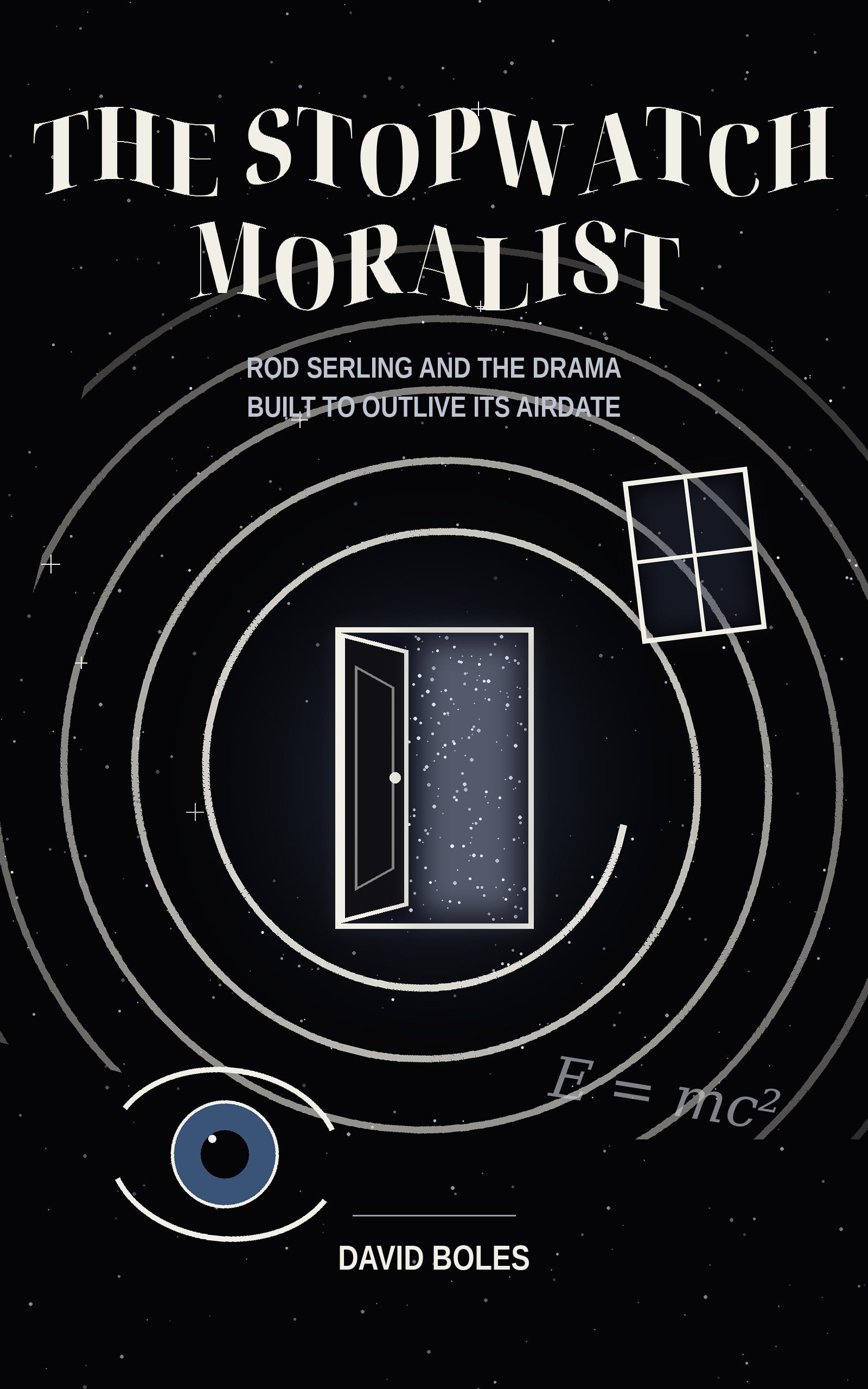
The book is called The Stopwatch Moralist: Rod Serling and the Drama Built to Outlive Its Airdate, and it is out now. It is, at bottom, an answer to Marshall, built the way he taught me to build things: on the record, with the receipts, by the rules. The record it stands on is the live-television economy of the 1950s, a theatre that burned its sets every night and called the fire the point. When Serling’s Patterns detonated in January of 1955, the only instrument the medium owned for showing a thing twice was human beings, so the network bought the play a second time and staged the identical hour live again, a month later, the only encore in the history of the form. When Serling tried to tell the Emmett Till story straight, twice, in 1956 and 1958, thirty readers with pencils sanded his plays into other states, other decades, other people, and the broadcasts evaporated on contact with the week they aired. The book handles those chapters with documentary restraint: the crime is never dramatized, the killers’ published confession is reported and its language kept out entirely, and the four dated tellings of the sanding, 1957, 1959, 2008, 2019, are left to disagree on the page, because the drift among them is evidence too.
His answer to all of it was engineering, and it is the engine of the book. The impossible premise, stipulated inside the opening minutes, in the open, signed for at the top: grant me one ghost, one gremlin, one talking doll, and everything that follows will be human. The ending computed from the characters’ own choices under that single pressure, never rescued, never lowered from a crane. And the author’s own face in the frame, reading the stipulation himself every week, until the authorship could never be stripped, cut, or reassigned. The Greeks lowered the god onto the roof in the last minute to cut the knot the plot could no longer untie. Serling ran the crane in reverse. The god arrives early, the crane goes home, and the ending is earned, and that is why the door still opens sixty-seven years later while the programs that owned the word “serious” sit in vaults you need an appointment to enter.
The book does not ask you to take that on faith, because faith is not auditable. It carries an instrument instead: the tally, the appendix that is the book’s signature, every episode of the original run written or adapted by Serling, all ninety-two of them, ruled one at a time with the airdate and one line of justification attached. Sixty-three verdicts computed from character. Twenty gimmicks. Five nullifications. Four lotteries. The cheats are named and dated, including the famous one: the most beloved episode in the run is in the cheat column, and the book loves it anyway, and it tells you why both of those things are true. A thesis that cannot survive its hardest counterexample is decoration, and this one walks through its own worst evidence carrying its own best.
It also does not flinch from the price, because the price is the proof. The man who built the one property in the medium’s history that could not stop earning sold it, cheaply, at the exact hour its earning began, because everyone at the table, the agent, the lawyer, the accountant, told him the show was dead. The widow’s preserved word for the persuasion is “x bucks,” and the sum is printed as the fog it is, because nobody in the family could later recall it. He died at fifty, in June of 1975, on the era’s newest table, and a year and a half later Roots ran across eight nights to the whole country, and the forms built for his talent pulled into the station as his train was leaving. The book prices that year and a half, and it refuses the violins, because the record, read plainly, outplays the ornament.
And here is the part that belongs to this page, to this voice, to the prairie. I met that show the way most of us out here met everything in those years: on the only signal that reached my grandfather’s corner of the state, on summer nights, on a one-channel set, the picture rolling when the wind worked the antenna. I came for monsters and I was made to sit through trials instead. The stories held still while the world around them changed, and the man at the top of each story talked to me as if the two of us had an appointment. He did. The appointment ran for decades, through the farm, through the NETV office, through the desk where the charge was delivered, through the wrong article and the long silence after it, to this week, when the answer is a book you can hold.
The celebration, since this is a celebration: the book is out as a Kindle eBook now, with a cover built from scratch in the show’s own graphic language, the floating door ajar at the center of the spiral vortex and the fifth dimension showing through the crack. The paperback follows on cream paper with a real index, page numbers computed from the typeset book itself, because an index that points nowhere is not an index. The audiobook is in production, with a narrator’s guide behind it, every name pronounced from Serling to Tagaytay Ridge. All of it exists because a boy on a farm got hooked by a form that turned out to be engineered for exactly the permanence it has enjoyed.
Marshall never read the answer. He died before the article, before the book, before the correction of either. But the coda addresses him directly, because debts to the dead are paid in the only currency the dead accept: the record kept, the count printed, the name corrected, the warrant reissued. You were half right, Marshall. The half you missed is named plainly, at the end, with love: the drama after the god arrives. The drama after the god arrives is the whole of the form, and it is playing tonight, on some screen, in some farmhouse, for some child who came for monsters.
Forty-four years is a long time to carry a charge. The answer was worth the carrying.
The Stopwatch Moralist: Rod Serling and the Drama Built to Outlive Its Airdate is available now in the Kindle store, with the paperback and audiobook editions following.