

The town I am thinking of has lost its bank, its rail spur, its second grain elevator, and most of the people under forty who were born there. None of that happened all at once, and none of it happened because of anyone who still lives there. The bank was folded into a regional holding company three states away. Its second elevator came down when grain storage consolidated into a terminal an hour off, on a rail line that no longer stops in town. The young people left for wages the place could not match. The cause of the decline is a stack of decisions made in rooms these families will never enter, by people whose names they will never learn.
That is a hard thing to live inside. A place under that kind of pressure needs a reason it can point at, a reason with a face and an address, because the true reason has neither. And this is where a book that seems to have nothing to do with the prairie turns out to describe it better than most books written about the prairie.
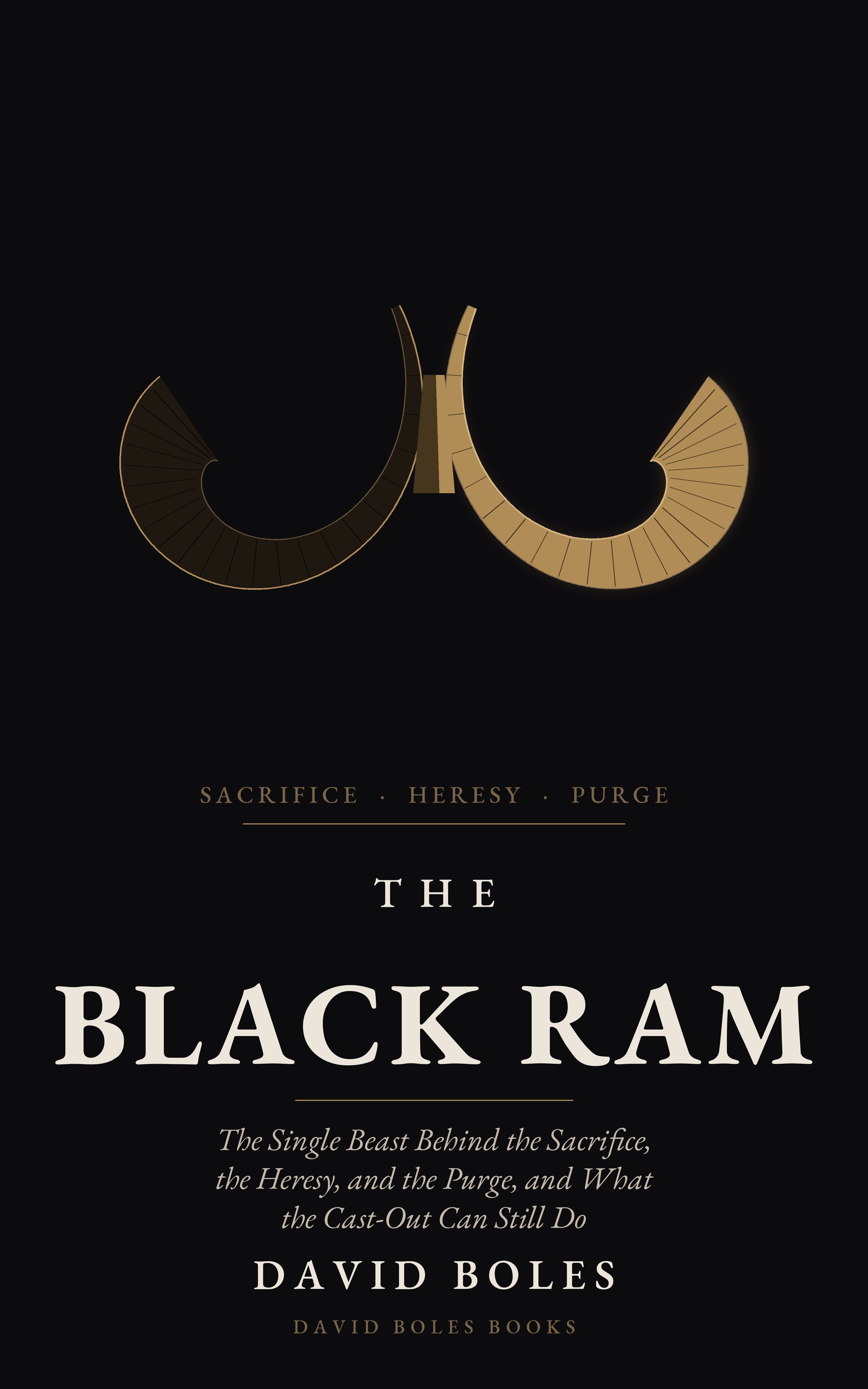
The book is The Black Ram, the new one from David Boles Books, and on its surface it is ancient and far away. It follows a single figure across five thousand years, the horned black animal that a frightened people loads with its guilt and drives out of the settlement. The book begins with the ram gods of the Egyptian Nile and the two goats of the Hebrew Day of Atonement, one killed and one sent into the wilderness with the community’s sins pressed onto its head. From there it moves through the Greek scapegoat, the medieval Devil, the burning of the Knights Templar, the witch fires of Europe, and the purges of the last century. René Girard is its spine, the French thinker who spent a life arguing that all of this is one machine, built before history and running still.
Nothing in that summary mentions a county road. But the machine the book describes has always run best in the kind of place this publication covers, and the reason should be said plainly, because it is neither flattering nor foreign.
Girard’s account is simple. A community under real strain cannot bear the truth that its trouble rises from inside itself, or from a system too large to see, or from all of its members at once. So it settles the whole weight onto one, and drives that one out, and the casting-out works. The tension breaks. The place feels clean again. Because the relief is genuine, the community learns nothing from it, and the real cause keeps grinding away, untouched and out of sight.
Set that against a hard year on the plains. The commodity price has no face. Consolidation has no face. The policy written for someone else’s benefit has no face either. But the new family two farms over has one, and so does the crew at the packing plant, and so does the person whose color or religion or plain manner marks them as not from here. When the fever needs somewhere to go, it goes toward the nearest body that can be named, and the naming feels like an answer to a question that has none.
The book’s witch chapters are rural chapters, though it never labels them that way. A neighbor hanged or burned to explain a dead child or a ruined harvest lived in a small and isolated place, where everyone knew everyone and the crop was the line between a hard winter and no winter at all. Our prairie has its own version of that story, and it sits closer to us than five hundred years. The historian James Loewen spent years documenting what he called sundown towns, communities across the Midwest and the plains that drove out their Black residents or forbade them to remain after dark, sometimes with a sign nailed up at the edge of the road. Thousands of them, by his count. The animal walked to the edge of the settlement in the oldest chapter of the book, and the family run past the town line within living memory, come out of one machine and one fear. A place decided its trouble wore a particular face, it removed the face, and the trouble stayed right where it was.
This is the story Prairie Voice exists to tell from the other direction. We give our pages to the real causes of rural decline, the distant capital and the vanishing infrastructure and the water law and the consolidation, because those causes are the ones a hurting town is least able to face and most tempted to trade for a neighbor. The scapegoat is always the wrong target, which is a mechanical fact before it is a moral complaint. The machine works by aiming a crowd at someone who did not cause the harm, for the plain reason that a person who did not cause the harm is easier to reach than a grain exchange in another time zone.
There is a further turn out here, and it is the one this publication was built to hold. We read the plains through the old-time morals of a bygone era looking for standing in a modern world, and the scapegoat is one of those old practices that never lost its footing. It fits a modern county as smoothly as it fit a bronze-age city. So does its opposite. I did not come to this book as a stranger to the ground, because I was born on the plains, and I know these towns, and I know they carry more than one inheritance at once. The same rural culture that has run people off has also, over and over, produced the one who would not run them off, the neighbor who stood in the road, the family that took the marked household in and dared the county to say a word about it.
The Black Ram ends where its whole argument has been driving. It closes with the cast-out who turned and faced the crowd, and with the ones who broke ranks to stand beside them, the judge who repented his verdict, the witness who named the accusers to their faces. The plains hold those people in their own record too, and they go uncelebrated far more often than the mobs they defied.
That is the celebration this book earns out here. It reads on the prairie as a working description of a machine still bolted into every small place under strain, and as a reminder that the machine turns on a choice, and a choice can be refused. The next time a county goes hunting for the reason its life is coming apart, and lands on a face at the edge of town, someone in that room will recognize the shape of what is happening and will have the words to name it. That person is worth more to a failing place than any sign ever posted at the county line.
The Black Ram by David Boles is available now from David Boles Books at BolesBooks.com, in paperback and for Kindle, with a free reading edition on the site.