

The product was sold in powder form. Mixed with water, it produced a thick, reddish-brown paste. It was applied by mothers with kitchen sponges to the skin of their children in the dressing rooms and hallways of the Kimball Recital Hall complex at the University of Nebraska-Lincoln, where in the mid-1970s a group of grade school kids from Brownell Elementary had been cast as the Siamese children of the royal household in a university production of Rodgers and Hammerstein’s “The King and I.” A former Nebraska football player named Chip Smith played the King. The children were all white. The children were all Midwestern. The product that turned them into something else was called Texas Mud.
In addition to having their skin darkened, the children had their eyes modified. Their mothers took black eyebrow pencils and drew lines around the outer corners of their eyes, pulling the drawn line upward and outward in the direction the adults wanted. The term used for this process, spoken without hesitation by the parents and absorbed without question by the children, was “slanty-eyed.” That was the word. The children’s hair was dyed black with semi-permanent color. The eyeliner and Texas Mud washed off after every performance. The hair color did not. The children went to school with it. They went to the grocery store with it. They went to church with hair that had been dyed to make them look like someone else’s children. The alteration of their skin was temporary. The alteration of their hair followed them home.
No one protested. No one raised a hand. It was the 1970s in Lincoln, Nebraska, and the production was associated with the university, and Rodgers and Hammerstein were the gold standard of the American musical theatre, and every adult involved believed they were doing something wonderful for the children and for the community. The music teacher at Brownell was married to a UNL School of Music professor named Roger L. Stephens, and through that connection the children were cast. The racism was structural, not intentional. The adults who penciled those eyes and sponge-bathed those children were not bigots. They were theatre people doing what theatre people had always done: using makeup to transform the actor into the character. The problem was the assumption beneath their technique, which was that a white body could be made to represent an Asian body through cosmetic manipulation, and that this manipulation was not a violation but a craft.
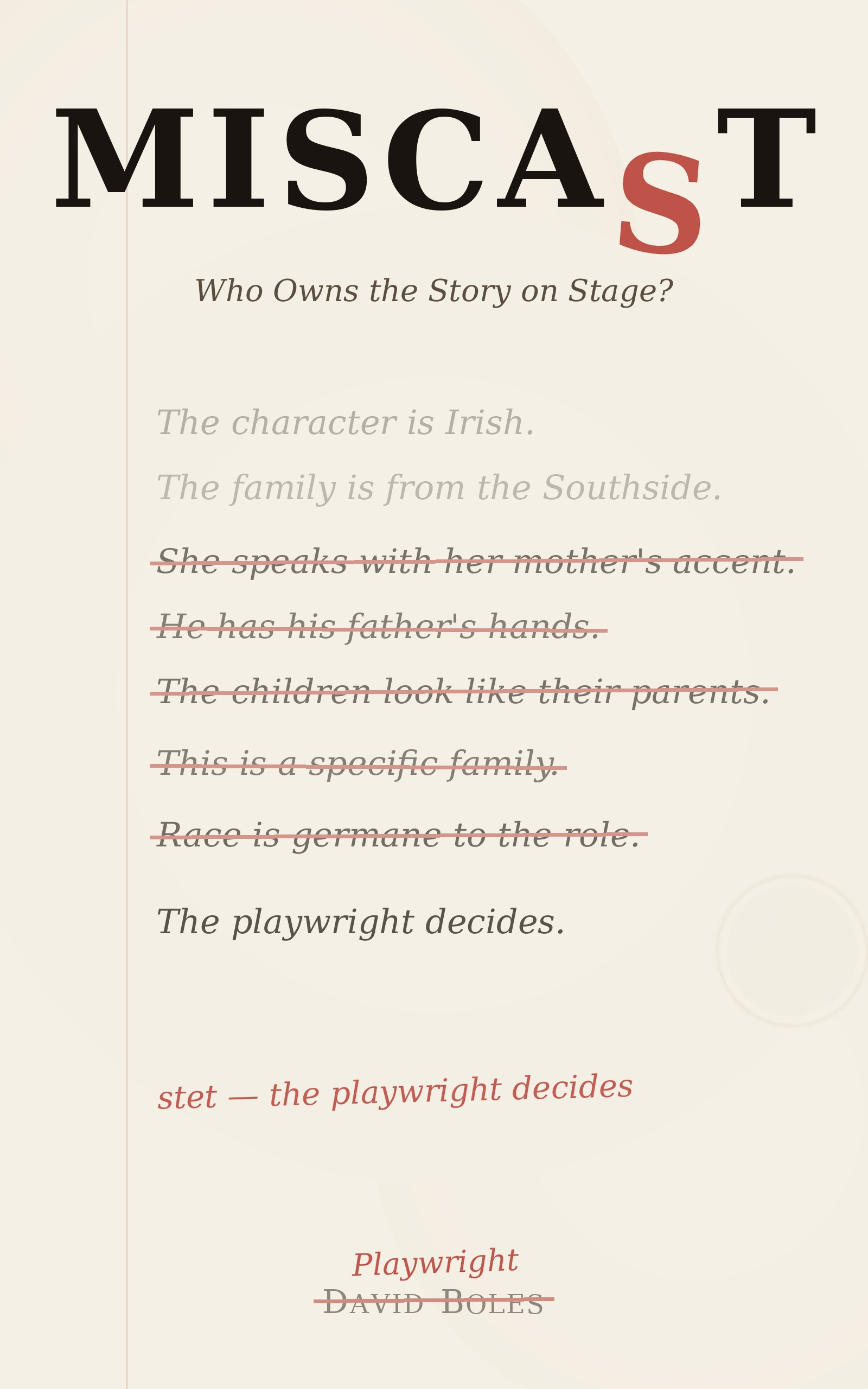
That is the first sentence of the book I have spent three decades thinking about and several months writing. It is not the first sentence of the published text, which begins with the all-male stages of fifth-century Athens, but it is the sentence that contains everything else. Every argument in Miscast: Who Owns the Story on Stage? leads back to that gymnasium, to that sponge, to that powder mixed with water in a university dressing room in Lancaster County, Nebraska. What happened in that building was the same thing that happened on the minstrel stages of the 1850s and the same thing that happens when a contemporary institution overrides a playwright’s casting specifications in the name of progress: someone with authority decided that a body could be painted to mean whatever the institution needed it to mean, and the person inside the body was not consulted.
The American theatre’s casting infrastructure was not built in New York. It was built in places like Lincoln. It was built in the high school auditoriums of the Great Plains, in the community playhouses of small cities where the entire apparatus of American dramatic performance is reproduced in miniature every autumn and every spring. In those spaces, the conventions that govern who is allowed to play whom are transmitted not through policy documents or contract riders but through the physical act of a mother drawing a line around her child’s eye with an eyebrow pencil. The conventions are learned in the body before they are articulated in language. By the time a young actor or a young playwright reaches a university program or a professional stage, the assumptions are already set. The body has already been painted. The question is whether anyone taught you to notice.
I noticed. I did not notice at the time, because I was a child, and children trust the adults who sponge-bathe them. I noticed later, at the University of Nebraska-Lincoln, where a freshman playwriting teacher named Joe Baldwin read the first one-act play I ever wrote and told me to join the Dramatists Guild. I did. That was July 2, 1984. Member number 45010. I did not understand at eighteen what that membership meant. I understand it now. It meant that someone had looked at my work and decided that the person who creates a play is the person who controls it. That principle would be tested ten years later at Columbia University, where a director proposed splitting a single character in one of my plays into bipolar twins under the banner of non-traditional casting, and where I cancelled the production rather than let someone else’s concept replace my text.
The Guild was not an abstraction in Nebraska. Joe Baldwin was a working playwright who understood that the profession had a structure, that the structure had rules, and that the rules existed to protect the writer from the institution. On the prairie, institutions are visible. The grain elevator, the courthouse, the school board, the church. You can see them from a distance because the land is flat and there is nothing between you and the thing that governs your life. In New York, the institutions that govern the theatre are less visible but no less powerful: the unions, the funding bodies, the advocacy organizations, the contract riders that now require playwrights to redirect their copyright authority toward demographic objectives determined by committees the playwright has never met.
Miscast documents that shift. It traces the line from the all-male stages of Athens through Shakespeare’s boy actors, through the blackface minstrelsy that dominated American entertainment for most of the nineteenth century, through the founding of the Non-Traditional Casting Project in 1986, through August Wilson’s 1996 declaration that Black plays require Black actors, through the casting of Hamilton and the revival of 1776, through the removal of a white ASL interpreter from The Lion King, through Ali Stroker’s wheelchair in Oklahoma!, through the cultural architecture of Eugene O’Neill’s Irish families in Long Day’s Journey Into Night and A Moon for the Misbegotten, and through the Dramatists Guild’s 2021 Inclusion Rider, the first contract addendum in theatre history that asks playwrights to cede control of casting to institutional policy.
Every one of those cases is documented. Every argument is sourced. And every one of them connects, structurally, to what happened in that Lincoln gymnasium, where a group of adults decided that white children could be made to represent Siamese children through the application of a powder called Texas Mud, and where no one in the room, not one person, asked whether the man who wrote “The King and I” had intended his characters to be performed by children whose skin had been painted to approximate a race that was not theirs.
The playwright’s answer, had anyone thought to ask, would have been obvious. Oscar Hammerstein II did not write stage directions that read “darken the children’s skin with a reddish-brown paste.” He wrote characters. He wrote a king. He wrote children. He wrote a story set in Siam. The production in Lincoln, Nebraska added the Texas Mud on its own authority, because the institution that controlled the stage believed it had the right to determine what the bodies on that stage would look like. The playwright was not consulted. The playwright is never consulted. That is the problem this book was written to name.
From Nebraska to New York, the silos are hollow until hallowed. The ones that stored grain have been emptied by consolidation. The ones that stored missiles have been decommissioned by treaty. The ones that store the assumptions about who controls the American stage have never been inspected at all, because the people who built them are still running the theatre, and the people who grew up inside them, who were sponge-bathed in Texas Mud and sent to school with dyed hair and penciled eyes, are only now old enough to say what happened and what it meant.
I am saying it now.
Miscast: Who Owns the Story on Stage? is available from David Boles Books in Kindle eBook ($9.99), paperback ($16.99), and free PDF download.