

The Iowa School for the Deaf sits in Council Bluffs, just across the Missouri River from Omaha. Founded in 1855, it is one of the oldest continuously operating schools for deaf children in America. For over a century and a half, children arrived from farms and small towns across Iowa, many boarding through the school year because their families lived too far away for daily commuting. They came knowing no sign language. They left fluent in a visual language their hearing parents could barely follow.
Janna Sweenie was born Deaf in Council Bluffs and graduated from the Iowa School for the Deaf. She would go on to teach American Sign Language at New York University for over thirty-five years, serve as Program Coordinator, and co-author textbooks that have taught thousands of hearing students their first signs. But the signing she learned in Council Bluffs was not identical to the signing taught in New York classrooms. The prairie produced its own variety, and that variety is disappearing.
Across the Great Plains, a network of residential schools for the Deaf once stretched from Texas to the Dakotas. The Kansas School for the Deaf in Olathe. The Nebraska School for the Deaf in Omaha. The South Dakota School for the Deaf in Sioux Falls. The North Dakota School for the Deaf in Devils Lake. The Colorado School for the Deaf in Colorado Springs. Each school served as a linguistic community where children who could not hear the spoken language of their families developed fluency in a visual language their families could not see.
These schools created signing space. Not metaphorically. Literally. The physical envelope in which signs are produced expanded in residential settings where signers communicated across dormitory halls, across dining rooms, across gymnasiums and playing fields. The arms extended further. The shoulders engaged more actively. The signing space grew to fill the visual field of receivers who might be standing across a room rather than seated at a desk.
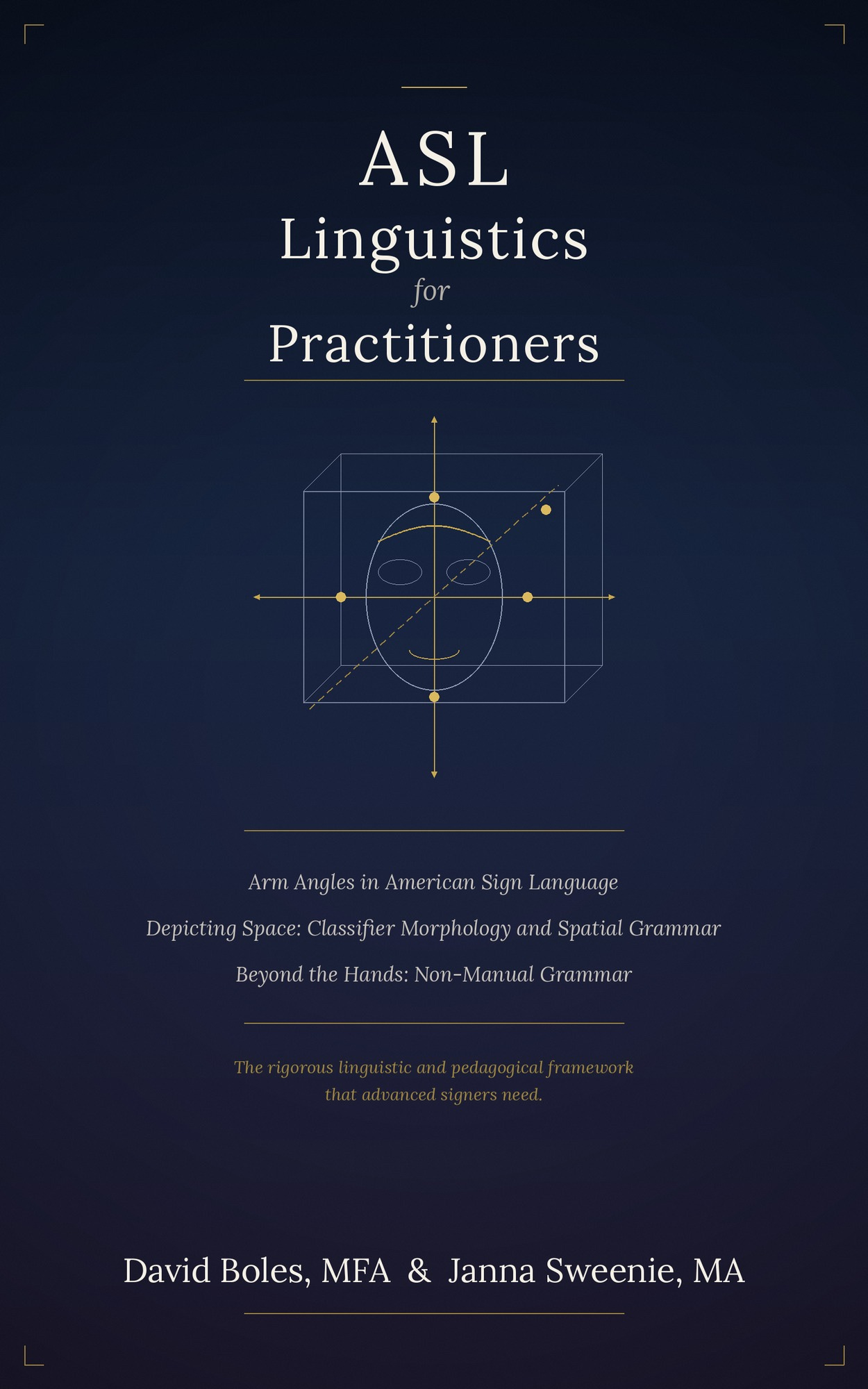
This is proximal articulation: signing that engages the shoulder and upper arm as primary articulators rather than restricting movement to the wrist and fingers. It is one of the central subjects of a new textbook called Arm Angles in American Sign Language, co-authored by Sweenie and David Boles, and it carries within it the history of how deaf children were educated across the American interior.

The textbook does not present itself as history. It presents itself as linguistics and pedagogy, twelve chapters covering anatomy, spatial dimensions, register variation, classifier predicates, and the biomechanics of sustainable signing. But embedded in its discussion of dialectal and generational variation is a record of what the prairie schools created and what mainstreaming is steadily dissolving.
The shift began in 1975 with the Education for All Handicapped Children Act, which mandated that disabled students be educated in the “least restrictive environment.” For deaf children, this increasingly meant placement in local public schools with interpreters rather than residential schools with signing peers. The policy had defensible goals: keeping children with their families, providing access to general education curriculum, ending the institutional separation that had characterized deaf education for over a century.
The linguistic consequences were not part of the calculation.
A deaf child in a residential school spent every waking hour in a signing environment. Meals, dormitories, classes, recreation, everything occurred in a community where ASL was the dominant language. A deaf child in a mainstream classroom might receive instruction through an interpreter but spend lunch, recess, and passing periods in a hearing environment where communication required lip-reading, written notes, or the goodwill of hearing peers who knew a few signs.
The signing spaces contracted accordingly. Where residential school signing needed to carry across rooms, mainstream signing occurred primarily in the narrow channel between student and interpreter. The arms pulled in. The shoulder involvement decreased. The signing became more distal, more compressed, more efficient for the intimate distances of interpreted education but less readable across the spaces where residential school signing had developed.
The textbook documents this shift without editorializing. Older signers, more likely to have attended residential schools, tend to use larger signing spaces than younger signers educated in mainstream settings. The observation is presented as dialectal variation, which it is. It is also the linguistic trace of an educational transformation that restructured how deaf children acquire language and how that language is physically produced.
Black ASL tells a parallel story. Segregated residential schools for Black deaf students, operating primarily in Southern states until court-ordered integration, developed their own variety of American Sign Language with distinctive features including larger signing spaces and more frequent use of two-handed sign variants. The signing style that emerged from institutions like the North Carolina School for the Colored Deaf and Blind in Raleigh carries the imprint of those segregated communities where Black deaf children developed language among themselves, isolated from both the hearing Black community and the white Deaf community.
These variations are not errors to be corrected. They are not departures from a standard that exists somewhere outside of community practice. They are the natural result of language developing in communities, shaped by the physical and social conditions of those communities. The prairie schools created one set of conditions. Mainstreaming creates another. The signing changes accordingly.
The Iowa School for the Deaf still operates. Enrollment has declined from peaks in the mid-twentieth century, but children still board there, still learn in a signing environment, still develop the larger signing space that residential education produces. The school sits on the western edge of Council Bluffs, a few miles from where Janna Sweenie was born, a few miles from the Missouri River that divides Iowa from Nebraska, where the Nebraska School for the Deaf in Omaha served a parallel function for children from the other side of the border.

The network is thinner now. Mainstreaming has become the dominant model. The residential schools that remain serve smaller populations, often children with additional disabilities or those whose local districts cannot provide adequate services. The linguistic communities that produced residential school signing are shrinking, and with them the variety of ASL that developed when deaf children learned language from each other across the open spaces of the prairie.
Arm Angles in American Sign Language does not mourn this change. It documents the variation, explains the mechanisms, and provides tools for learners and instructors to understand how arm positioning affects meaning across registers and contexts. The textbook is available as a Kindle edition and as a paperback version, too and as a free PDF at David Boles Books, with additional resources at HardcoreASL.com.
But the book carries within it a history that extends beyond linguistics. The residential schools of the prairie were institutions of isolation and community, places where children were separated from their families and united with others who shared their experience of the world. The signing that developed in those schools reflected the conditions of their development: large spaces, shared dormitories, generations of deaf children teaching each other the language their hearing parents did not know.
That history lives in the arms. In the shoulder engagement of older signers who learned in residential schools. In the contracted signing space of younger signers educated in mainstream classrooms. In the distinct features of Black ASL that carry the trace of segregated education. The land remembers in different ways. Sometimes it remembers in buildings and roads and property lines. Sometimes it remembers in the way bodies move through space, carrying the imprint of communities that no longer exist in the form they once took.
The sign schools of the prairie taught a language. The language carries their memory.