

In the 1920s, on a farm in Kansas, a boy dug a cellar for a purpose no county extension agent had a pamphlet for. Clyde Tombaugh’s family could not afford to send him to college, so he built his first serious telescope out of what the farm could spare: parts of a cream separator, pieces of a discarded car, the crankshaft of a 1910 Buick. He ground the mirror himself, down in the cellar he had dug because precision grinding wants still air and steady temperature, and a Kansas afternoon offers neither. Then he drew what the instrument showed him, careful pencil renderings of Mars and Jupiter, and mailed the drawings to the Lowell Observatory in Arizona, hoping a professional might tell him whether he was any good. Arizona wrote back with a job. The farm boy went west and found the ninth planet.
He is farther away now. In 2006 the New Horizons spacecraft left Earth with about an ounce of Tombaugh’s ashes fixed to the inside of its hull, and in July of 2015 that ounce crossed Pluto’s sky at roughly thirty-one thousand miles an hour while the cameras photographed the frozen heart on the surface below. The container carries an inscription, and the inscription gets the order right. It calls him “Adelle and Muron’s boy, Patricia’s husband,” then a father, a teacher, a punster, and only after all of that the man who discovered Pluto. Family first, planet last. Any reader of this publication has stood in a church basement and heard an obituary built just that way. My new book, The Two Letters, follows the messages our species writes past its own lifespan, and the sentence in it I keep returning to is about that farm boy: “The deepest burial the species has yet performed did not fail, and it is still moving.”
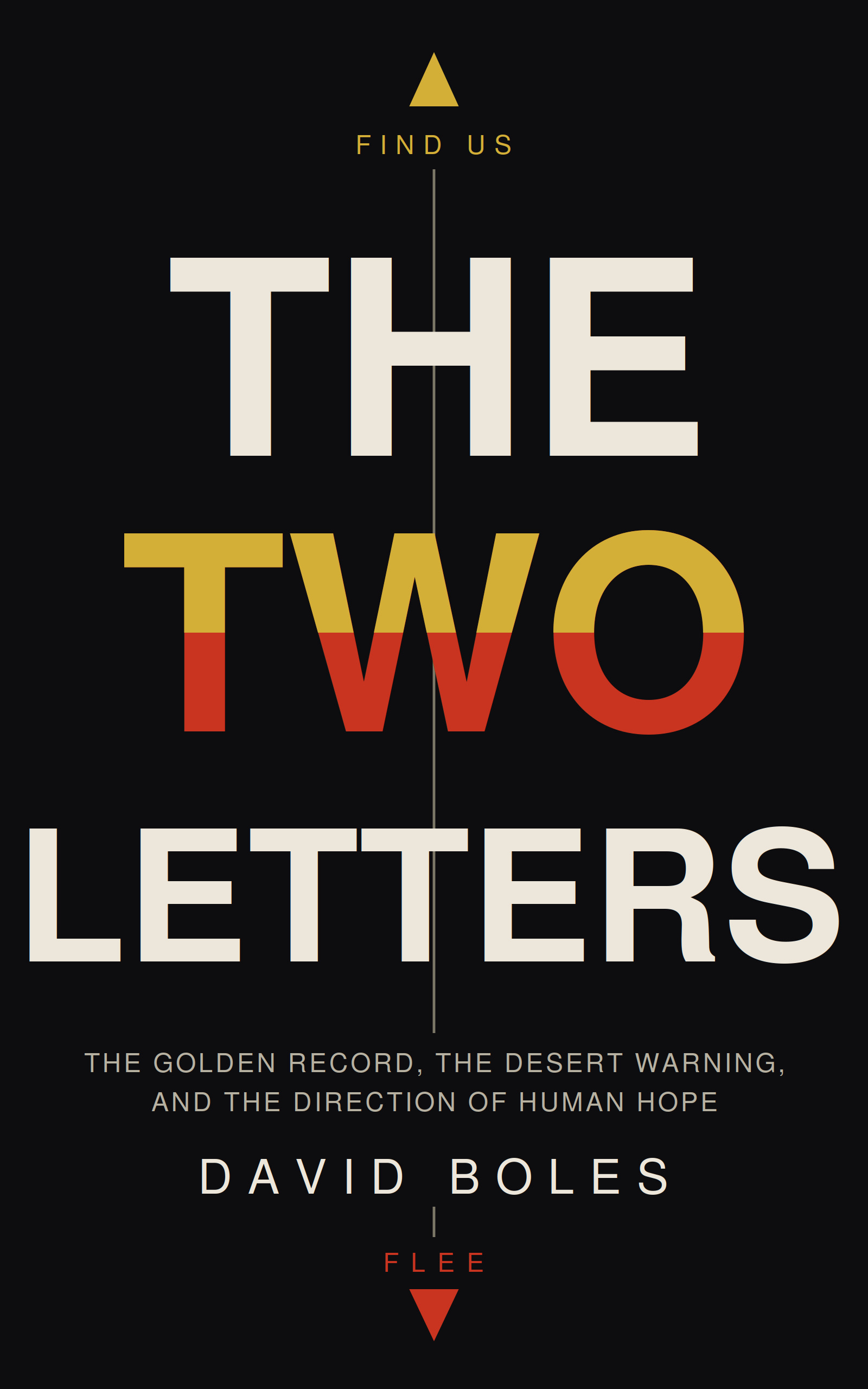
The book’s official subjects sound like coastal property. One letter is the Voyager Golden Record, ninety minutes of music and greetings launched toward strangers in 1977 with a map that shows the way back to us. The other is the warning for the tomb of our nuclear waste in the New Mexico salt, language and architecture assigned to keep people away from poisoned ground for ten thousand years. Pasadena wrote one. Federal panels wrote the other. Read from the middle of the country, though, it is a farm book, because the plains invented the genre it studies and run both letters every year without a committee. The book says so in its own grammar: “A farmer buries seed with his own hands, and then the enterprise leaves his hands and passes to the clouds.” “Prayers skip the harvest and go straight to the weather, and the weather keeps no ground floor.” Seed down. Prayer up. Everything else in the book is scale.
Then there is what happened to the ear. Delaware, Ohio, sits twenty-five miles north of Columbus, and in 1977 the land just south of town held a radio telescope called Big Ear, a flat tiltable mirror and a great curved reflector facing each other across an aluminum ground plane. On an August night that year it caught six characters of signal, seventy-two seconds long, more than thirty times the background of the sky, and a volunteer named Jerry Ehman circled the printout in red and wrote Wow! in the margin. That field is the only American ground that ever heard something so much like an answer. Nothing protected it except a lease. The golf course next door eyed the acreage for years, the lease ran out in 1997, and in 1998 the crews came. The mirror that had selected strips of sky since the Eisenhower administration was pulled down for scrap, and the ground plane across which the whispers of twenty thousand galaxies had bounced was broken up, hauled away, and regraded for fairways and homes. Readers of this publication know the shape of that story. It is the elevator demolition and the school consolidation, told at the scale of the sky, and the book gives it the funeral it never got.
Now go down instead of out. East of Carlsbad, New Mexico, an elevator drops through the layered names of a vanished sea, the Rustler beds giving way to the Salado’s halite, a ride long enough, the book says, to “reorganize a visitor’s sense of what a basement is”. At the bottom, rooms carved in salt hold the radioactive leavings of the weapons program, and the walls come up crystalline, shot through with warm bands of salmon and rose. This is the ground the ten-thousand-year warning is meant to guard, the deepest promise the government ever made to people it will never meet.
The promise cracked in 2014, and Prairie Voice readers should sit down for the reason. A single drum, number 68660, had been packed with an absorbent that a revised procedure specified as organic, and the product that met the specification came from the pet aisle: a wheat-based cat litter sold as sWheat Scoop. Wheat is fuel. Nitrate is oxidizer. Sealed together in a steel drum, in the dark, in the warm salt, they began slowly to react, and the drum breached inside the tomb built to outlast civilizations. Investigators chased the wording change through drafts and contractors and meeting notes without ever finding a person who intended it. The book’s accounting is blunt: “The money saved on warning the future had not purchased infallibility in the present. It had purchased wheat,” and the wheat entered the safety literature by name, a cautionary genus. The most ordinary crop of the American interior defeated the deepest engineering on the continent, quietly, the way water finds a seam.
The plains hold the hopeful version of the down letter too. The Svalbard Global Seed Vault keeps more than a million seed samples in Arctic permafrost against the failure of harvests, and the book names that arrangement in words any wheat family will recognize: “hope with its eyes closed, insurance interred.” The vault has already been tested. When war drove a Fertile Crescent gene bank out of its facility near Aleppo, the deposit came back up, the seed was regrown in Lebanon, and the daughters of the collection went back into the mountain for the next emergency. A grain elevator holds one town’s year. Svalbard holds the species’ menu. And near Concordia, Kansas, a developer bought a decommissioned Atlas missile silo at government auction and rebuilt it as a private ark for the wealthy, which means the prairie now stores both kinds of down letter, the one addressed to everyone and the one addressed to a client list, within a day’s drive of each other.
The book ends far overhead, with the Golden Record nearly a full light-day out and still carrying the music. I keep ending on the ground. Somewhere under Kansas grass there is a filled-in cellar a boy dug because the sky required a basement. The cream separator is gone, the Buick crankshaft is gone, the mirror he ground down there was scrap two owners ago. Its digger is past Pluto, still moving, labeled as his parents’ son before anything else. The prairie has always known how to address its mail in both directions. This book just followed the furrow past the fence line.
The Two Letters is available now as a Kindle eBook and paperback at Amazon, and as a free PDF download at BolesBooks.com. The book is published by David Boles Books Writing & Publishing.
David Boles is the author of The Two Letters and the publisher of Prairie Voice. He founded David Boles Books in Lincoln, Nebraska, in 1975, and writes from New York City about the hidden systems, extracted resources, and abandoned covenants of the American interior.
PrairieVoice.com | BolesBooks.com | (212) 982-7700